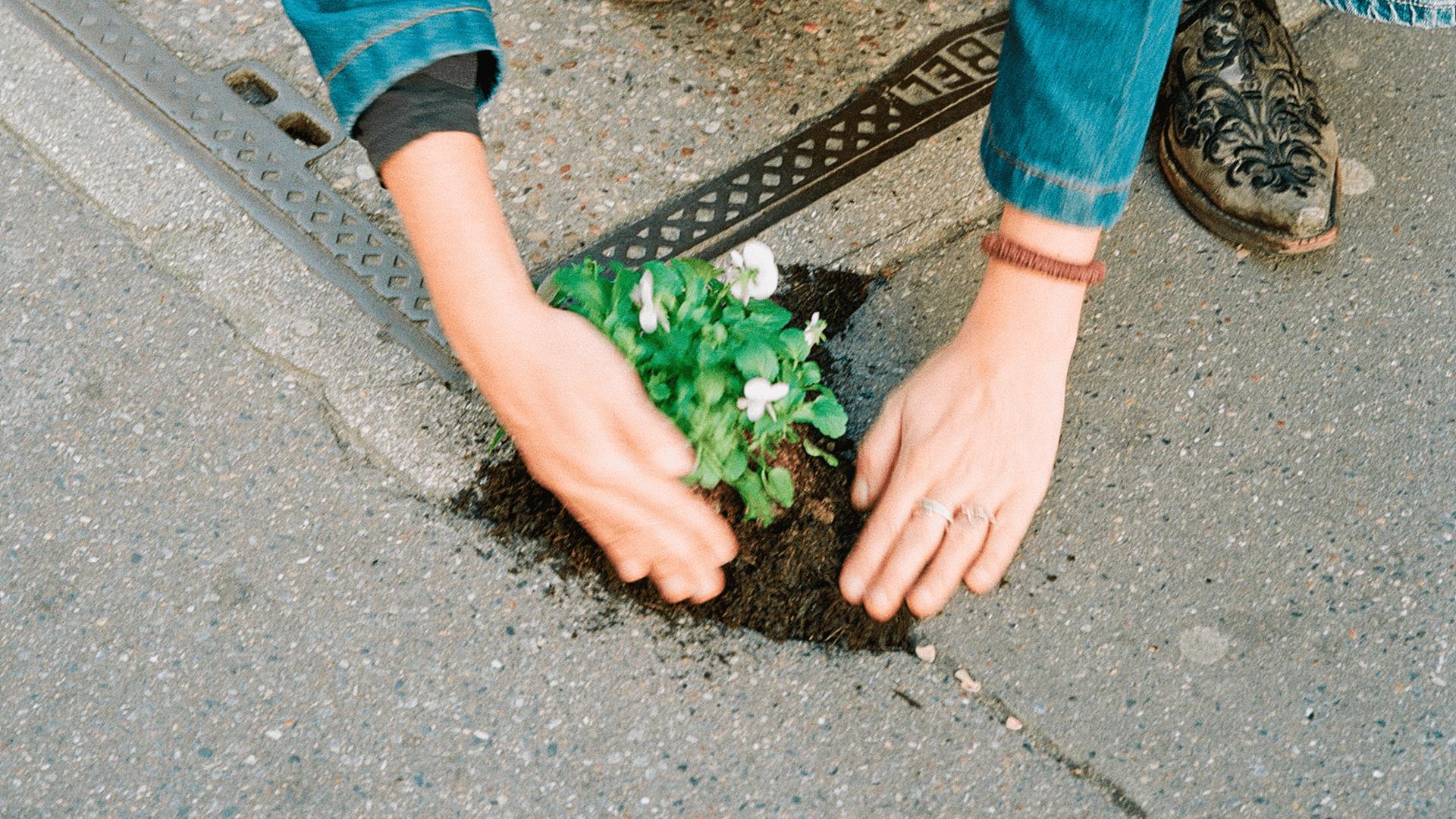
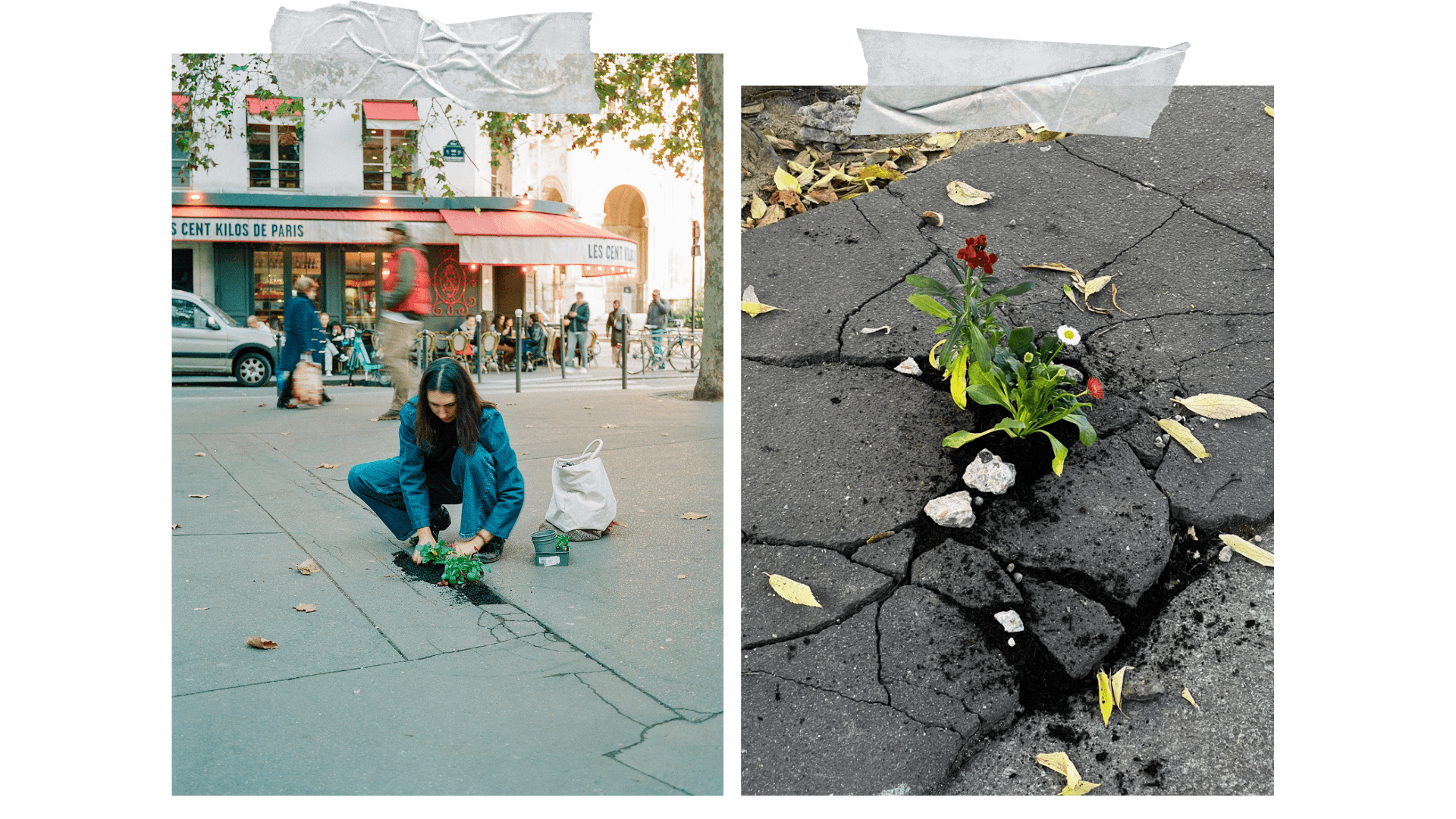
April was coming to its end in Paris when urban designer Lily Tagiuri decided to host a springtime bike ride. The plan was simple: she and a dozen others would meet in the 4th arrondissement and cycle through the city looking for empty tree beds, vacant lots and other disused land. Targets acquired, they would lob over a seed bomb or two – a compacted ball of soil and flour and pollinator seeds, rolled by hand and intended to implant into the soil to grow into a living, breathing plant.
“We biked from the oldest tree to the tallest tree, talking about the potential for green spaces to improve air quality, lower temperatures, and increase biodiversity,” says Lily. Most of the group were new to guerrilla gardening, the practice of planting in public spaces without permission. Their intention was manifold: not only to beautify empty pockets of land, but also to purify the surrounding air and ecologically diversify the area. “There was a lot of laughter and delight,” she says.
Lily started teaching people to gather and propagate wild seeds during the pandemic, when it became clear how disconnected many city dwellers had grown from the ecology of our cities. After moving to Paris from New York, she started spreading seeds as a “little act of generosity” to her new neighbourhood. She’s not the only one turning disused spaces green.
In Sofia, Bulgaria’s bustling capital, artist and nature lover Ana Avramova-Pesheva didn’t know there was a name for the way she transformed the patch of soil outside her printmaking studio. She lives in a Plattenbau neighbourhood, built during the city’s Soviet era and marked by rows of grey, pre-fab panel buildings. Her flowers brought colour to the concrete. It was only after they’d bloomed that she came across the movement of guerrilla gardeners online. “I saw people in the US turning common areas into gardens, throwing seeds and seed bombs around,” she says. “It seemed like the right kind of resistance for me.”
Last year, Ana started making and disseminating her own seed packets, each printed with her own artwork, called Growing Resistance. Her tending has encouraged life all around her. “When I started looking after my green spot, the soil was cold and hard. Now it’s filled with worms, beetles and critters,” she says. She is currently working on a common space in front of her block of flats, planting seeds sourced from seed swaps, plant exchanges and unsold remnants from the local flower shop. A community has stirred around her: elderly people from her building will pop by, offering advice, tools, another pair of hands. “I do feel that positive deeds and being a part of a community is the only way to survive through chaotic times,” she says.
Mischief – for a good cause – is also part of the draw of guerrilla gardening. Minor civic disturbance can be a way to assert individual agency in a world that feels ever more absurd, politically and ecologically. “When authorities fail us, it’s nice to feel like you’re doing something,” says author and activist Ellen Miles, who’s based in Hackney, London.
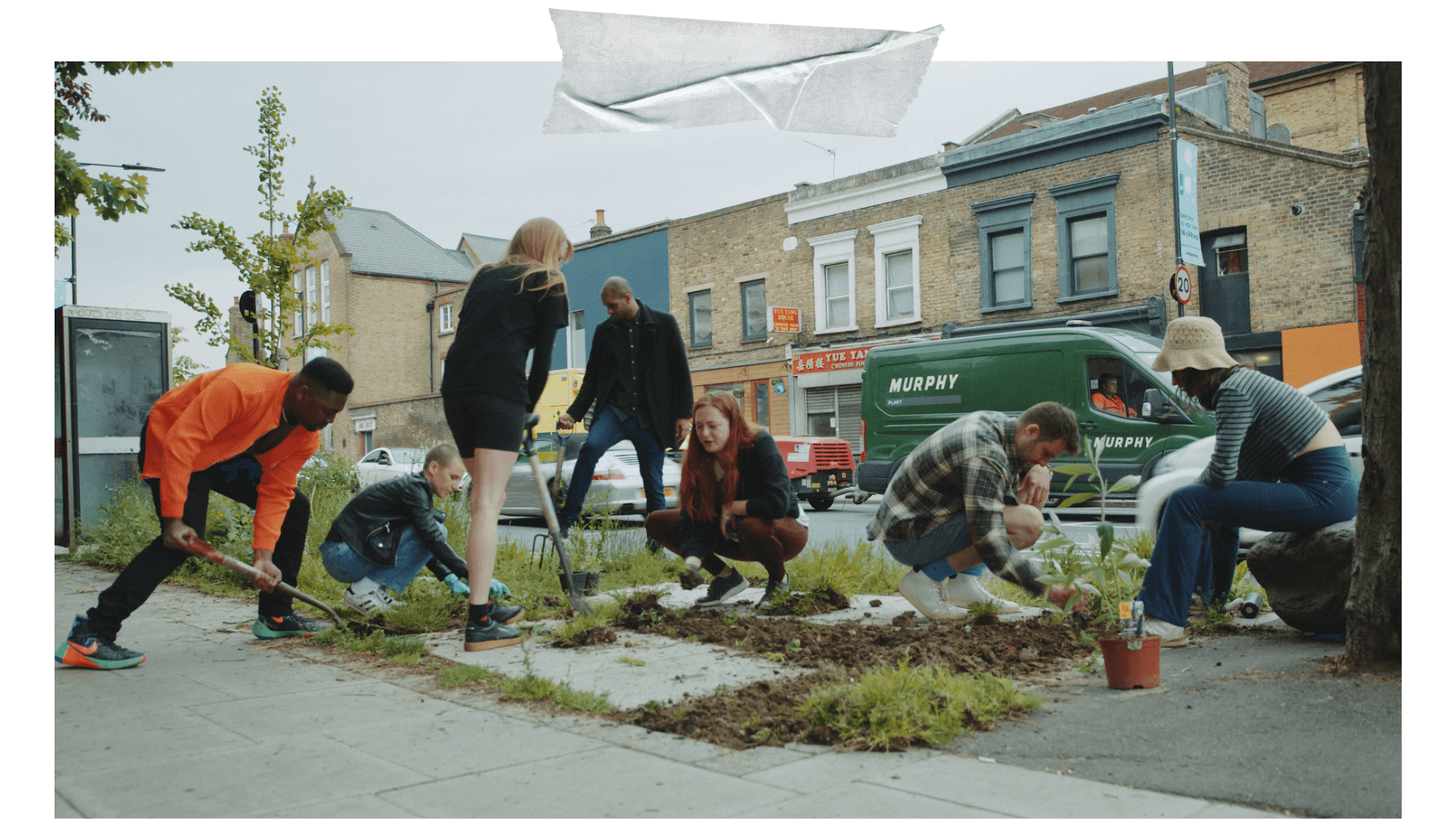
Ellen was, for a time, the darling of the guerrilla gardening movement in London. During the pandemic, she cobbled together a community of amateur gardeners via WhatsApp, Nextdoor and Facebook and set out planting in central Hackney, the neighbourhood in which she was born and raised. In 2023, she published Get Guerrilla Gardening, a handbook to encourage others to engage in the practice themselves.
“It’s funny, because it’s a kind of anarchy, guerrilla gardening,” she says. “Not in the way that people think – it’s not rowdy or destructive. But it’s about what communities need and their ability to direct that themselves.” It was out of a deference to those anarchic ideals, in part, that Ellen decided to take a step back from the public-facing part of the work. “I felt like I was representing this movement, and that didn’t feel right. It’s really at its best when it’s coming from local communities, when people in neighbourhoods are talking to each other about what they’d like to see in their own spaces.”
As a practice, guerrilla gardening is thought to have started with activist Liz Christy’s Green Guerrillas in New York in the 1970s. But, Ellen says, many of those who work in the space aren’t necessarily calling it by the name. Much like Ana when she began, or the people Ellen has encountered who plant in refugee camps, prisons, or in local plots, many don’t know the term at all. “I’ve met people who’ve come across our work and gone, ‘Oh, I’ve done that too.’”
“When the climate crisis feels beyond our control and the world feels grim, it is empowering to remember that you can always grow something”
Ellen continues to plant. In a world that feels out of control, it’s a way of finding a sense of sanity and agency through individual, tangible action: your hands in soil; the rushed bloom of cornflowers or oxeye daisies. “When you plant something, and then care for it, you feel a responsibility towards it. You respect it more. And it feeds itself” she says. “I feel like it’s a way to feel connected to a place I was always from. I felt like it was mine when I started to look after it.”
It’s a practice growing roots around the world, from London to Thessaloniki, Sydney to Toronto. The barrier to entry is low; the easy joy of giving life to neglected ground hard to resist. A year ago, at her father's funeral, Lily gave out packets of perennial wildflower seeds for those who loved him to plant in his memory. A year on, she wakes up to their pictures of wildflowers thriving all across the US – in vacant lots, on rooftops, on lawns. “In a way, everyone who took that directive to plant seeds in my father’s honour became a guerrilla gardener,” she says. “When the climate crisis feels beyond our control and the world feels grim, it is empowering to remember that you can always grow something.”
Guerrilla Gardening: Where To Start
1. Pick a site that’s “neglected and near”, says Ellen Miles. Her own spot is “two seconds down the road”. Making sure your area of need is close by will reduce the friction of carrying equipment, tools and water.
2. Embrace the flexibility. Part of the beauty of the work of guerrilla gardening is its flexibility; it can be done alone or together, opportunistically or with coordinates. It doesn’t need to be strict and scheduled: Lily Tagiuri and her Parisian community – a mish-mash of designers, scientists, educators, journalists, and chefs – often take the opportunity of a pleasant day to stroll through the city, throwing out seeds along the way.
3. Find others to motivate you. Ana Avramova-Pesheva’s work took off in earnest after she began “talking, sharing ideas and dreams” with two other Bulgarian women working in their own neighbourhoods. “That’s how Growing Resistance was really born.”
4 Global Guerrilla Gardening Communities To Get Involved With
Systems of Matter, Paris. A community celebrating the ecosystems we’re a part of, hosting workshops, field trips and events to invite us to explore the world around us in new ways.
Grow To Know, London. The devastating fire at Grenfell Tower in 2017 led to a guerilla gardening movement as locals sought relief in their surroundings. Founder Tayshan Hayden-Smith established Grow to Know as a not-for-profit in response, and the organisation continues to serve as a community-centred collective of changemakers.
Ron Finley Project, Los Angeles. In 2010, Ron Finley, aka the Gangsta Gardener, decided to plant some vegetables in some neglected dirt patches in his neighbourhood in South Central LA. The City of Los Angeles issued a legal notice for gardening without a permit. Ron fought back – and changed the law. Now, it’s legal for the public to grow gardens and food in public parkways in LA, and his organisation actively encourages people to get involved.
Cob: Building With Earth, Thessaloniki. A social cooperative with its own farm in Nessonas, focusing on natural building, sustainable agriculture, and responsible tourism, which hosts seed bombing workshops for families and young people.