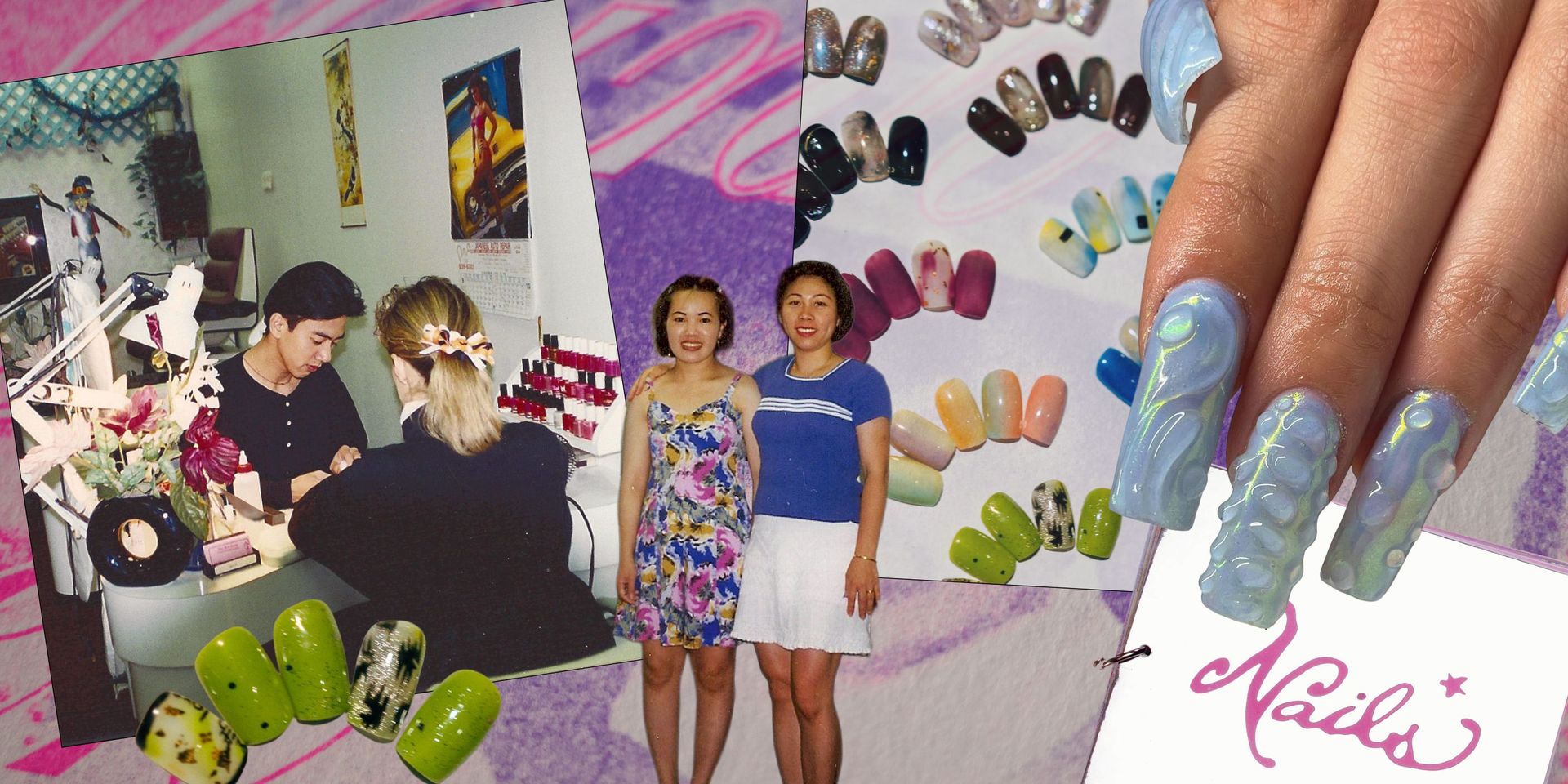
For half a century, the nail salon has been where Vietnamese Americans found work, community and a bridge between homes both old and new. Now a new generation is making that inheritance their own.
“Snakeskin nails? That came from us!” Olivett Robinson laughs in an interview with her business partner Charlie Vo. In beauty, an industry built on the ephemeral, credit rarely sticks with those who earned it. But Charlie and Olivett, founders of Mantrap in Los Angeles, are finally getting their flowers from a generation of Vietnamese American nail artists for whom the salon is a cultural inheritance.
Filmmaker Adele Free Pham understands that inheritance. She centred her 2019 documentary Nailed It – which features Charlie and Olivett – around the idea, because “nail salons are so intertwined with Vietnamese American identity”. The scale of that intertwining is hard to overstate. Today, more than half of all licensed nail technicians in the United States are Vietnamese American, and over 48% of nail salons are owned by people of Vietnamese descent. In the past 50 years, manicures and pedicures have grown into a multibillion-dollar industry, one that working-class Vietnamese women undeniably helped build.
The story usually begins in 1975, when Hollywood actor Tippi Hedren began volunteering at Hope Village refugee camp outside Sacramento, California. The women there admired her manicure, a luxury usually reserved for the wealthy. So, Tippi flew in her nail technician, Dusty Coots, to teach 20 of them the trade. This vocational training became a route to economic independence: Tippi secured them free enrollment at a beauty school, and even helped find job placements.
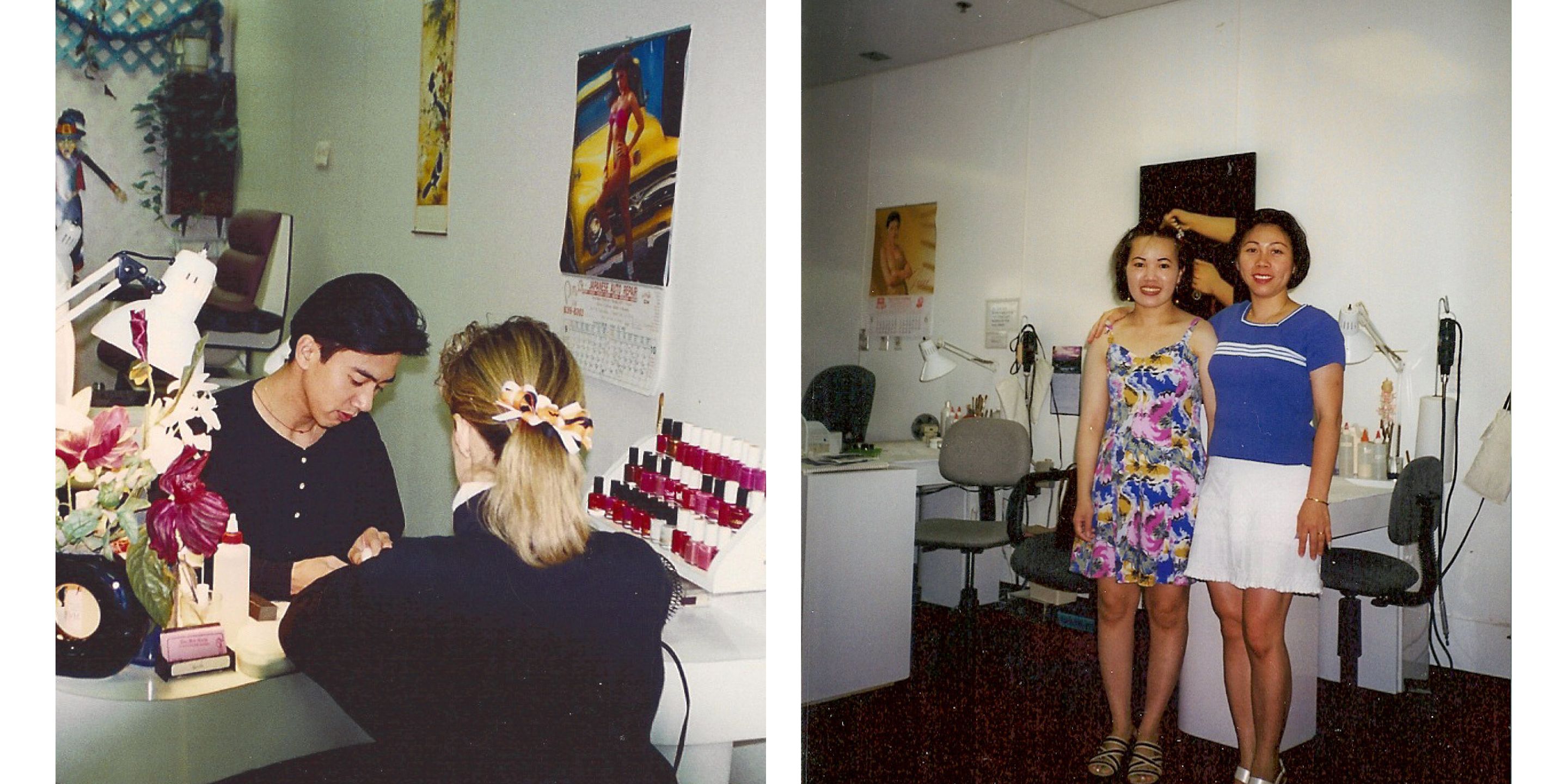
Adele, who interviewed Tippi and members of the “First 20” for her documentary, emphasised that though Tippi may have opened the door to nails, it was the Vietnamese community who seized the opportunity and kept the door open for the refugees who came after. “The Vietnamese pulled this thing out of the mud,” says Adele. “It took hundreds of thousands of refugees who needed work. It took a lot to discover an avenue for survival and business that hadn’t been tapped into before.”
That’s why it was important for Adele to spotlight Charlie and Olivett, shifting the narrative toward the broader community of women who would shape the industry. Mantrap opened in 1976 in an unassuming South Los Angeles strip mall. Charlie, who had immigrated to the US after the fall of Saigon, met Olivett as her client in a nail salon. During their sessions, Olivett taught Charlie English phrases, and the women became fast friends – eventually deciding to open a business together.
Theirs was a unique model. Co-owned by a Vietnamese woman and a Black woman, Mantrap bridged racial divides while creating a space for beauty without the luxury price tags. Olivette and Vo would go on to open nine more Mantrap salons across LA.
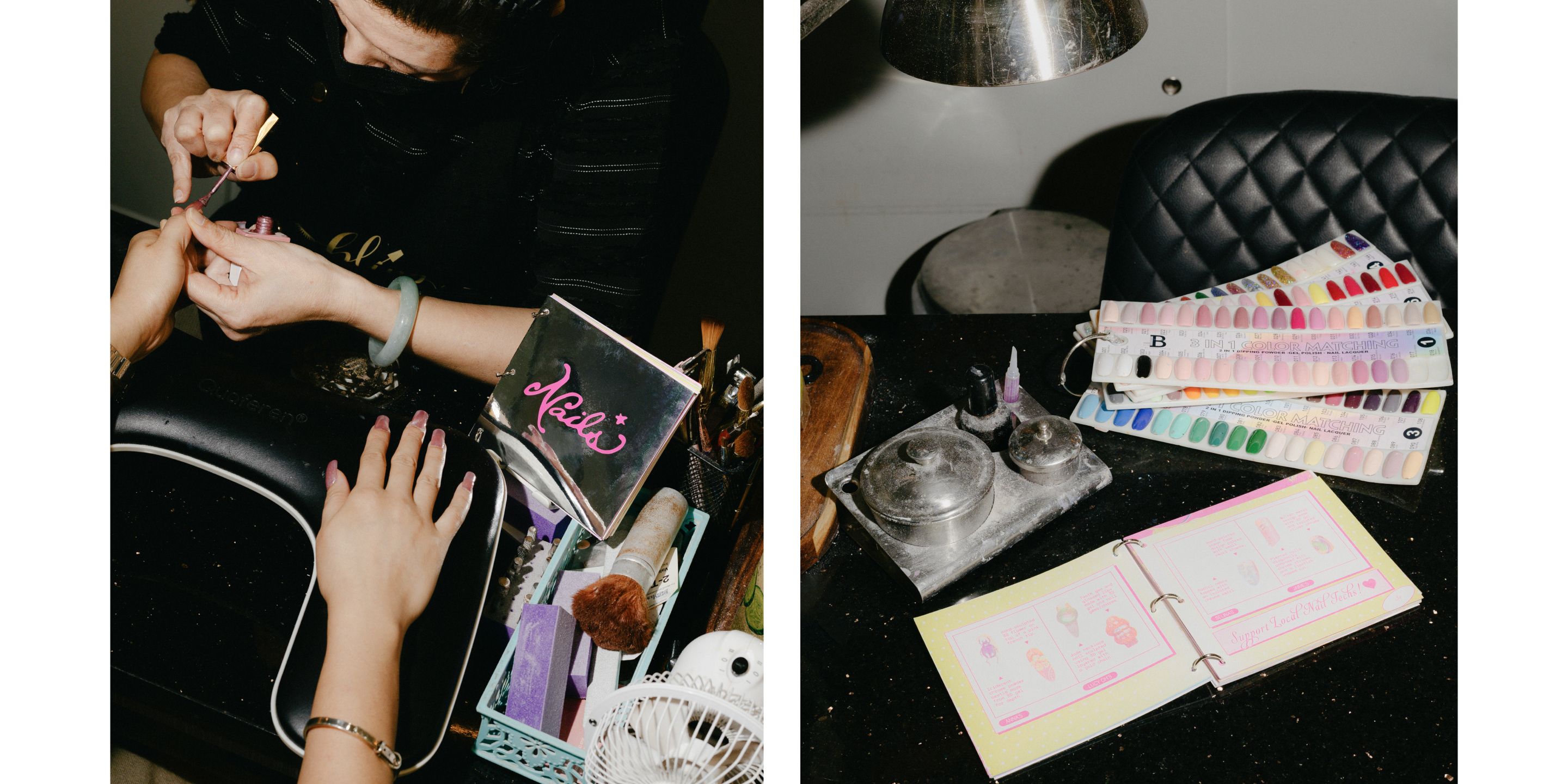
Their story remains an inspiration: alongside Adele’s film, it served as the starting point for Vietnamese publishing collective Superblooom’s latest zine: Nails! Printed with Brooklyn’s Lucky Risograph, it pairs a retelling of Mantrap’s history with stories from nail technicians today. “It was a no-brainer for us as a research topic, because all of us have different familial connections to nail salons,” says Jennifer Bui, the zine’s lead designer. “It feels like an integral part of every Vietnamese American’s identity.”
She adds: “A lot of these things that our parents maybe had to do out of survival, we now get to choose to do. I think there’s beauty in that, what we’re able to create from their legacies.”
Jaime Huynh grew up inside one of those legacies, in her parents’ New Jersey salon, with Oprah on in the background and regulars who became friends. Nails are at the heart of her family’s immigration story: her father, from North Vietnam, and her mother, from South Vietnam, met in a shared house in the US where recent immigrants could gain visa sponsorship and train as nail technicians.
Her parents hoped she would do something else. “It’s a physically demanding job. They would work 12-hour days, seven days a week with no lunch break,” she says. So, Jaime went to study photography – but found her way back to nails once she began working on editorial photoshoots, where she began building nail designs with 3D gel, a long way from the classic styles of her parents’ salon. “Doing it on my own changed the definition of being a nail technician for me. I was able to make it more art-driven,” she says.
Kiyomi Nguyen, a Washington DC based nail artist who also picked up the craft in her family’s salon, turned to nails to support her own creative path. “Nails were always a safety net I could fall back on,” she says.
Though that safety net has its frays. Salon work has long been feminised labour, with little advocacy for the people doing it. After moving to Virginia as a student, Kiyomi worked at a salon where the owner took a 60 percent cut of her earnings. It is normal to charge for space and tools, she explains, but the cut should never be more than half. The experience pushed her to open an at-home studio. “It allowed me to be more hands-on with my clientele, allowing people to feel beautiful on a budget.” It’s the same spirit Olivett and Charlie built Mantrap on. And one that continues to shape her work.
“I like to make every set very personal,” she says. “I let clients make mood boards of textures, art and designs.” The result goes beyond a classic manicure: each of Kiyomi’s sets is a miniature world of texture, charms and colour.
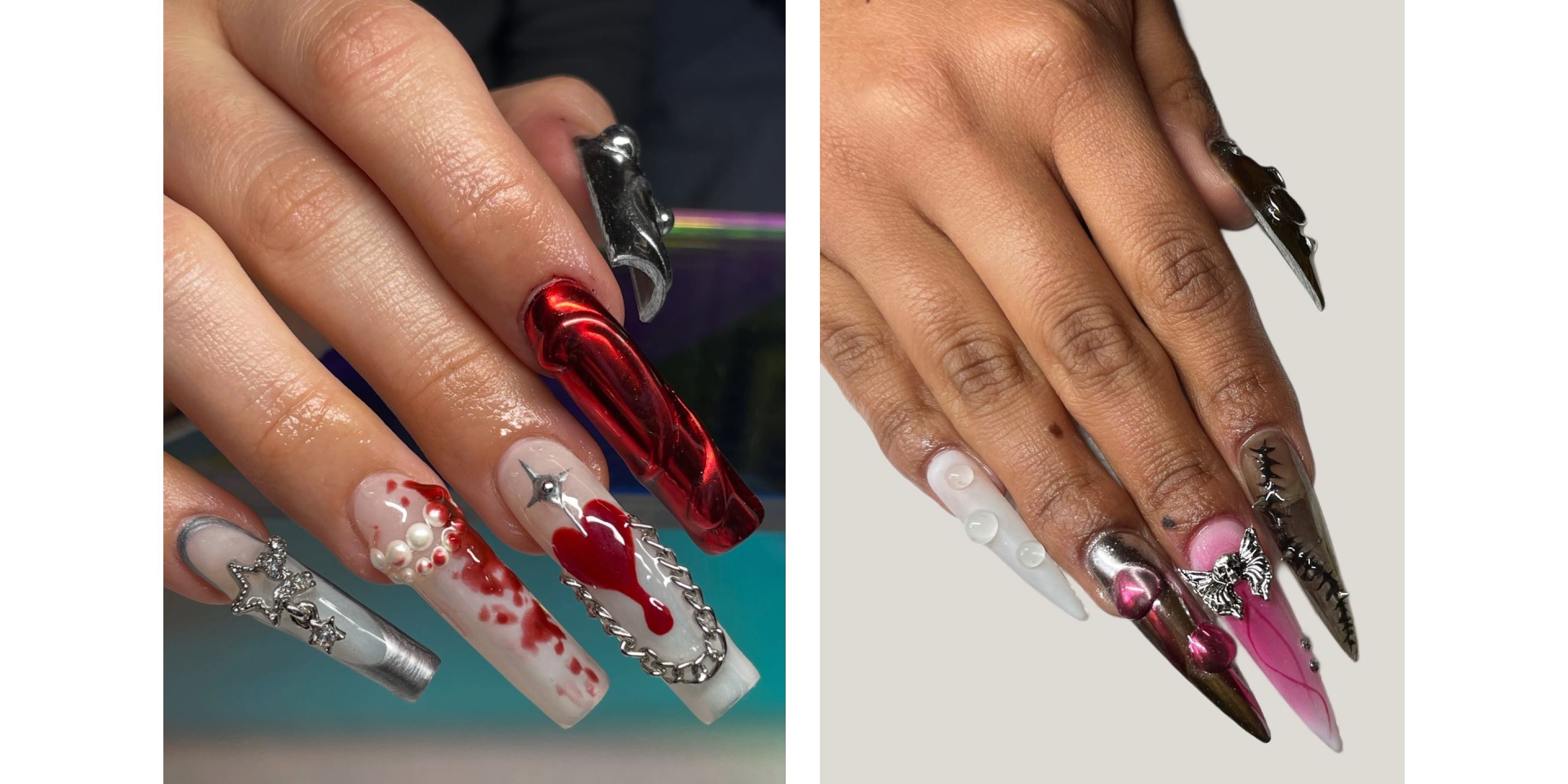
Jaime Huynh, meanwhile, has come full circle. She has stepped back from editorial work to join her family’s salon, with plans to take it over when her parents retire. For her, honouring this legacy means both holding on – and driving it forwards. “The salon has been open for as long as I’ve been alive,” she says. “I would hate to see it go. And now I have the opportunity to turn it into something fresh. My parents did it out of necessity, but now I get to make it my own.”
Nails! imagery courtesy of the Superbloom team: Jennifer Bui, Colin Viet-An Nguyen, Shawn Williams, Katlyn (Catlinh) Phi, Annie Hoang, River Huynh and Isabelle Samay.