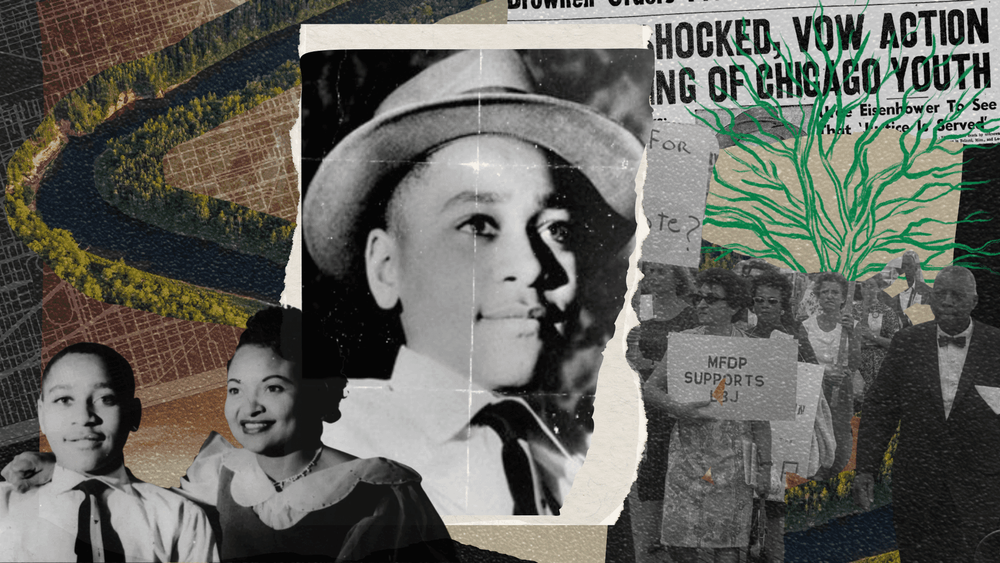
In The Trees, Dua’s Monthly Read for September, author Percival Everett uses a fictional narrative to confront the pervasive and unresolved nature of racism in the United States. One of the central characters in the book is, however, non-fictional: Emmett Till, the teenager whose brutal murder in 1955 shocked a nation and became a catalyst for the American Civil Rights Movement.
But what place does a real-life victim of lynching from 70 years ago have in a novel that is set in the present day? Everything, as Percival explains in his interview with Dua: “[Emmett] is the ghost that should haunt America.”
Here, Brendon Holder recounts Emmett Till’s story: that of a young boy whose face became an undeniable reality; whose murder sparked a movement; and whose legacy – as Percival so deftly explores in his novel – serves as both a relic of America’s dark past, and a stark reminder of how the fight for racial equality continues in the present.
The Tallahatchie River runs brown like skin, bending in the basin of a horseshoe, picking up sediments of silt and clay before draining into the Yalobusha River. The north pigtail of the Yalobusha slices across Money Road before meeting the south tail, imprisoning the southern town of Greenwood in the bird’s-eye view of its noose. There you’ll find the usual things you’d expect to find in a town: a Walgreens, a Bed, Bath & Beyond, and a church that overlooks the Tallahatchie, 13 miles from Money, Mississippi. The Yalobusha River continues on, meandering southwest and eventually bleeding into the Yazoo River, carrying more soil to muddy its complexion before eventually flowing into the Mississippi River, the second-longest river in the United States of America.

In 1955, when Emmett Till’s body – five foot four and bludgeoned beyond recognition – was dumped into the Tallahatchie, he never made it to the Mississippi. Instead, he sank, his lifeless body weighed down by a 75-pound fan looped around his throat with barbed wire, plummeting him into the river’s mahogany streams. Silently, he drifted there, camouflaged for three days while his family and the local authorities searched for him. On the third day, his body began to float to the surface, naked and mutilated, soon to be discovered by two teenage boys who had stuck their rods in the river to fish. When he was retrieved from the water, he was unrecognisable; so pummelled beyond comprehension that only his mother could identify him.
Before that, Emmett was just a 14-year-old boy from Chicago. To his family, he was “Bobo”; a lover of baseball and rock ’n’ roll, marked with a stutter from a bout of polio. He was only in Mississippi visiting family.
A Boy From Chicago
In late August of 1955, Emmett travelled from his home city to visit his great-uncle and cousins in Money, Mississippi. His initial excitement was tempered by the concern of his mother, Mamie Till-Mobley, a US Air Force clerk. Mamie hesitated to send Emmett there because of the treatment of African Americans in the Deep South, marked by its racial tension and subsequent violence. After consulting with family members, she eventually agreed to send her son to Money with a warning, urging him to behave differently in Mississippi than in Chicago, especially when interacting with the segregated white population.

A few days after Emmett arrived in Money, his cousins took him to the Bryant’s Grocery & Meat Market to purchase candy. The store was run by a white couple named Roy and Carolyn Bryant, 24 and 21 years old respectively, and serving mostly the Black sharecroppers who worked in the area.
When Emmett entered the shop, only Carolyn was working. The details of what took place in the store between Emmett and Carolyn are, to this day, uncertain. Initially, Carolyn Bryant reported that Emmett whistled at her suggestively, grabbed her wrist at the cash register, and made sexual advancements towards her, such as grabbing her hips, before leaving the store – behaviour that would have been inappropriate under any circumstances. However, the story has been contested and revised by Carolyn and others in interviews and statements since.
Regardless of the specifics, none of the reports warranted the fatal outcome that followed. But this was 1955, in America’s Deep South, and Carolyn was white and Emmett was Black. Upon learning about the encounter, Roy Bryant was enraged and went with his half-brother JW Milam to the family residence where Emmett was sleeping, and abducted the boy a few hours after midnight on 28 August. Three days later, Emmett Till’s tortured, mutilated body was found in the Tallahatchie River.
The Image That Changed America
When Emmett’s swollen body was fished out of the currents of the river, he was only identifiable by a family ring on one of his fingers. His face had been brutalised into a purple mass of burgundy craters, and the contours of his skull had become warped by blunt force trauma. His right eye was completely dislodged from the socket, and a bullet had torn through his skull, just north of his right ear. There was bruising all over his body and marks on his legs and hips. The fan that had been tied to his neck with barbed wire weighed him down in the river for a bit, but the tide always rises, and this brought the dead boy with it.
Emmett’s murder is one of many. While official records are inconsistent and vary, The Freedmen’s Bureau found that more than 2,000 Black people were killed in the South from 1865 to 1875 alone with a further 4,400 lynchings documented between 1877 to 1950. However, what made Emmett Till’s death a national outrage was his mother’s brave decision to have a multi-day open casket funeral in Chicago, forcing the world to observe what happened to her son: “Let the world see what I’ve seen,” she told the funeral director.
More than 50,000 people attended, including the press, witnessing the horrific trauma marked across Emmett’s body. Newspaper photographers captured images that ended up in the Chicago Defender, a local Black newspaper, but, more significantly, Jet magazine – a massively influential weekly Black culture magazine – published photos of Mamie next to the open casket on 15 September 1955. These photos, in modern terms, ‘went viral’, and galvanised activists to bring awareness and protest the racist horrors of the Jim Crow South.
After Emmett’s body was discovered, Roy Bryant and JW Milam, were arrested by local law enforcement. In late September, the pair was indicted by a grand jury of all-white men in Tallahatchie County for the murder and kidnapping of Emmett. In Mississippi, there were only three outcomes for the men’s murder charge: life imprisonment, the death penalty or acquittal.
The trial lasted five days, but it only took the jury 67 minutes to acquit both men, with one juror claiming that, “If we hadn’t stopped to drink pop, it wouldn’t have taken that long.” When asked in later interviews, the jurors admitted that they knew JW and Roy were guilty. However, they believed that life in prison or the death penalty was too heavy a punishment when it came to white men murdering Black children. The next year, under the protection of double jeopardy, both Roy and JW admitted to the killing and kidnapping of Emmett Till in Look magazine, for which they were paid $4,000. Carolyn Bryant later recanted her testimony. But Emmett Till is still dead. He would have been 84 today.
A Lasting Reminder
For many, Emmett Till’s murder was considered the first great media event of the Civil Rights Movement, brought to life by the images of his body. This created a ripple effect, where activists spearheaded several rallies – one of them being Martin Luther King Jr., who led a rally in Montgomery, Alabama, that Rosa Parks attended. Soon after, in protest of the segregated buses in Alabama, Parks historically refused to give up her seat and move to the back of the bus for a white patron, stating, “I thought of Emmett Till and I just couldn’t go back.” This eventually led to a political campaign that resulted in the US Supreme Court declaring that segregated buses were unconstitutional. It would be decades later, in 2022, when lynching was deemed a federal hate crime under the Emmett Till Anti lynching Act.

It is difficult to classify the historical milestones catalysed by Emmett’s death as progress. Even as I write this, I am unsure how much of the aftermath calls for celebration. In a country where Black people continue to face systemic disadvantages, the darkened tides of history cannot be course-corrected overnight or in a matter of decades. Not even a Black President could do that. Plenty of African Americans continue to be brought closer to death, simply because they are Black. Since 2000, eight suspected lynchings of Black men and teenagers have taken place in Mississippi alone. And across the United States, even though the noose may look different than it did in the Jim Crow-era South, the hands of the police, a discriminatory health care system and wage gap inequity continue to form a different kind of lynching.
The scenes of decayed outrage have become predictable, winding down on a loop whenever we’ve moved past our initial anger: the streets, once lush with protest and riot, retreat to a murmur; the newspapers, once plastered with headlines, carry on in search of a new topic. But the faces of the tragedy live on. In a way, they become immortal, frozen in time by their brutal death, their stories embalmed in the imagery that circulates about them. Usually, it only takes one image: the charcoal murals of George Floyd; the aquamarine and ash portrait of Breonna Taylor, painted by Amy Sherald. Survived by their faces, they become symbols of a great injustice, a reminder that the fight for equality is not over.
Emmett Till’s face looms over Money, Mississippi – and America – wretched with images of his brutalised corpse and canonising the 14-year-old as the face of Jim Crow-era lynching. The published photography surrounding his death marked a critical inflection point for the American Civil Rights Movement, and is one of our earliest examples of how the faces of Black death are absorbed into political tools. And yet, after years of images and faces similar to Emmett’s, racism persists. Like a river, it runs, drowning all that it comes in contact with, flooding the country with its dark tide.
Brendon Holder is a Canadian writer who lives in New York. He is the writer of LOOSEY, an arts and culture newsletter for interested people.
The Trees by Percival Everett is Dua’s Monthly Read For September – discover her full conversation with the author and more with the Service95 Book Club...
WATCH Dua’s interview with the author, Percival Everett
LISTEN to the interview on the go with the new Service95 Book Club podcast
BOOKMARK the novels and music that inspire Percival Everett
READ the story of Emmett Till and how his murder launched a movement
DISCOVER what to read next in Percival Everett’s back catalogue