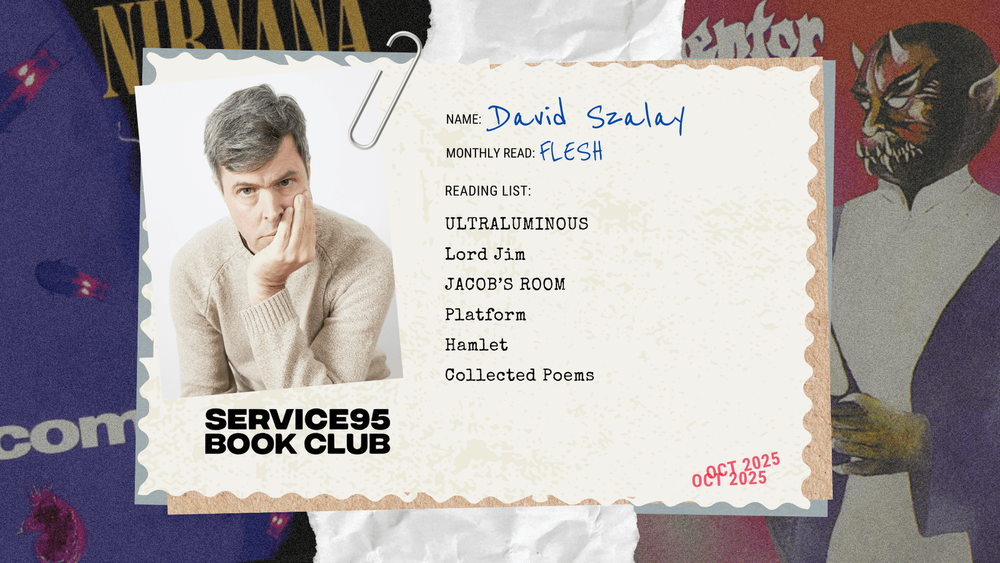
David Szalay is the acclaimed author of Flesh – Dua’s Monthly Read for October for the Service95 Book Club. This taut and quietly devastating novel follows István, an inscrutable Hungarian man, from shy and awkward adolescence into spare and melancholy middle age. Along the way, he is buffeted by political and economic forces beyond his control. Here, David shares the books that helped shape the atmosphere and structure of Flesh, alongside a handpicked playlist to accompany your reading...
The Books That Inspired Flesh
Ultraluminous by Katherine Faw
“I stumbled on this book in the very early stages of writing Flesh, just as the novel was taking shape in my mind – and Ultraluminous definitely contributed to that process of taking shape. It’s the story of an escort in contemporary New York, and is told in vivid little fragments that focus entirely on the immediate physical reality of what is taking place. Other realities – emotional, economic, social – emerge powerfully from this without ever being directly stated. It’s a fascinating experiment and an utterly absorbing read.”
Lord Jim by Joseph Conrad
“Another book that I read more or less by chance (and isn’t that ultimately always the way?) during the writing of Flesh. I had actually read it decades earlier, as a set reading at college. I still had that old copy on my shelf and I took it down one day out of a sort of curiosity. I ended up reading the whole thing. As often with Conrad, it’s a fascinatingly realistic seafaring story set at the tail end of the nineteenth century, and mostly in Southeast Asia. It’s also a meditation on the nature of moral failure, morality itself, and the possibility or otherwise of redemption in a godless universe.”
Jacob’s Room by Virginia Woolf
“Much as To the Lighthouse is one of my very favourite novels, Jacob’s Room had a particular influence on Flesh, I think, in that it’s the story of a single individual, over many years, but told in the form of what amount to little more than momentary glimpses of him, separated by long stretches of time, which somehow come together to create a character at once intimately known and stubbornly mysterious.”
Platform by Michel Houellebecq
“I’m a great fan of Houellebecq’s writing – above all, just because I enjoy it so much. It never bores me. I think one aspect of this is his commitment to presenting contemporary reality as he actually sees it, and not as he thinks it should be seen. There’s something bracingly true and unliterary about it. The corporate banality of the modern mass-tourism industry has never been so engaging.”
Hamlet by William Shakespeare
“Among other things, Hamlet is a play about masculinity – indeed about a crisis of masculinity. At the time it was written, a militarised society of semi-literate warriors was giving way to a modern world of documents and lawyers. Hamlet himself is a student at university, a wordsmith, introspective, self-analytical. But his father was a famous soldier and his ghost appears to him fully armed and battle-ready to tell him that he needs to kill Claudius to avenge Hamlet senior’s murder. In other words, physical violence is what’s required, not cogitation. Hamlet is filled with disgust and self-loathing by his own inability to act on this, and by the suspicion that a real man wouldn’t have needed to be told what to do, and wouldn’t hesitate to do it.”
Collected Poems by William Carlos Williams
“To be honest, not all or even most of the poems in this book are entirely to my taste. The ones that I do like, however, I like so much that they’re enough. “No ideas but in things,” Williams writes in one of them. And the total absence of ideas in poems like Young Sycamore, The Red Wheelbarrow or This Is Just to Say is what, for me, makes them so great, so beautiful, so infinitely interesting. Things just are, they say. They mean by being. It’s as simple, and as complex, as that.”
Recorded at the McNally Jackson bookstore in Seaport, NYC, click here to watch David talk through these books that helped shape Flesh.
The Playlist To Soundtrack Your Reading Of Flesh
“This playlist has several overlapping themes. On one level, it’s just a chronology – the music, for the most part, spans the years covered by the book, taking us from the late eighties to something like the present,” says David. “It often picks up on specific mentions in the novel – from the second-hand Nirvana T-shirt the 19-year-old István wears to the ambient hip-hop of his 40th birthday party. Beyond that, though, I think that all of these tracks have something about them that captures the spirit of the novel, and of the somewhat mysterious, somehow melancholy character at its heart.”
There’s More – Delve Deeper Into Flesh With The Service95 Book Club...
WATCH Dua’s interview with David about the novel