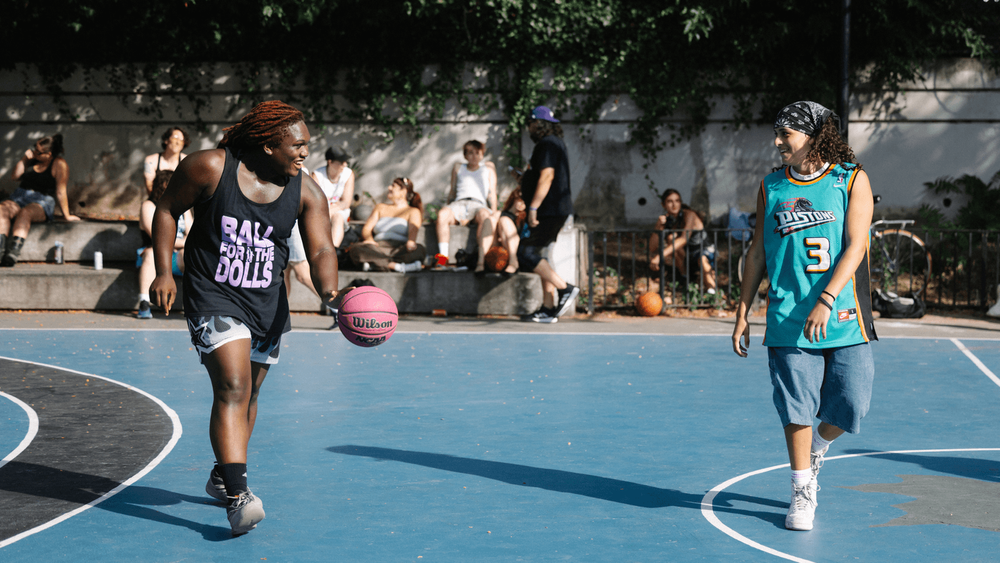
At Thomas Boyland Park in Brooklyn, NY – affectionately dubbed T-Boy Park by its devotees – a lively crowd has gathered along the sidelines for the final game of the Doll-4-All Tournament, organised by the streetball league Basketdolls. Body Tea, the team proudly repping Ridgewood, moves like one body with many hearts – fluid, fearless and locked in sync. Their chemistry is undeniable, forged through a season of sweat and shared rhythm. When the final shot drops and the game is theirs, the dolls erupt. For everyone watching, it feels like a spiritual experience. Sure, they got the win – but what lingers is bigger than that: the energy, the joy, the way they lift each other up.
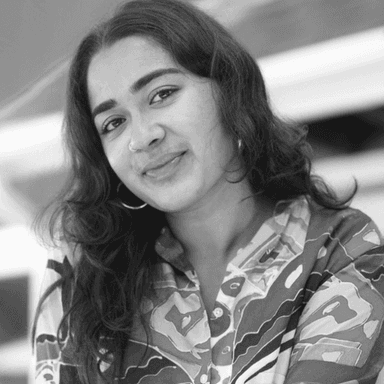
Founded in 2024 by Devin Myers, Basketdolls strives to offer “respect, resource, and reparations” for Trans athletes on and off the court. “I moved here [in 2023] and within a week, I was already on the basketball court,” says the 24-year-old. “I looked around and thought, I really want to build a church here.”

We’ve met at St. Andrews Playground in Brooklyn, two weeks after the tournament. Though summer is winding down, the court is alive: kids horse around, dunking and laughing; a stray ball bounces our way. Devin catches it, spins it once, and good-naturedly slings it back. This is the same court where legendary Brownsville rapper Ka, who passed away in 2024, once played as a child – verses Devin holds close to her heart, like gospel.
To Devin, church is a spiritual state – not organised religion or physical place, but a coming-together of people; a swell of emotion and love. “To be together with everybody – 20, 30 of your friends, playing basketball, hanging out, sitting down, smoking a joint, being in community with each other – it is really the place where we gather, because we as Trans people traditionally don’t really have a church,” she says. “We jokingly say that ‘Ball is Life’. It’s not a religion but maybe, in a sense, it is. We pray to the basketball gods when we make a long free throw. We get down on our knees and celebrate.”
Church, with its collective energy, threads through Devin’s life – from Black churches in St. Petersburg, Florida, to the state’s A&M University (FAMU), one of the nation’s most storied historically Black colleges, and later to New York’s Black Trans Liberation Kitchen at Judson Memorial Church. Inspired by such spaces, she explains that communities like these are vital: “Getting the girls fed, creating a church healing space where ballroom can coexist with spiritual elements.” Rather than being a building, for Devin, church is a living sanctuary of care, joy, and survival.
“To be together with everybody – 20, 30 of your friends, playing basketball, hanging out, being in community with each other – it is really the place where we gather, because we as Trans people traditionally don’t really have a church”
That longing for sanctuary followed her to Brooklyn. When she first arrived, Devin felt “desperate” for stability and belonging. As political repression intensified against Trans people in Florida, she’d had to flee the state, leaving her Sports Journalism degree behind – but she carried valuable lessons with her. “I really wanted to bring that community feeling I sought at my HBCU [Historically Black College and University] to Brooklyn,” she says. For her, the borough – a mecca of Trans and Black culture – has always felt like home. “I live in Ocean Hill-Brownsville. This part of Brooklyn is almost spiritual, and I think a lot of that comes from hip hop.” In hindsight, hip hop and basketball – another point of symbiosis for Devin – feel almost divinely ordained.
That said, basketball wasn’t the most obvious sport for her to play. A dessert chef by profession, Devin had long felt alienated from organised sports. Like many Trans women, she endured the masculine pressures of athletics as a teenager, growing up playing baseball. Her first real connection to basketball came later, via a cheap ticket to a WNBA game bought from a stranger on the social app Lex – a classic queer New York origin story. Soon after, she tried a meet-up with the lesbian basketball league Froot Hoops, only to find she was the only Trans girl there. “I was kind of fighting these feelings of, Do they want me here? Should I be here? Like, I had never played basketball before, but what if I’m too good, too dominant – the same kind of feeling I felt as a kid,” she reflects. “It was nothing [Froot Hoops] put on me, it was just in my head. But I thought, I want this for us. And it was during that tournament that I came up with the name: Basketdolls.”
While dreaming up what the collective could be, Devin made pilgrimages to iconic spots of streetball, from The Cage at West 4th Street, to Inwood’s Dyckman Park, to Rucker Park in Harlem, where she remembers watching a game the same day her mother was diagnosed with cancer. “She called me, and I cried about it, then I went to watch that game,” she says. “I wanted to invoke the feeling that I had [at that moment], where no matter what’s happening around you, you’re just happy out there playing, or in the crowd watching a competitive game of basketball.”

The magic of Basketdolls is right there in its name: bridging basketball and dolls (the term coined by Black, Latina and non-white Trans women in 1980s Ballroom culture to affectionately refer to Trans women or Transfeminine people). “We’ve been denied these spaces for decades,” she says, adding how it can be a vulnerable thing for Trans girls to ball out in public. Some are self-conscious about their bodies or recovering from surgeries; others, especially femme queens, hesitate to risk a chipped nail on the court. “I’m asking a lot of these girls, especially the ones who, like me, had sports trauma growing up and were made fun of,” she admits. “Maybe their dad forced it onto them or they weren’t masc enough or whatever, [but] now they’re out here walking the balls.”
That’s why Devin is determined to make every game as affirming and accessible as possible. Leaning on no algorithm, she collects meticulous data about players’ locations, skill levels, schedules and vibes – like a team matchmaker. It’s a labour of love aimed at building friendship groups that will last beyond the court. And the team pride is unmistakable: Body Tea standing for Ridgewood, Metropolitan Trans Authority holding court for Manhattan, and Team Werk bringing the energy from Crown Heights and Flatbush.
This past summer marked Devin’s second time running the tournament. At the first event in 2023, she expected maybe four people – instead, 40 showed up. People ate fruit on the sidelines; it was a chill vibe, she says. But once the game was afoot, the competition heated up. Devin thrives on that kind of court energy, building lore and fandom around her players. and still talks about legendary moments like her friend AJ’s buzzer-beater shot: “It was beyond half court. Everyone went crazy for it. I lost my goddamn mind on that shot. Earlier this year, I read The City Game by Pete Axthelm, about the oral history of streetball and how legends would electrify people. I look at that and I’m like, that’s AJ to me. That’s Maya. I love that we’re creating something that is almost mythical. We can contribute to the history of streetball in a real way.”

Moments like these underscore that Devin isn’t just running a tournament – she’s building history in real time, sparking a homegrown wave of Trans basketball leagues. Her frequent collaborator is local Trans basketball legend Eshé Hughes, who first crossed paths with Devin at a Trans basketball tournament he hosted in May 2024. A few months later, Devin went back to Eshé with a different idea: a league specifically for Trans men. “Devin was like, there’s a name in my mind, Trand1. And I said, ‘That name is insane’,” says Eshé. While both leagues are co-ed and boundaries are fluid, Devin and Eshe agreed that the boys deserved their own space. “We threw some ideas around and then I was like, ‘Cool, I’m ready to take this on as my project,’” says Eshé – and the Trand1 streetball league was born.
“I feel a sense of fatherhood when it comes to the Trans basketball scene in New York – I was here since Jump Street!” Eshe jokes before adding, “Reclaiming sports in the Trans community is a revolutionary thing. What we’re doing here is world-making.” It’s true: this past summer also saw the arrival of Truth Basketball – a free recreational programme for queer and Trans youth, while AJ, of buzzer-beater fame, has also founded a Basketdolls league in Detroit, where she now lives.
“While Trans people should have access to mainstream athletic contexts, we’re always going to create our own forums and modes for gathering outside of institutional permission”
“I’m building an empire!” says Devin. Her role models include the legendary Black Trans elder Ceyenne Doroshow, founder of GLITS (a grassroots organisation dedicated to supporting the LGBTQIA+ community on a global scale), and Qween Jean, founder of the Black Trans Liberation, which provides housing and food to Trans women. Meeting the material needs of Trans folk is central to Devin’s ethos – not just generosity, but a form of reparations. Devin herself moved to New York City thanks to $5,000 raised via GoFundMe, and so her dream is to redistribute that tenfold.
Last winter, Basketdolls organised a holiday drive to get basketball shoes for its players, after Devin noticed many slipping and sliding in non-athletic footwear. The latest Doll-4-All tournament doubled as a fundraiser for her friend Oceane, whois recovering from gender-affirming surgery, with sliding-scale meals from HAGS, the iconic queer fine-dining restaurant in the East Village, and a book table from the Trans-led Nonbinarian Bookstore in Brooklyn, featuring Benedict Nguyen’s satirical Trans sports novel Hot Girls With Balls.
Benedict says she lives for the drama and majesty of Trans sports. “While Trans people should have access to mainstream athletic contexts, we’re always going to create our own forums and modes for gathering outside of institutional permission,” she says. “Sports help people express such a wide range of our humanity, from the disappointment of small fumbles and bigger failures to the spectacular gratification of a well-executed play.”

Indeed, Basketdolls operates amid – and despite – an era of targeted political attacks against Trans athletes. But even with the political backlash, Devin is hopeful: “I have faith in the future of Trans sports. When WNBA opens its doors for us, we need resources to answer that call.” She dreams of pipelines of talent and a permanent athletic mecca built for, by and with her community in Brownsville near Broadway Junction, where many Trans residents live. She imagines a space that uplifts and protects, citing a lyric from the rapper Ka: “Watch me blueprint rec centers/I’m trying to inspire.”
“I feel like his spiritual seed,” she says. “I’ve been trying to start Soccerdolls and Tennisdolls. I want Trans people to go outside. I want Trans people to be well and be active because so many of us are just confined to being creatures of the night. It’s not going to happen overnight, but we’re setting a precedent that I’m really proud of.”