As world leaders begin discussions in Brazil for COP30, the air feels thick with contradiction. Three decades after the first Earth Summit promised salvation, the rainforest that once symbolised hope is being razed to make way for the conference meant to save it. Nearly 100,000 trees cut down, an eight-mile scar carved into the Amazon so motorcades can glide toward air-conditioned halls. Inside, 40,000 delegates will speak of “commitments” and “pathways” while, outside, the planet wheezes.
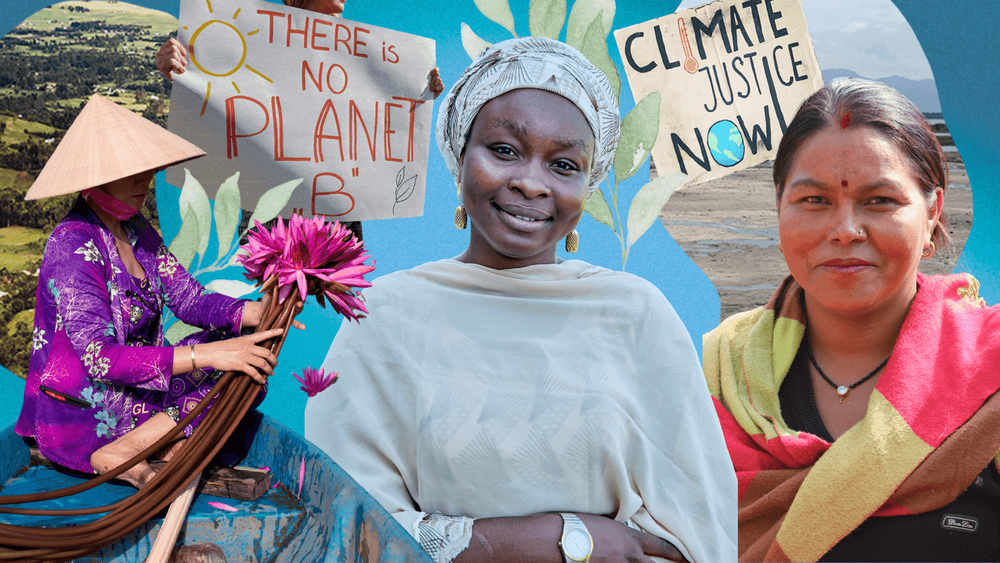
But far from the spectacle, another kind of climate leadership is already under way – quieter, rooted in the soil, and led mostly by women. From the flooded deltas of Bangladesh and Vietnam to the cracked earth of Brazil’s northeast and the rising waters of Senegal’s coast, women are not waiting for policy to catch up. These women, across eight countries, are building barriers against floods, planting mangroves, harvesting rainwater, reviving lost crops and fighting for land that can still sustain life.
Their stories, told here through a photo series from ActionAid, show what adaptation looks like in practice. As UN Women calls for a bold, well-funded Gender Action Plan at COP – one that finally puts women at the centre of climate policy – these portraits serve as a reminder of what that could look like. The crisis may not be of their making, but the solutions they are shaping are among the most powerful on earth: practical, local and led by those with the most to lose. In their hands lies not only adaptation, but hope itself...
Krishni Tharu: Rajapur, Nepal

On the golden banks of Nepal’s Kauriala River, Krishni lives on land that disappears each monsoon. Years ago, she and her neighbours worked as bonded labourers, tied to wealthy landowners and paid only in food or harvest scraps. When the system ended in 2000, they were freed – but resettled here, on flood-prone ground that becomes unliveable when the river rises. “The government gave us land without knowing its geography,” she says. Now she’s taking back control. As a women’s leader, Krishni trains families to prepare for floods and campaigns for women’s equal rights to own land. Freedom means work: petitions, maps, sandbags. But the goal is simple: no one should have to run from floodwaters again.
Aisha Abdullahi Izge: Borno, Nigeria

When devastating floods hit Borno State, Aisha doesn’t panic, she co-ordinates. “My friends were trapped at home; people were sitting on their roofs trying to find a way out”, she says. Working with the army, the Red Cross and her youth network, she helped organise rescue efforts, using army trucks to evacuate families to safer ground. Through her organisation, the Hallmark Leadership Initiative, she set up temporary safe spaces for women and girls and distributed dignity kits and soap to hundreds of affected households. “Young people are energetic and ready to help,” she says. “We just need to be engaged.”
Sharmila Priyar: Jajarkot, Nepal

In November 2023, the quake tore houses like paper sachets along Jajarkot’s hills. The counting of dead was brief, the world’s attention briefer. Sharmila lost her home and injured her arm – but not her resolve. She says: “Most of the men in the village are abroad. Now, we women are left and only we know the suffering that has happened to us after this earthquake.” Rather than wait for help, Sharmila and other women began planning a women-led safe centre – a place to heal, share experiences and learn how to rebuild stronger homes. She says: “We are rebuilding our lives, and our confidence, together.”
Chan Kimcheng: Koh Kong, Cambodia

In Trapaeng Pris, a fishing village on Cambodia’s southwest coast, Chan watches the last pond shimmer under the heat. Once there were nearly 50, providing fresh water and fish for the community. The rest, she explains, were filled in and sold to private developers. Chan leads patrols to prevent illegal logging, fishing and fires, while her committee maps land boundaries and pushes for a legal land certificate to secure ownership. “We must protect this place, not just for our generation but for all future generations,” she says. “Women are the ones earning money, caring for children, fetching water, bathing their children, and cooking. It is all women’s responsibility, yet we suffer most when water runs out.”
Kleidianny Ferreira Sousa: Maranhão, Brazil

In Brazil’s northeast, the babassu palm tree is life itself and Kleidianny is fighting to keep it standing. As the leader of a women’s coconut-breakers association, she trains others to use every part of the palm sustainably: the shell for charcoal, the kernel for oil, the stalks for fences. Her group campaigns for enforcement of the Free Babassu law, which allows women to harvest coconuts even on private land and they’ve begun replanting the trees lost to fire and logging. She says: “The palm tree is like a mother. If we care for her, she will keep feeding us all.”
Le Thi Mong Thu and Nguyen Thi Huong: Mekong Delta, Vietnam

In Kinh Lon village, on Vietnam’s southern coast, the rice fields taste of salt. The sea has crept inland, killing crops and turning the earth brittle. When the water came for their farms, Thu and her friend Huong refused to give up. “Our families had to sell two cows last year to make up for the loss from our rice crops,” she says. They now wade to the ponds twice a week, hauling 20-30 kilos of waterlilies to market at about $0.17 a kilo. These waterlilies help to not only filter water but bring a modest income. They’ve also joined the village women’s group to learn new ways to cope, such as rainwater harvesting and growing crops that can tolerate brine.
Awa Sarr: Saloum Delta, Senegal

On the island of Djirnda, rising seas are steadily reshaping the land. Homes are disappearing, crops are failing – but Awa and the women she leads are reclaiming their future through beekeeping and mangrove restoration. Together, they’ve built small barriers of earth to slow the floods and planted mangroves to hold the coast in place. Their beekeeping project gives women a new income and protects the trees that shelter the hives. “Beekeeping,” Awa says, “will create the revolution we need for our well-being.” When the bees thrive, the mangroves do too – and the island endures.
Anwara: Cox’s Bazar, Bangladesh

Six years after fleeing Myanmar, Anwara’s life is measured by storms. In the sprawling refugee camp of Cox’s Bazar, where bamboo shelters buckle in the wind, she works as a Site Manager – the person people call when the sky turns black. Trained by ActionAid, she organises women to prepare for fires, floods and cyclones that now come harder each year. At night she checks on the sick, making sure they reach the clinic before the rain cuts the paths. Her small salary buys rice and schoolbooks for her daughters. “As long as I live, I want them to be educated by any means,” she says, “this is my dream.”
Marisol Cuatin: Nariño, Colombia

High in Colombia’s Andes, where mist drifts through the grasslands, Marisol patrols the paramo – the fragile ecosystem that stores the water feeding whole valleys below. As part of the Environmental Indigenous Guard, she helps protect this landscape from fires, illegal farming and the slow advance of climate change. Trained in disaster response, the group supports villages during floods and earthquakes, using traditional knowledge to read the changing land. “Climate change is having a very negative impact,” Marisol says, “but through preservation of our environment we can help counteract that.”
Ashtami Majhi: Satkhira, Bangladesh

When black clouds gather over Gopalpur village, Ashtami is already on her feet. Trained through ActionAid’s Women-Led Emergency Response project, she warns neighbours, checks on the elderly and guides families – and their livestock – to cyclone shelters. During Cyclone Remal in May 2024, she organised food and water for nearly 1,000 people and made sure women were safe inside the crowded shelters. In the aftermath, she assessed the damage so families could receive support. “It felt good being able to stand by my people,” she says. “The villagers respect me more now than before. They come to consult me about various issues.”