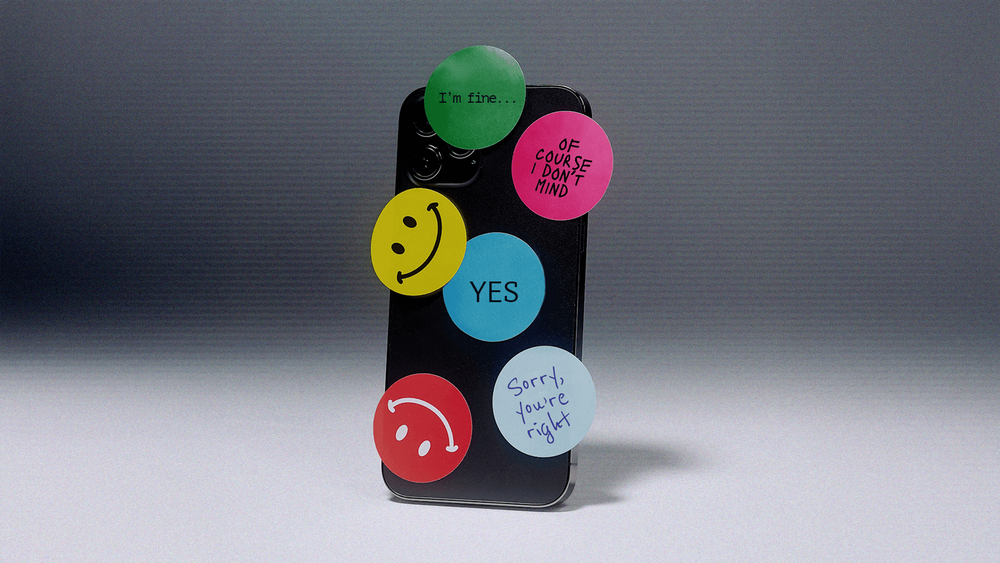
The fact that there are tear-stains on my copy of Are You Mad At Me?, a new book on people-pleasing by psychologist Meg Josephson, is a sign that I needed it badly. I’d only got as far as the dedication, which reads: ‘For those who have kept the peace but lost themselves.’ A few years ago, before a life-changing course of cognitive behavioural therapy, that is exactly how I felt – exhausted from trying to manage the emotions of everyone around me, and completely detached from my own.
Millions of us know we are people-pleasers – a YouGov poll found that 56% of women identify as such, compared with 42% of men – but few of us understand why it’s such a problem until we find ourselves at breaking point. It might manifest as a sudden, blazing resentment towards the people you love; sleepless nights ruminating over something you said at a party; or the certainty that if you have to smile through one more patronising work meeting, you might spontaneously combust. All of these things, according to Meg, are signs that your nervous system is stuck in the ‘fawn response’: the little-known survival mechanism at the root of all people-pleasing behaviour.

“A lot of us are familiar with fight, flight or freeze as threat responses, but we actually have a fourth, which is the reflex to appease and pander to the threat,” explains Meg. “Your body doesn’t know the difference between a real threat (say, a lion in front of you) or a perceived one, so it feels just as urgent to try to ‘fawn’ your way out of danger.” She gives the example of a friend seeming a little standoffish, making your brain fill with anxious thoughts: Are they annoyed at me? Did I do something wrong? “The fawn response would be to immediately start complimenting them or over-apologising for something you didn’t do; anything to reaffirm that they still like you and you are emotionally safe,” Meg explains.
The problem is, merely existing in 2025 feels at odds with emotional safety. We are subject to an endless scroll of curated perfection and other people’s opinions, which makes everything we do feel loaded with the risk of instant negative feedback. “People-pleasing means living in a cycle of craving and seeking external validation, and digital communication pushes that cycle into overdrive,” says Meg. “It’s no longer just, ‘Did that conversation go OK?’ but ‘Why didn’t they watch my Instagram Story?’, ‘Why didn’t they respond to my joke with a laughing emoji?’ and ‘Will people judge me if I share these political views? Will they judge me if I don’t?’” When we’re exposed to the thoughts of 100 people every day, it makes it very hard to hear our own inner voices above the noise.

Though this desire to please others is not a bad thing, Meg emphasises – being community-minded creatures is what got humanity this far – but women in particular are consistently taught that likeability is our main currency. As girls, we’re told that being ‘good’ means being sweet and caring. As adult women, we’re expected to ‘do it all’ with a smile – be a good worker, a good daughter, a good parent, a good friend – and put ourselves at the bottom of the list. “It can be tough to recognise fawning as the root of our unhappiness when it’s the one trauma response that society encourages and rewards us for,” says Meg. Until, of course, the personal losses start to outweigh the rewards of other people’s approval.
For Tamu Thomas, who left a 16-year career in social work on the brink of burnout, it took a series of terrifying panic attacks to make her realise she was under impossible pressure. “As someone who was socialised as a girl, I was taught that being nice and making life easy for others was more important than doing what feels right for me,” she says. “I had a mother who was very conscious of the fact that education and professional success was a way to mitigate some of the discrimination I’d face as a Black woman, and so I was afraid of doing anything that could be misconstrued as a negative stereotype. As ambitious as I am, I always felt I had to make myself smaller and more acceptable to the people around me to get by in the workplace.”
She gives the examples of not offering up a better idea in a meeting, even though she knew she had one, and toning herself down when she noticed, as a gifted speaker, that everyone’s eyes were on her instead of her superiors. “Because people-pleasers are so hypervigilant, we can tell very quickly if somebody is likely to feel threatened and we modify ourselves to make them comfortable,” she says. “I think a lot of us are natural leaders – switched on, empathetic – but we’re too worried about stepping on others’ toes to actually lead. If I’d realised how much I was people-pleasing early in my career and learned how to set boundaries, then I know I would be in a very senior position by now. As it is, I had to leave that career and work for myself to really thrive.”
Tamu’s story is just one example of how fawning can hold us back, but the impulse to put others’ feelings above our own can emerge anywhere from our earliest family dynamics to romantic relationships. For me, growing up with a volatile parent meant I learnt to be emotionless in order to make room for their big emotions, and for years I was actually proud of being ‘the chill girl’ with very few needs. But as an adult, this impacted all of my relationships: I’d never share when I was struggling, then silently simmer with hurt when no one seemed to show up for me. It was a lonely way to exist.

Meg says keeping others at an emotional distance, even though we crave their love, is very common of people pleasers. “An intense fear of conflict stops us articulating our feelings,” she says. “But a little bit of friction is a healthy thing in any relationship, because it means there’s enough space and safety for differing opinions to exist. It’s difficult to really feel close with someone if you’re performing a version of yourself you think they’ll want, rather than letting them see the real you.”
If nothing else, we all deserve real connection. In a digital-first world that pressures us to be flawless two-dimensional beings, allowing ourselves to be messy and whole feels like a radical and deeply necessary act. Take it from me: trying to please everyone is fruitless, life-limiting work. Learning how to please yourself is the only way to feel truly content.
If you’re ready to start, here are four expert-backed ways to reclaim your inner voice...
4 Ways To Stop Being A People Pleaser
1. Identify Your Archetype
In her book Are You Mad At Me? Meg identifies six loose archetypes that people-pleasers fall into – not, she says, as a means of labelling yourself, but as a tool for recognising how you might be fawning and what situations bring out the people-pleaser in you. Briefly, they are:
- The Peacekeeper, who is focused on ensuring their relationships are harmonious and friction-free and believes other people’s happiness is their responsibility.
- The Perfectionist relies heavily on external validation to feel comfortable and uses success and achievement to receive it. They struggle to let anyone see them ‘off their game’ and are always striving to prove themselves.
- The Caretaker finds their value in being helpful and tends to abandon themselves completely in favour of always being available and in service to others. They struggle to say no or set boundaries.
- The Performer finds safety in alleviating tension and lifting others’ moods through humour or positivity. This can result in them feeling like no-one really knows them, because they’re always ‘onstage’.
- The Chameleon morphs themselves to please whoever they’re with and feels they don’t really know who they are or what they want because they’re always shape-shifting.
- The Lone Wolf tries to please people by never ‘burdening’ them with their problems or feelings, keeping it all inside. This can look like self-isolating or avoiding social settings altogether.
2. Practise ‘Leaning Back’
Once you know when you tend to snap into people-pleasing behaviours, you can try this simple strategy for breaking the habit. “Healing starts with awareness,” says Meg. “Because fawning is an unconscious pattern, we need to bring it into the conscious mind, and all that means is implementing an intentional pause that tells our nervous system: ‘This is a perceived threat, not a real one’. Say you feel someone is being cold with you and your impulse is to ask, ‘What have I done? Are you mad at me?’ Lean back, put down the phone and don’t respond for two minutes. All this is doing is breaking the cycle and telling your body: we don’t need to act immediately, this is not urgent, we’re safe.”
3. Tell Yourself The Truth

Tamu Thomas, author of Women Who Work Too Much, developed her own checklist to help her set a boundary when she was about to jump into saying ‘yes’. “In those moments where you’re about to agree to something you really don’t want to, your body tells you – it’s almost like a sinking elevator feeling in your stomach,” she says. “When I feel that, I ask myself a few questions in my head: if I wasn’t worried about looking bad, what would my answer be? If I wasn’t worried about feeling bad, what would my answer be? And is saying yes to this thing going to bring me closer to the things I care about, or further away? These questions force you to get really honest with yourself and therefore act from a place of authenticity.”
4. Turn Up Your Inner Voice
Meg recognises how people-pleasing can make us feel adrift from our own identities, especially if we’ve spent years moulding ourselves to suit other people. She recommends journaling as a way to turn up your inner voice and give yourself space to speak without an audience. Try writing down your answers to the following questions, and thinking about what small steps you can take to bring them into reality.
- Who am I when I’m not being perceived?
- What is my personality when I’m not trying to impress or please anyone else?
- What would I want for my life if I couldn’t tell anyone about it, and if it wasn’t being judged by others?