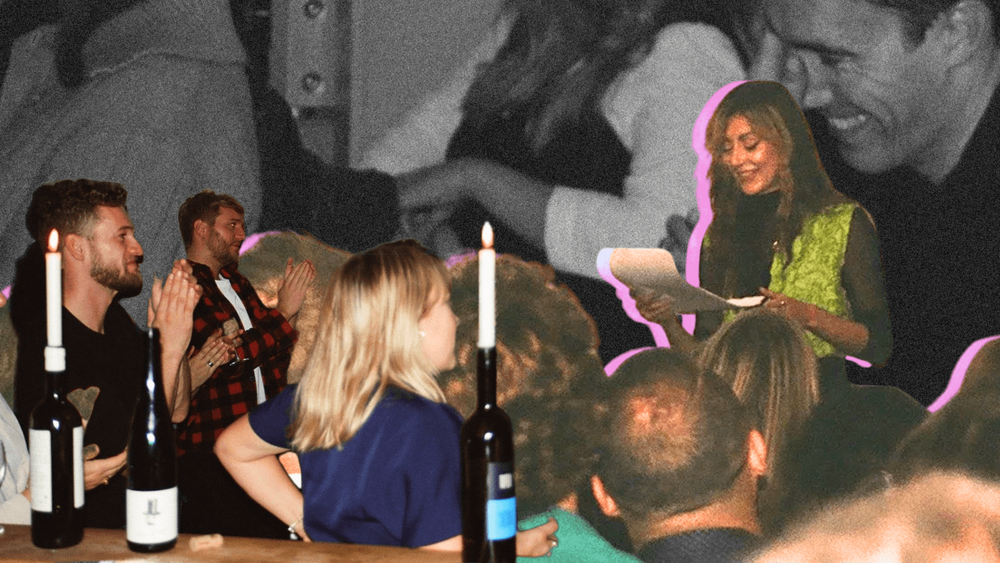
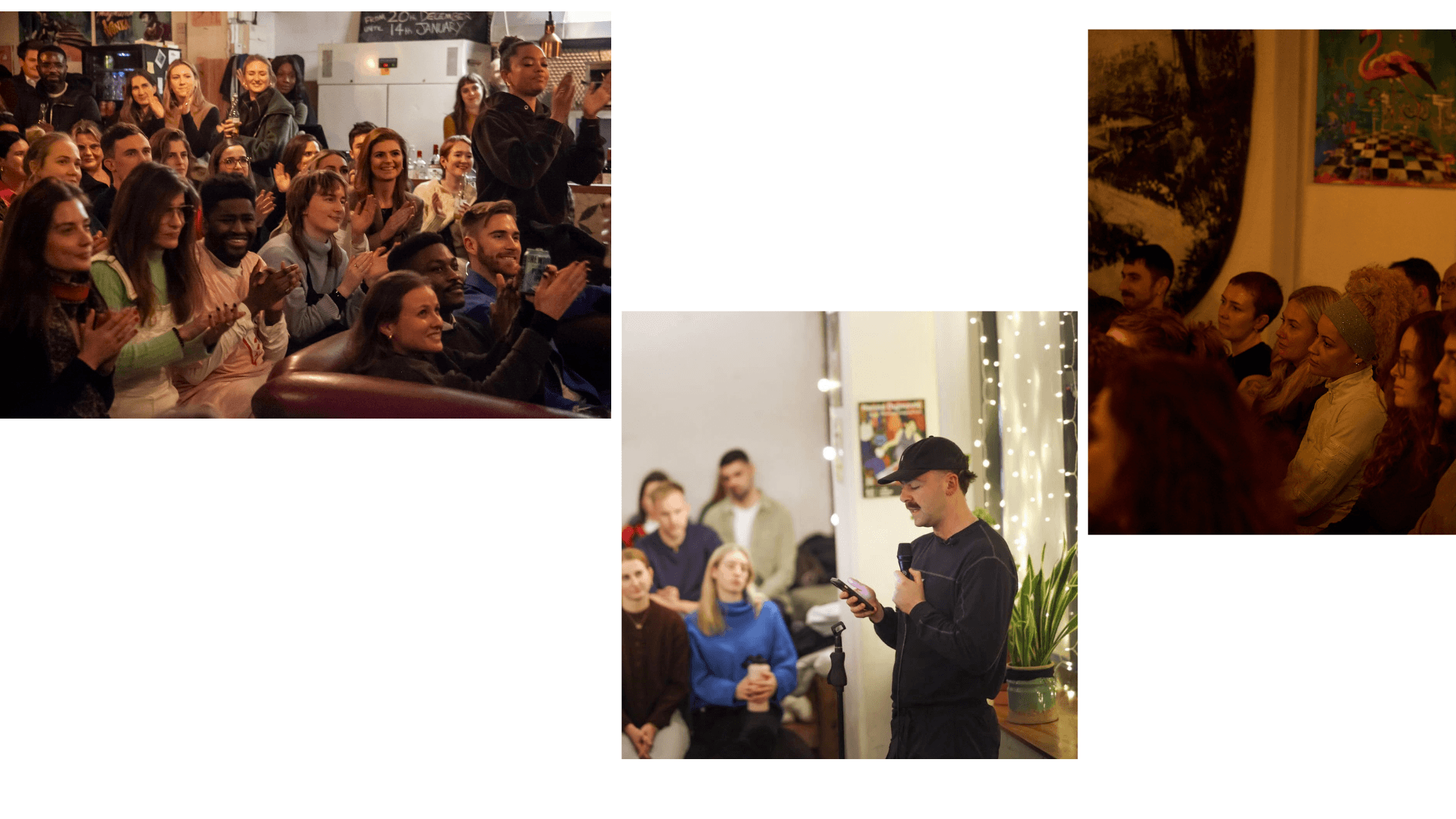
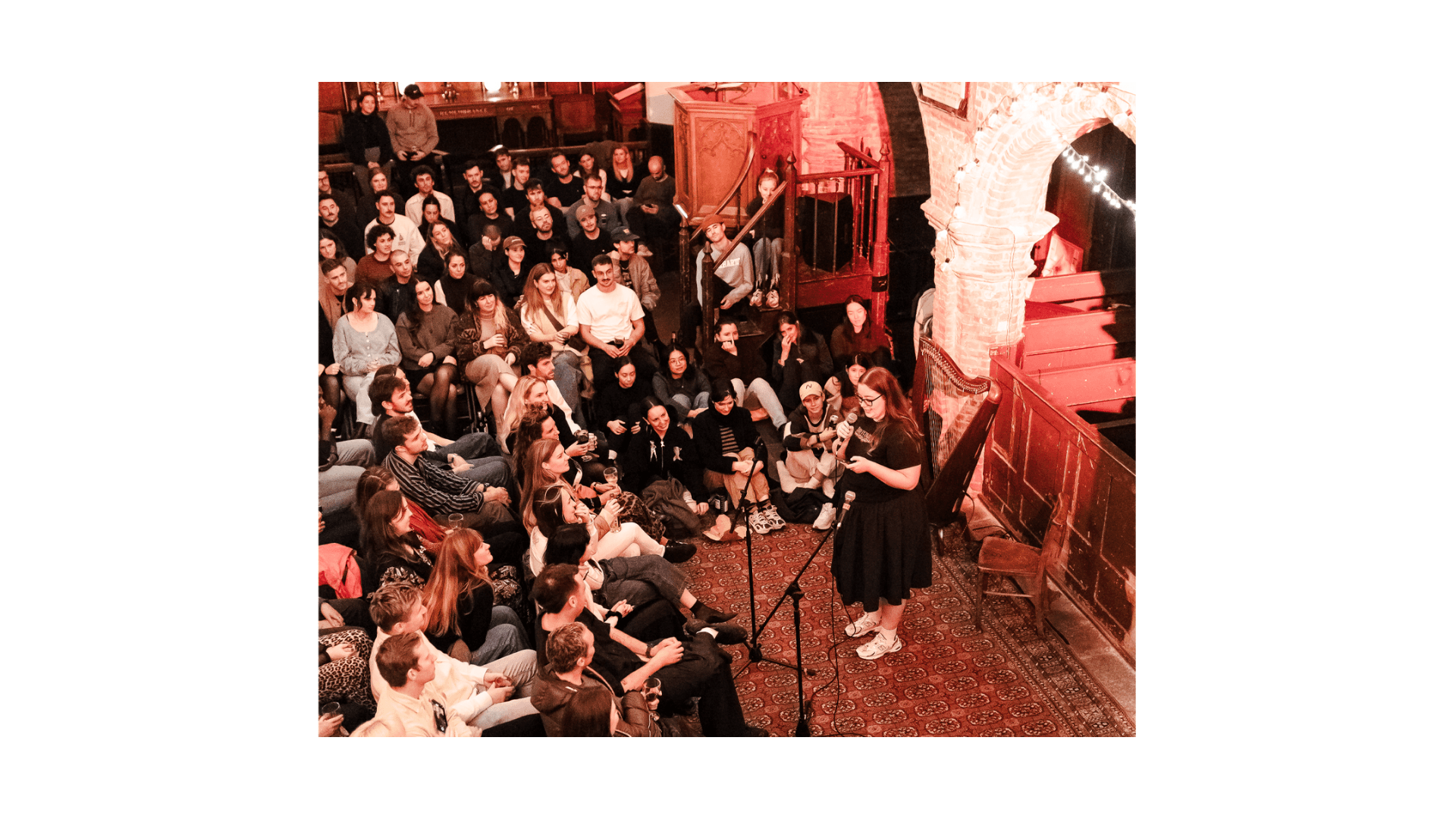
It’s 8pm at the Irish Museum of Modern Art in Dublin, and the room – a former 17th-century chapel – is full of tears. They’re not all signs of sadness or grief; some people are shedding tears of empathy; others relief. An Australian woman tells the story of a life-threatening moment at sea that made her perspective on life change forever, while another young Irish woman – who shares her journey to overcoming mental health struggles – announces this is her first time speaking at an event, let alone telling such a personal tale. The room is comfortably silent until the moment a speaker signals the end of their story, and a long round of applause is given in exchange for their vulnerability.
Welcome to Seanchoíche. Tonight’s theme is Discovery, interpreted uniquely by each of the eight speakers across the evening. At Seanchoíche, the stories exist only that room, for that night – a fleeting gift you’re reminded of as the nearly three-hour event draws to a close. You never know how the stories told at Seanchoíche will resonate. “The people who come are completely struck by how simple it is – and also how much it touches them, hearing people going through the exact same things that they are”, says founder Ciaran Gaffney. “Hopefully it makes the people that attend the events feel a little bit less... alone.”
What Is Seanchoíche?
Founded four years ago in Dublin, Seanchoíche – which translates from Irish to ‘storytelling night’ offers a platform for ordinary people to tell extraordinary stories, and for others to listen. Each event centres on a universal theme, such as love, fear or memory, with speakers (who are mostly beginners to storytelling) sharing personal experiences in front of a room of open minds. While the format is deceptively simple, its impact is profound. Across cities and countries, audiences sit in attentive silence, hanging on every word – a rare act in an age defined by distraction.
Though Seanchoíche feels contemporary, its roots run deep. Seanchaithe (storytellers) are a longstanding part of the country’s traditions, gifting knowledge and entertainment from barstools or a perch by the hearth. Over time, that tradition faded, displaced by modern technology and changing social habits. It was a history Ciaran became deeply familiar with while attending an Irish-speaking school in Dingle, County Kerry. “I just thought it was such a beautiful tradition,” he says. “Something that was only natural to exist in Ireland, because so many people are great storytellers as is.” To him, the Seanchaithe were community leaders – figures who created belonging through shared narrative. Seanchoíche, in many ways, is an attempt to restore that sense of collective listening.
“Seanchoíche – which translates from Irish to ‘storytelling night’ offers a platform for ordinary people to tell extraordinary stories, and for others to listen."
With the passing of time and new technology, the prominent role of the Seanchaí faded – until now. The vulnerable ritual of offering and receiving a story in a room full of open minds that lies at the heart of these moments of connection has once again been given space thanks to Ciaran. “This tradition had begun to die out,” he says, noting how modern media and technology has played a role in replacing the art of recounting stories through word of mouth, with information now able to travel across the globe in seconds. “I wanted to bring storytelling back to life,” explains Ciaran.
The idea for Seanchoíche began to form while he was living in Argentina seven years ago. There, he attended a storytelling event and was struck by its intimacy. “I loved it,” he says. “But it didn’t really click at the time that it was a very Irish thing.” That realisation came later, during the COVID-19 pandemic. Like so many others, Ciaran found himself spending long stretches indoors with close friends and family reminiscing about the past and painting pictures of the future. “During the pandemic, we became so much more nostalgic,” he says. “We were able to see the magic in the mundane.” From those moments of genuine human connection, Seanchoíche was born.
From Dublin To The Diaspora
What started in a few Irish venues – from cafes opened just for the night to an old Church – quickly spread beyond the island “through just word of mouth and organic social media for the first two years”, Ciaran says. “We are quite lucky in that the Irish diaspora is in so many countries, so a lot of them would see their friends back home going to an event in Ireland, and were already following us by the time we reached London, Melbourne, New York... and so on. They would come and invite their friends, who’d invite their friends.” Not only did the event find homes in pockets around the world, but the roster of speakers has become international, too – some of Seanchoíche’s are now performed fully in Spanish and Dutch.
Today, Ciaran (along with his team of four) have found communities everywhere from Australia and Canada to the Netherlands and United States, and events sell out year-round. “I think people are already keen on reconnecting with culture and with their heritage, but with this, we wanted to make it accessible to everyone, not just Irish people,” explains Ciaran. “We always communicate at every event that storytelling exists in every culture because it is the crux of culture, and naturally that has allowed us to open up to more nationalities speaking at our events”.
Attend an event and that ethos is evident: a chorus of accents echo into the microphone, reminding listeners that, regardless of background, we are all drawn to the same need for connection. In this social-first age dominated by performance and self-promotion, Seanchoíche offers something quietly radical: deep listening. This is what compelled me to speak at one of their London events – friends who had spoken previously had expressed nothing but gratitude for the opportunity, for the release of bottled emotions it afforded them, and I wanted to experience that, too.
“At Seanchoíche, there is no pressure to impress, no expectation to entertain, only a willingness to be heard. The result is a shared emotional release that feels almost contagious”
Despite having a background in theatre, stepping up to the mic in a crowded room of strangers is never easy, especially when the intention is to offer a story never read aloud before. I’m confident in my words as a writer, but less so when translating text to speech that has only ever been read by the voice in my head. But hearing laughter at the end of a punchline or looks of understanding amid a tender moment made it all worth it. At Seanchoíche, there is no pressure to impress, no expectation to entertain, only a willingness to be heard. The result is a shared emotional release that feels almost contagious. During those evenings, vulnerability becomes collective and the act of listening transforms strangers into a temporary community.
It’s this sense of connection – fleeting, generous, and deeply human – that has fuelled Seanchoíche’s growth, and the event’s international expansion shows no signs of slowing. With consistent demand and an expected increase in funding from the Irish government and brand partnerships, Ciaran is hoping to launch into countries with events that can be offered free to the local community. “I want to be able to give back to the community as much as we can with this event,” he says. “It’s there for people to feel better, so we should be doing as much as we can to make people feel better.” Following a successful funded trip to Ghana in 2025 with Culture Ireland, plans are underway to expand to Nigeria and Lebanon this year, alongside more pro-bono work aimed at sharing humanitarian and activist messages through Seanchoíche’s already strong network.
More Than A Moment
Seanchoíche exists within a broader resurgence of Irish cultural expression – a so-called “green wave” that shows no sign of waning. Everything from local moments that inspire profound moments of patriotism – such as the former Ireland president, Michael D Higgins, performing spoken word at the Irish festival Other Voices in November, which was livestreamed – to the international success of Dublin-born musician CMAT’s recent album Euro Country, which tells nuanced accounts of growing up during the post-Celtic Tiger, as well as featuring an introduction in Irish for the album’s title track.
Céilís, a traditional dancing event, are now selling out halls outside of Ireland, while collective Croí na Gaeilge (‘Heart of Irish’) are organising Irish speaking nights – for speakers of all levels – in London boozers. Acts like West Belfast trio Kneecap – who fuse Irish and English while using their platform to speak on global injustice, including the genocide in Palestine – further demonstrate that a language once outlawed is now living, evolving and politically alive.
Back in that chapel in Dublin, the stories continue. Chairs are pulled close. Microphones are passed. The room listens – fully, openly. “Seeing the people who are now representing Ireland, it’s just magical,” says Ciaran. “I’m so proud to call myself Irish.” He isn’t alone. Beneath the noise made in Ireland’s name is a collective force: a chorus of voices across the diaspora crossing borders as much as our Irish ancestors once did out of necessity – now driven instead by pride and possibility. It’s a movement rooted in celebrating what Ireland means today: home, community and creativity, for open to anyone willing to pull up a chair – and listen.