I have played Nadia’s* interview – conducted by my colleague in western Herat province as part of our reporting on girls’ education under the Taliban – several times. Her voice trembles in places, cracking under the weight of what’s been lost as she breaks down into tears twice during the nine-minute call. She is 18, and in her voice I hear both a child’s unshaken dream and an old woman’s grief. Nadia recalls her 45 classmates, though she’s begun to forget their names – even those of her closest friends. What she remembers instead are their ambitions: an astronaut, a president, a fashion designer, a model. Her own dreams shifted weekly – one week she longed to study astronomy, the next she imagined herself a police officer. “That is what I loved the most about school,” Nadia says. “It was possible to dream.”
And then, one September morning in 2021, the school doors closed.
“I feel words cannot express what I felt when the Taliban sent us home that day,” Nadia says, her gaze distant, as though replaying the moment. “It felt like being paralysed; like your body is unable to move no matter what you do.”
She pauses, tears streaking her face, “I have many dreams,” she whispered, “but I hope they don’t remain just dreams.” She talks of a deep pain that presses hard on her every day. “It is painful to see other people going to the moon, and us Afghan girls, we can’t even leave our home without a chaperone.” More than anything, it’s her tone that carries the weight of it all – one that bears both devastation and defiance.

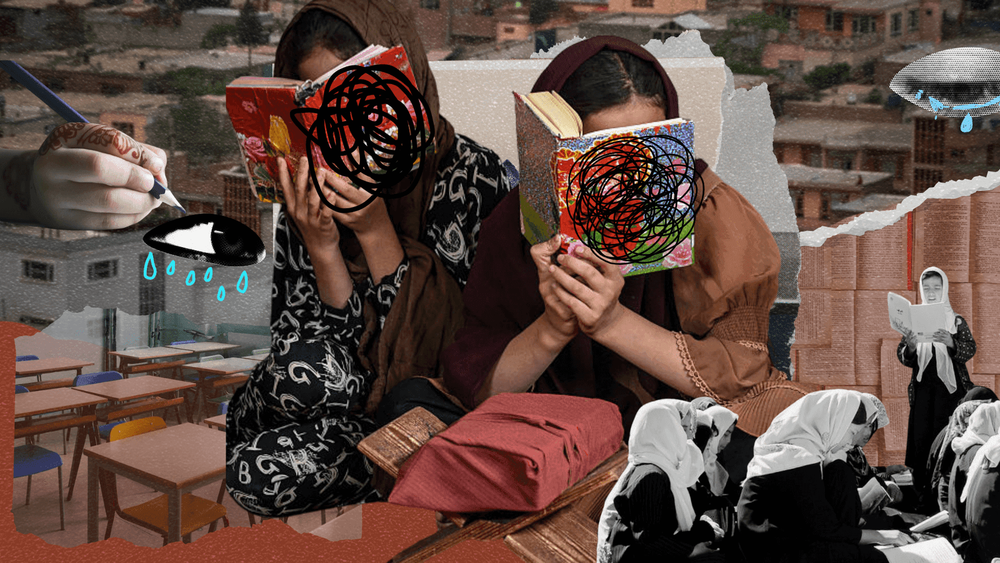
Nadia was in 10th grade when, in August 2021, the Taliban imposed the most sweeping ban on girls’ education in modern history. First, they barred secondary schools – promising it was temporary. Weeks passed, then months, and the ban never lifted. Teenage girls across the country were suddenly cut off from their classrooms, their futures put on indefinite pause. In December 2022, they shut universities to female students.
Today, nearly 2.2 million Afghan girls are out of school – and the loss is not only academic. School was often the only safe space for girls, a place to laugh with friends, exchange ideas and imagine futures together. That loss of freedom is felt in even the smallest corners of daily life. In Kabul, 19-year-old Maryam* told me that if schools had stayed open, she’d be studying law right now, working towards her dream of becoming a judge. Instead, she spent six months trapped at home, crying “day and night”. “Most families won’t allow girls to visit their friends at home,” she explained. “School was the only place we could see each other.”
“Words cannot express what I felt when the Taliban sent us home that day – It felt like being paralysed; like your body is unable to move no matter what you do.”
Eventually, her parents found her an online school, which operates in secret from the Taliban, where she now studies – and even teaches younger girls herself. Networks like Ideas Beyond Borders (IBB) support these efforts, and as of 2025, IBB reports having over 40 secure locations, teaching nearly 2,000 students, with 50 Afghan women instructors risking their safety to keep education alive.
A volunteer organiser at the school Maryam is studying at says the school has around 1,000 students and 30 teachers, all working underground. “One of our schools in Kabul is run by a teacher and her daughter who graduated school before the Taliban came. They teach around 50 girls and focus on social studies and languages, especially English,” the volunteer says, adding that the teacher – who is in her 40s and risks everything to keep teaching – is a constant source of inspiration. “The other day she announced with excitement that there are 10 new students in her class. I was so happy but also worried – it is not safe for 60 girls to come and go inside a home in Kabul.”
And she’s right: with no protection, these teachers, some of them volunteers, endanger themselves to educate girls across Afghanistan. One teacher, who works along four others, knows the stress and fear of running a secret school firsthand. For more than two years, she taught around 100 girls in a religious school and one day, last September, the Taliban visited the venue: “When the Taliban came to the school gate last September, I was pregnant and nearly fainted from fear.” She avoided arrest by convincing the Taliban that she was teaching the girls about the Quran.
Some of these schools, like Maryam’s, also operate online, allowing many girls to join classes from their own homes. But this fragile lifeline has its own risks. Just last month, Afghanistan experienced a 48-hour internet and telephone blackout. Although services were eventually restored, the Taliban gave no official explanation. However, two weeks prior to this, the spokesman for the Taliban governor in Balkh had told the media that the group’s leader had ordered a ban on fibre-optic internet to “prevent immorality.”

When the internet was finally restored, many Afghan social media users said the blackout left them with a sense of despair reminiscent of August 2021, when the Taliban took power. For many young women, it felt like losing their last lifeline to learn, to work and to stay connected with the world. For students like Maryam, that connection isn’t just about access to information – it’s a crucial source of stability and hope. “After joining the school, I feel I have a place to calm down my mind,” she told me. “Many of my friends are having mental health issues because we all have been hurt. One of my friends who was very intelligent would cry a lot and say, how should we come together again? Her parents took her to Pakistan for treatment, [but] even there, she is suffering. This is painful for all of us.”
So far, the ban on education has denied Afghan girls their social lives, their identities, their sense of belonging. It has created an invisible mental health crisis in a country that barely recognises mental health as real. As a journalist who grew up, studied and worked in Kabul, I’ve seen this shift firsthand – from classrooms once filled with laughter and ambition to silent homes where hope is flickering out. Because in Afghanistan, illness is something you can see: a fever, a wound, a broken bone. Pain of the mind is often dismissed as weakness, or equated with madness. It’s why families hesitate to seek help, and even when they do, support is nearly non-existent.
“We have an estimated 250 patients a day, most of them young women,” a psychologist in western Afghanistan told me. The hospital where he works has only 12 therapists – just four of them women – to handle the overwhelming demand. Each patient is seen for no more than 15 minutes. It’s barely enough time to ask what’s wrong, let alone treat the root of it. “Most of these girls don’t need medicine,” he says. “They need someone to listen. But the doctors don’t have time. So they are given pills, which create dependency but don’t heal the pain.”
In a country where therapy is scarce, trauma is constant and stigma runs deep, mental health support is collapsing under the weight of silence. These girls aren’t just struggling with grief and fear – they are being medically sedated against a backdrop of social and political paralysis. The ban on education isn’t just denying them a future. It’s fracturing their present, quietly and systematically, with consequences that can’t be solved by a prescription.
“Most of these girls don’t need medicine. They need someone to listen. But the doctors don’t have time. So they are given pills, which create dependency but don’t heal the pain.”
But this is the reality of Afghanistan’s fragile mental health system: too few professionals, mostly concentrated in cities, and a widespread lack of awareness of understanding of mental illness across society. Even when treatment is available, it’s often out of reach or too expensive for families. Nearly 9.5 million people are severely food insecure, and close to 5 million women and children suffer from malnutrition, according to the WFP. Therapy at private clinics comes at a cost, and for many – especially those in rural areas – even the price of transport can make care impossible.
I grew up never learning the language for what was happening inside me. I certainly didn’t know anything about trauma. It wasn’t until the summer of 2022, while coordinating a trauma-informed journalism workshop with the International Women’s Media Foundation, that I began to understand my own pain. The sleepless nights. The unexpected tears. The racing heart. The crushing hopelessness I couldn’t explain. For the first time, I recognised these as symptoms of trauma. In Afghanistan, we are taught to carry on. We don’t talk about mental health – we endure until we break. And since the Taliban takeover, more and more women and girls are breaking.
Fatima was once studying midwifery. In December 2024 she was stopped at her college gates – the new ban had kicked in, barring women from studying healthcare. She cried all the way home and, once there, swallowed a handful of pills. She woke up in hospital with her mother by her side. “After that,” she said, “my family followed me like a shadow, afraid I would kill myself.” Her story is tragically not unique. Some of her classmates did not survive their despair. One took her life.
In fact, since the Taliban took over, suicides and suicide attempts among Afghan women have surged. In 2023, an investigation I worked on across 11 provinces uncovered something deeply troubling: Afghan women are now attempting suicide at rates that invert the global pattern. Around the world, men are statistically more likely to die by suicide. But in Afghanistan, it is young women – especially those denied access to education and basic freedoms – who are dying in alarming numbers. Their despair is not abstract. It is the direct result of being silenced, shut indoors and cut off from the futures they were building just a few years ago.

The UN has confirmed the scale of the crisis: in 2024, 68% of Afghan women reported “bad” or “very bad” mental health, while 8% said they personally knew a woman or girl who had attempted suicide. These are not isolated tragedies. They are patterns, shaped by the Taliban’s policies of gender apartheid.
Mental health professionals I spoke with warned that without urgent investment in mental health, culturally sensitive therapy, trained professionals and accessible care, Afghanistan risks losing an entire generation. “If we grow up with this depression, we will have a generation of sick, depressed people,” Nadia said with stark clarity. “And just one generation is enough to destroy a country.”
Still, there are pockets of resistance: a therapist who counsels a suicidal girl without pay; a woman who transforms her basement into a secret classroom; the teachers and activists who set up online schools despite the risks. These are small, flickering lights in the dark, keeping hope alive for a generation drowning in despair.
But courage cannot replace infrastructure, and resilience cannot substitute rights. The Taliban show no willingness to lift the ban. “My biggest dream is to wake up one morning, put on my school uniform – and leave the house to go to school,” says one girl from Kandahar who was in the 9th grade when the ban took hold. “I haven’t felt well since I’ve been separated from my studies. I hate the fact that I am a young Afghan girl.”

Nadia now spends her days in a handicraft workshop, not because she wants to, but because she fears what might happen if she stays idle. “I do this so I don’t lose my mind,” she says. When we asked her if she had any demands for the Taliban, she shook her head. “I don’t have any demand from them,” she said. “It has been four years since our schools closed. We are trapped in a whirlpool. But I do want people to please study, to be happy even if they can’t. I want them to be vigilant, to plan for the future, and not allow another generation to become like us – stuck.”
Afghanistan’s invisible mental health crisis is not just a story of lost classrooms or silenced voices – it is a story of shattered futures and the quiet unravelling of a generation’s spirit. Behind every closed school door, behind every moment of forced silence, lies a profound, unseen trauma. Yet amid this darkness, there are still those who risk everything to fight for learning. “My fear is that the girls will remain illiterate. I fear that our girls will be left without a future. [that’s why] I am resisting the Taliban,” a young teacher from northern Afghanistan told me.
Afghan girls have shown extraordinary resilience. What they need now is the world’s solidarity – not just to survive, but to hope again. Without urgent change, the dreams of girls like Nadia will remain suspended – echoes of what might have been, but never will be.
*Names have been changed