I learned about Hurricane Melissa half-asleep in bed, the dim light of my phone cutting through the dark. A news alert. A headline that made my chest tighten. Jamaica. Haiti. Cuba. Then the dread. Then the all-too-familiar wave of grief, anger and powerlessness that rises every time I learn about another climate disaster. This time, though, it felt different. I texted my family immediately. My mother wrote back within seconds, saying she had been praying the storm would weaken before landfall. From our homes in the States, all we could do was watch. I thought about a meme I had seen with Ralph from The Simpsons mocking the emptiness of “thoughts and prayers”. Still, I sent up a small one for those who would feel the storm directly, without the distance that was protecting us. There was nothing else I could do.
My relationship to the Caribbean begins long before me. My mother, Marlene, grew up in Saint-Marc, Haiti, the daughter of my grandfather, Lorvance Beauliere – a soldier, police officer and one-time senatorial candidate – and my grandmother, Hosanna “Mommy Hosanna” Delphin, a pianist and dressmaker who lived one day short of a full century. My grandfather’s family had emigrated from Cuba in the late 1800s. My mother grew up in Saint-Marc, surrounded by beautiful beaches, books, wandering farm animals and church services at the First Baptist Church of St. Marc. She came of age under François “Papa Doc” Duvalier’s regime and, after finishing secondary school, worked as a secretary at the National Assembly. In 1968, at 19, she chose to leave for the United States. Later, my grandmother and the rest of the family followed, rebuilding their lives in New York before settling in Port Charlotte, Florida.
My family’s journey from Haiti to Florida eventually became part of my own story. When I was a kid, I spent most summers in Port Charlotte, a community full of Haitian families who built their lives one job, one church, and one block at a time. Those summers shaped me. The smell of djon djon rice in my Aunt Claire Edith’s kitchen, the tanbou drum echoing through her living room, my siblings and cousins talking over one another. The laughter and full-throated mes amis – the Haitian equivalent of “Oh my God” – rising above it all. Those were the days.
Last year, Hurricane Milton tore through that same community. My aunt’s house flooded. Windows shattered. The roof peeled back like cheap wrapping paper. For weeks, the neighbourhood smelled like damp wood and seawater. Even now, repairs across the area are incomplete, with insurance companies finding new ways to delay or deny payouts.
But this wasn’t a freak storm – what happened to my aunt’s home is happening everywhere, as extreme weather – fuelled by human-driven climate change – pushes communities like ours to the breaking point. Everywhere you look, another disaster unfolds: a wildfire, a hurricane, a flood, an avalanche – each one tracing back to the same accelerating crisis. Last month’s Hurricane Melissa was not only catastrophic for the Caribbean, it was historic. It roared through as a Category 5 storm, with sustained winds of 185 miles per hour, making it one of the strongest storms ever recorded in the region and the third-most intense Atlantic hurricane on record.
“This wasn’t a freak storm – what happened to my aunt’s home is happening everywhere, as extreme weather – fuelled by human-driven climate change – pushes communities like ours to the breaking point”
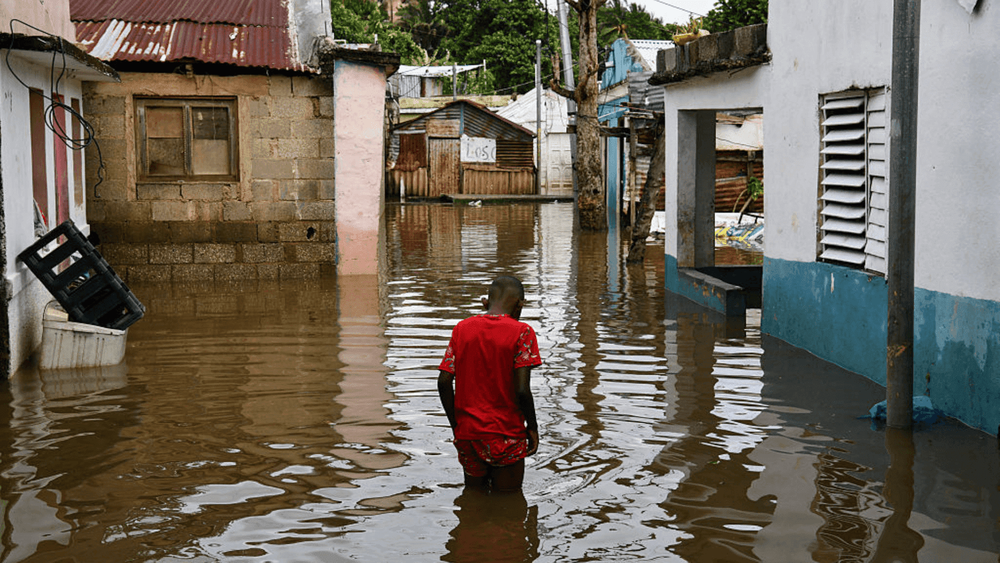
In Petit-Goâve, 10 children were killed, according to Haiti’s Civil Protection Agency. As of 10 November, 96 deaths have been attributed to Melissa: 48 in Jamaica and 43 in Haiti, and more elsewhere. In Cuba, the American Red Cross reported that over a million homes were damaged or destroyed. And the ripple effects will be felt for years across The Bahamas, Turks and Caicos, and the Dominican Republic.
The science is clear: models from the National Oceanic and Atmospheric Administration’s (NOAA) Geophysical Fluid Dynamics Laboratory project reveal that as the oceans warm, the proportion of tropical cyclones reaching Category 4 and 5 will likely rise, even if the total number of storms stays the same. According to the University of the West Indies’ State of the Caribbean Climate report, sea levels in the Caribbean are already rising at roughly 1.8 mm per year, with projections suggesting an increase of 0.26 to 0.82 meters by 2100, amplifying storm-surge risk. Meanwhile, rainfall rates within and around hurricanes are expected to rise by about 15%, making flooding more intense when these powerful storms strike.
Behind those staggering statistics are communities fighting to rebuild. In Jamaica, Melissa carved a violent path through St. Elizabeth, Westmoreland and Manchester. Farms that sustained entire communities were pulverised. Black River suffered catastrophic destruction. The Prime Minister of Jamaica, Andrew Holness, said recently that the storm’s damage amounts to nearly a third of the country’s GDP from the previous year. Food, aids and support will be critical as families rebuild. For my own family, seeing the slow recovery after Hurricane Milton makes the scale of this loss immediate. Rebuilding is already difficult as it is, but for communities in Haiti and Jamaica, the challenge is far greater.

Speaking at COP30 in Belém, Brazil, last week, Barbados’ Prime Minister Mia Mottley shared that Jamaica’s damage alone is expected to exceed US$7 billion – and that figure doesn’t include Haiti, Cuba or the other countries Melissa struck. While a number like 7 billion can feel abstract, it represents hundreds of thousands of people whose lives have been upended by the storm. It includes destroyed homes, schools, hospitals, roads and small businesses. Denver Thorpe, a farmer in Westmoreland, saw both of his greenhouses and more than 15 acres of mango trees destroyed. “There’s absolutely nothing,” he told AP News.
As Jamaica-born climate organiser Mikaela Loach wrote for British Vogue, “Hurricane Melissa is not a natural disaster. It is not an inevitable, unavoidable ‘act of God’.” She’s right. We know, beyond a shadow of a doubt, from the data and from climate scientists, that human behaviour is driving climate change and extreme weather – and that we cannot continue filling the atmosphere with CO₂ without serious repercussions. On TVJ’s Smile Jamaica, Dr Jayaka Campbell, a climate scientist and professor at the University of the West Indies, explained that hurricanes like Melissa are fuelled by superheated waters. “The primary driver for that is anthropogenic change... human-induced forcing that raised our sea surface temperatures about 1.5 degrees warmer than they would have been.” Warm water feeds storms. That hunger becomes speed. Speed becomes devastation.
For my forthcoming book on the climate crisis and how we can respond, I spoke with Dr Johan Rockström, Director of the Potsdam Institute for Climate Impact Research. When I asked what the science tells us about the near future, he said, “That we are no longer a relatively small economic world on a big, infinite planet with an abundance of fish in the ocean, heat-uptake capacity in the ocean, ice, atmosphere, species and trees. No. Today, we are a very large world on a small planet. We have filled up the entire space. There is no atmosphere left that we can pollute. There isn’t one square metre of this planet that is not affected by microplastics and chemical pollutants.” He added that he believes “phasing out oil, coal and gas is just as important as immediately stopping forest loss in the Amazon”.
“Today, we are a very large world on a small planet. We have filled up the entire space. There is no atmosphere left that we can pollute. There isn’t one square metre of this planet that is not affected by microplastics and chemical pollutants.”
Dr Johan Rockström, Director of the Potsdam Institute for Climate Impact Research
Of course, climate scientists have warned for years that warming oceans are supercharging storms faster than our models can anticipate. Over the last decade, the Atlantic – which is now warmer than at any point in recorded history – has seen a sharp rise in Category 4 and 5 hurricanes, and rainfall extremes are intensifying. But science alone cannot explain the full story. The Caribbean sits at the intersection of that scientific reality and a political one: a legacy of colonial extraction that left behind fragile infrastructure, under-resourced institutions and economies pushed into cycles of dependency. Many islands entered the climate crisis already carrying the weight of debt, underinvestment and limited bargaining power in global financial systems. So when a storm like Melissa hits, it doesn’t just meet wind and water – it meets vulnerability that was engineered long before the climate began to warm.

That inherited vulnerability is visible everywhere. Colonial land policies and construction standards often placed communities in low-lying, hazard-prone areas with weak building codes and little enforcement. In places like Jamaica, land ownership remains uneven, and many rural areas still reflect patterns of extraction. Across the region, outdated or inadequate infrastructure compounds risk, making each storm more destructive than the last. The climate crisis only makes things worse.
The truth is becoming harder to ignore. Floods sweeping through European towns, heat waves in cities once known for rain, and fires in some of California’s wealthiest neighbourhoods. No place is exempt. Climate change does not check zip codes before it arrives, but it does hit the hardest where the protections are fewest. Inequality often determines who survives the storm and who does not. It directly shapes what gets rebuilt and what gets abandoned. It decides whose grief becomes a statistic and whose becomes an emergency. And still, many people pretend climate change is happening “elsewhere”. But what is elsewhere? As the now-famous quote from @perthshiremags on X puts it, “Climate change will manifest as a series of disasters viewed through phones with footage that gets closer and closer to where you live until you’re the one filming it.” Still, the price paid is not equal and never has been.
In the aftermath of Hurricane Melissa, people across the Caribbean did what they always do – they showed up for one another long before outside help arrived. Organisations like the Office of Disaster Preparedness and Emergency Management in Kingston and Kadesh in St. Elizabeth mobilised quickly to support displaced families and help rebuild homes. In Haiti, small grassroots groups distributed water, food, and tarps within hours, well before international attention landed. In Cuba, neighbours formed brigades to clear debris from entire blocks.
“Climate change does not check zip codes before it arrives, but it does hit the hardest where the protections are fewest. Inequality often determines who survives the storm and who does not”
Diaspora communities stepped in, too. Captain Barrington Irving Jr., the Jamaican-born pilot (who became the first Black person to fly solo around the world) partnered with Grammy-winning musician Buju Banton, leaders from Memorial Hospital, the Florida Panthers and others to deliver more than 100,000 pounds of supplies – including food, water, medicine and medical equipment – from Miami to Kingston. Nonprofits like Global Empowerment Mission established relief camps in Black River, while Samaritan’s Purse erected emergency hospitals to treat injuries and provide essential medications. As Jamaica’s Minister of Tourism, Edmund Bartlett, told FOX Weather, “Our nation has weathered many storms but we are well on our way to recovery. Melissa revealed what defines us most: our unity, our courage, our kindness, and the trademark spirit of the Jamaican people.”
Recovery is a long road, but it has already begun.
In moments like these, I often think about hope – what it is, what it isn’t, and what it cannot be in this moment we are living through. Justin Worland, a Senior Correspondent at TIME Magazine, has spent the last decade reporting on climate and energy issues. In January of this year, his parents’ house, his childhood home, burned down in the Los Angeles wildfires, specifically the Eaton Fire, where his home in Altadena was engulfed in the flames. For my book, we spoke about how this is no longer some “distant problem” we can address in the future, and how people came together to help one another. “That kind of solidarity is something,” he said. “It’s a small silver lining, but I often wonder: how do we channel that energy? How do we make sure it’s not just something that happens in the crisis moment? How do we channel that energy toward addressing the root causes? Toward making sure that when we rebuild, we rebuild the right way?”

My own family’s story, from Cuba to Haiti to Florida and beyond, reminds me that the Caribbean is bound not only by water but by kinship. Jamaica’s pain is Haiti’s pain. Haiti’s loss is Cuba’s loss. The storm did not differentiate, and neither should we. The global South is paying the highest price for a crisis fuelled by the greed of a few. We must do everything we can to ensure that those responsible are held accountable. We must continue to show up for one another. We must also continue to choose each other. We must help rebuild, and rebuild the right way. That is where our responsibility lies.
“The global South is paying the highest price for a crisis fuelled by the greed of a few. We must do everything we can to ensure that those responsible are held accountable”
If you are reading this, I hope you will consider supporting local groups with deep roots in their communities – even a small contribution can make a difference. Push your governments to back climate-vulnerable nations and advocate for equitable climate finance. Share what you’ve learned about this crisis with the people around you – awareness is the first step toward change. Silence in the face of climate change is deadly.
The next storm is coming, but our response is the part we can change. In the spirit of regeneration, healing and repairing our relationships with both the living world and with each other, supporting Caribbean-led recovery efforts today really is a meaningful way to help.
4 Organisations You Can Support Today
United Way (Disaster Relief & Recovery): Coordinates disaster relief and recovery efforts across affected regions.
Hope For Haiti: Delivers aid and long-term support to Haitian communities.
Share The Meal (UN World Food Programme): Provides emergency food assistance.
The Government of Jamaica’s Emergency Appeal: Supports local relief and rebuilding initiatives.
For further updates on his upcoming book, follow Glenn on Instagram @glenn_lutz