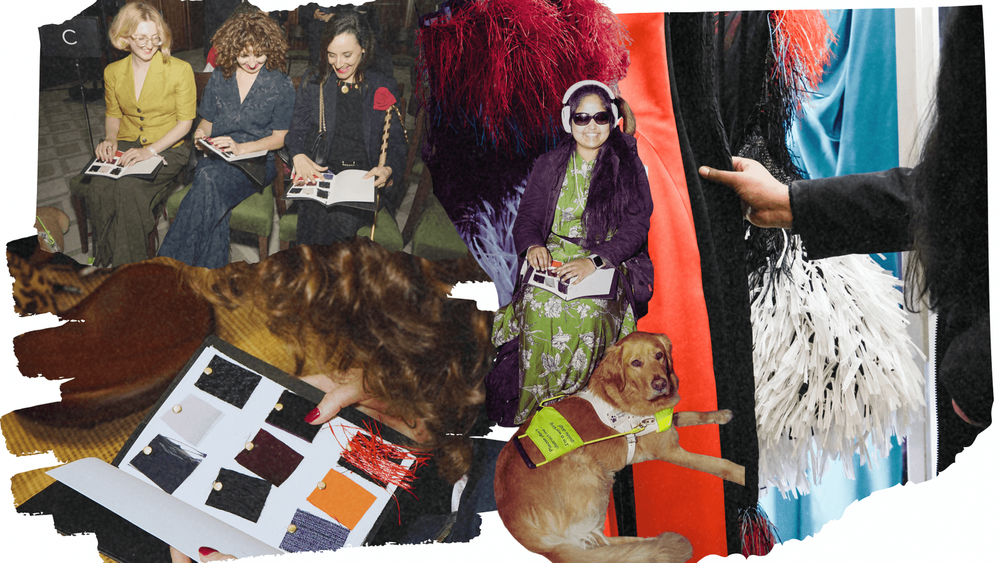
Last London Fashion Week, the front row looked a little different than usual. At Roksanda Ilinčić’s SS26 show, it played host to the usual fashion editors, stylists and a few recognisable faces. But a pair of golden retrievers, Summer and Bertie, quietly commanded attention, their eyes tracking the models with focused calm. They belonged to activist and architectural designer Poppy Levison and artist-advocate Ruqaiya Asim, who sat alongside brand strategist Victoria Seffens-Mepsted and writer-activist Bérénice Magistretti – all guests of Hair & Care that season.
What connects these women is more than a passion for creative arts and fresh experiences. They share a mission: to advocate for people with disabilities in worlds not built to include them. They also happen to be low vision or blind.
Their journey intersects with that of Hair & Care, the East London-based nonprofit set up by award-winning hairstylist Anna Cofone (a backstage regular at fashion month, who created the hair looks for this very show with Authentic Beauty Concept and has also styled Service95 founder Dua Lipa). “I set up Hair & Care initially with the goal of supporting blind and low vision women with their hair care. I grew up with a blind parent, and saw from a young age the barriers this community face,” says Anna. “I have lived experience of he impact that self-care and positive self-image can have on a person’s wellbeing. That’s what I experienced with my dad – people would be like, ‘Oh, poor him, he can’t see.’ Actually, it wasn’t poor him. He was the most well-dressed person I can remember. Just because blind and low vision people might require things addressed in a certain way doesn’t mean they shouldn’t experience the things everyone else gets to.”

Since its inception in 2019, the organisation has supported more than 500 individuals. Whether it’s through free monthly workshops inviting women and girls to its Hackney studio to learn more about styling their own hair and encouraging self-expression through self-care, or by opening up runway shows to guests who would otherwise be overlooked on the invite list, Hair & Care is actively carving out space in fashion for people so often excluded from the narrative.
While some efforts have been made to increase diversity throughout the fashion industry, when it comes to disability inclusivity, representation remains startlingly low. In the British Fashion Council’s most recent diversity, equity and inclusion census of the UK fashion industry, only 6% of the participants identified as disabled. When you consider that more than 15% of the world’s population lives with some form of disability, it’s clear that the fashion industry has a long way to go. In fact, research found that while fashion is top of the industries consumers expect to be inclusive in their marketing, 75% of people with disabilities still do not feel that their needs are being met.
Just look at the actual runway shows, for example. Often held at sprawling venues only accessible by multiple public transport links, guests must navigate stairs, dim lighting and cramped seating – backless stools with barely enough room for mobility aids like canes, guide dogs or wheelchairs – all on their own. “In my line of work, I came to notice the level of inaccessibility across both beauty and fashion for people with sight loss – they’re such visual industries and leave out a whole community,” says Anna. And that’s exactly how the idea for Making Fashion Accessible (MFA) came about: the Hair & Care initiative focused on working with designers across London and Copenhagen Fashion Weeks to open up fashion shows to blind audiences, reimagining how style can be experienced beyond sight through audio descriptions, tactile elements and multisensory storytelling that centre inclusion at every step.
Because when sight isn’t your primary sense, touch, scent and sound shape your experience of the world – and fashion is no different. After the Roksanda show – the first she’s ever been able to attend – artist Ruqaiya Asim shared how getting dressed is all about feel: the fabric, the cut, the way it moves on her body. While she relies on sighted friends and store staff for visual cues, it’s touch that guides her style.

Touch is where the MFA experience begins, too. Days before the show, guests are invited to the designer’s studio for a ‘touch tour’ to explore key pieces up close. As Anna explains, this allows guests “to have that firsthand experience, meeting the designers and hearing the inspiration for the collection, enabling them to understand and feel the fabrics ahead of hearing them in the pre-show audio. It makes for a more, cohesive and straight-rounded experience.” Then, on show day, they arrive early for a smooth entry and time to settle into the space. They’re given a swatch book of the fabrics, along with an audio guide describing each material and its use, setting the scene before the first look even hits the runway.
“It was amazing to be able to experience the show in such a nuanced and multisensorial way – being able to touch the fabric swatches ahead of the show,” says Bérénice Magistretti, writer and co-founder of platform Visible Voices, who hasn’t attended a runway show since she began using a cane two years ago. “Because of the degenerative nature of my eye condition, I constantly need to plan ahead when I attend an event like this. I remember attending a big runway show a few years ago and feeling very lost and anxious, as it was dark and difficult for me to find my seat. Now, having the Hair & Care team meet us in front of the hotel and doing everything in a slow, mindful and intentional way really helped to make the experience feel safe, welcoming and enjoyable.”
It’s this kind of care and collaboration that’s driving the momentum behind MFA. Since its launch in February 2024, Hair & Care has partnered with designers across London and Copenhagen Fashion Weeks – including Sinéad O’Dwyer, SS Daley, Chet Lo and Roksanda. “It’s a beautiful platform for mutual learning – there is so much the designer can take away from making their show accessible, as well as the guests,” says Anna, adding it’s also about dispelling myths that low vision people don’t care about style. “Fashion has always been a huge part of my life,” says Bérénice. “My style has especially evolved since I started using a cane – I started paying attention to how I dressed and how I felt in the clothes I wore, thinking: If people are going to stare, I may as well look fabulous. The hypervisibility of my disability made me up my game fashion-wise.” It’s clear the desire for fashion – and to be included in its world – is there. Now, the industry needs to catch up.

Hair & Care is leading by example, taking a thoughtful approach to every aspect of the runway experience. Once seated, their guests are presented with headphones, so they can listen to an audio track during the show describing each look in detail. “Being there and listening to the atmosphere, hearing the audio description of the dresses and also being around other visually impaired people was amazing,” says Ruqaiya, smiling post-show. For the upcoming AW26 season, things are being taken up a notch, thanks to a new partnership with Philips Sound, who are providing headphones for guests to wear during the show for a seamless, hi-tech audio experience. “Our partnership with Hair & Care shows how thoughtful design and inclusive thinking come together in fashion, turning sound into shared moments,” says Amat Hildebrand, head of customer experience at Philips Sound. “The headphones help everyone feel included, creating a sense of belonging [so we can] enjoy the experience together.”
“That’s what’s key with delivering experiences like this, making sure it is streamlined, because otherwise that in itself can make it inaccessible,” adds Anna. She’s right – having the audio description available clearly, to begin exactly as the runway show starts, is pivotal to the MFA experience. And it actually provides an enhanced insight into the show that not everyone else gets to see. “In the fashion world, you’re usually an afterthought or not considered at all when you are disabled. Here, I felt like a VIP,” adds Bérénice.
And the impact doesn’t stop at the end of the runway. From front-row guests to backstage milestones, Hair & Care is reshaping what inclusion in fashion can look like. Anna cites Copenhagen Fashion Week in autumn 2024 as a standout moment: “Being able to champion the inclusion of the first blind model to walk the runway in Copenhagen [for Sinéad O’Dwyer’s SS25 show] was such a milestone. And to achieve it with the wonderful Lucy Edwards – who was one of our first guests, and has been on this journey with us since then – was really special.”
Headline moments aside, Hair & Care’s real power lies in the personal: women gaining confidence through hair care, and the joy of entering fashion spaces with a community that sees them. “We’ve seen people grow in confidence and thrive,” says Anna. In that way, what Hair & Care is offering is more than the everyday fashion experience. How many people can say that they have been in the design showroom, previewing a collection before it launches? Most fashion show attendees have seconds in which to work out the components of a look as the model speeds past; Hair & Care guests have a description provided by the designer, and swatches of the actual materials used at their fingertips.
It’s a lesson in how fashion is – and should always be – a sensory experience. “If you think about the time, energy and work that goes into creating a collection like this... All of that culminating into a 12-minute show that is then captured and converted into a 45-second Reel, and then it’s over,” says Bérénice. “Being able to take the time to feel, touch and hear about the collection in addition to being able to see it is a real treat in today’s world.”
It’s affecting how designers approach their shows, too. For AW26, Hair & Care is bringing 10 guests to Chet Lo’s runway show – a designer they have worked with multiple times, who is proof that the benefits of Making Fashion Accessible goes both ways. “Chet has said to that now, when he is designing, having had to describe the fabrics and the looks previously [for the touch tours and audio descriptions], he’s thinking about the fabrics and the feel of them much sooner,” says Fiona. “To us, that says a lot. We’re not creating policy change. [Yet! – Team Service95] But what we are doing is delivering this incredible experience to blind and low vision people with the hope that it stimulates a desire to not isolate themselves, and to trust that people out there are trying to make life a little bit easier for them. Knowing that someone like Chet is now automatically thinking about a blind or low vision person and how they might be interpreting his designs before he’s even finished his collection, is testament to the ripple effect that this is having.”
Then there’s Authentic Beauty Concept – the haircare brand Anna works closely with when styling fashion week shows – which has also come onboard as a partner. It’s a natural fit, with the brand recently introducing Braille labelling and NaviLens scannable codes to its packaging, beginning with the Replenish range. “What’s really inspiring and motivating is that having the support of brands like Authentic Beauty Concept and Philips that actually recognise the importance of accessibility and inclusion and it’s not just, a tick box,” says Anna.

So with multiple shows and designer collaborations under its belt, what’s next for Hair & Care? “We’re working towards digitising our workshops to reach as many blind and low vision people as we can globally,” says Anna. And the goal for wider change continues: “We want to continue disrupting the industry and bringing more brands on board to open themselves up to accessibility. Our goal is for designers to come to us and say, ‘Help us make our show accessible’, for them to recognise the value of the Purple Pound and want to welcome people who are blind and low vision into their world.” As Bérénice points out, this change depends on buy-in from the top. “Luxury brands think of people with disabilities as individuals who aren’t interested in how they look, not interested in buying beautiful things and not having the disposable income to do so. All of which are ignorant stereotypes,” she says. “I have a cane and I also have a Chanel bag – why can’t I be both disabled and fashionable?”
“It’s about also making this the norm. That's going to be the next step for us as we progress,” adds Anna. “Imagine if that was standard. Imagine if the audio descriptions were laid over a beautiful piece of music for every fashion show. That sighted guests actually got this whole other experience that they would never have had, because it was originally created for the blind person in mind. Now we’re showing how sighted people can learn from a blind person, in a way that maybe will give them a completely different experience and challenge their perceptions.”
Because Hair & Care isn’t just about access – it’s about flipping the script. By putting blind and disabled people where fashion rarely makes space – front rows, backstage, centre stage – it challenges the industry’s obsession with the visual and proves that style is something you feel, not just see. When inclusion is baked in from the beginning, not tacked on at the end, the industry doesn’t just open up – it levels up.
Discover more about Hair & Care and the work they do in their short film, Beyond Vision, here.