On a brick wall, the bodies of deceased doctors hang from hooks. Clad in white coats, the men have white bags covering their heads and lanyards draped around their necks – each one containing a drawing of a human foetus to show the reason for their execution. The doctors have been killed for providing abortion care.
Welcome to the Republic of Gilead: a brutally dystopian Christian fundamentalist theocratic system of rule. Gilead is not a real place, but rather a fictional country located in Margaret Atwood’s famous novel The Handmaid’s Tale (which is Dua’s Monthly Read for November). “It’s no excuse that what they did was legal at the time: their crimes are retroactive,” Margaret writes of the aforementioned doctors. “They have committed atrocities and must be made into examples, for the rest.”
Set in New England in the US, in a future where women have been turned into breeding machines for the state, The Handmaid’s Tale is beyond haunting. In the novel, a political group called the Sons of Jacob have overthrown the American government, with so-called ‘Handmaids’ forced to procreate for the ‘Commanders’; their reproductive rights brutally eradicated.
Rights Under Threat

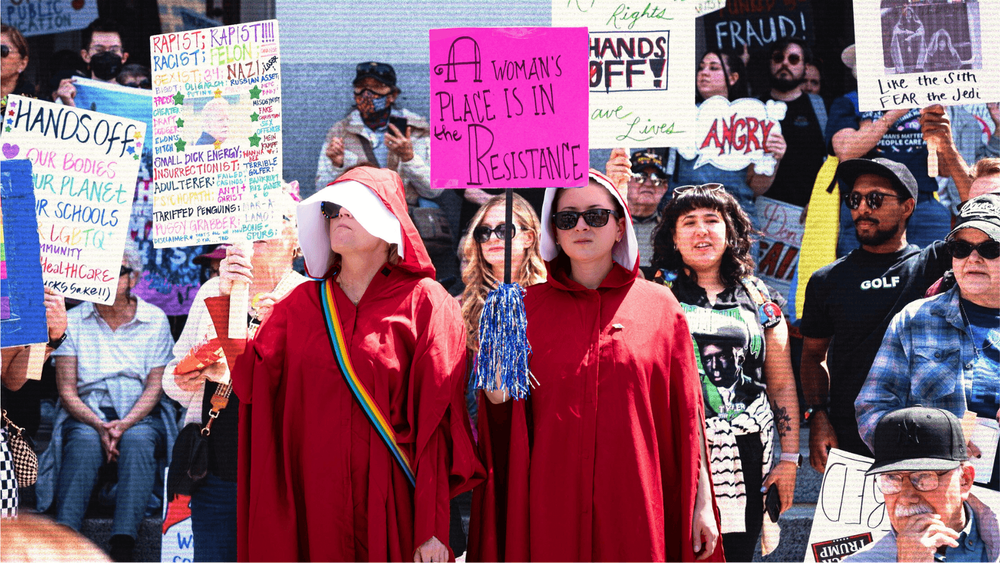
While Gilead is conjured up by Margaret’s imagination, it is a place which shares bald parallels with the modern-day world, just 40 years after The Handmaid’s Tale’s publication. The hanging doctors are arguably reminiscent of the clampdown we are currently witnessing on medical professionals who provide abortions in Trump’s America, as well as the lengthy and tragic history of violent attacks on services or doctors delivering abortions in the US and Canada. Life has changed immeasurably for Americans since the US Supreme Court toppled Roe v Wade – the landmark decision legalising abortion nationwide in 1973 – in June 2022. This change instantaneously ransacked millions of women of a human right many understandably saw as inalienable: the legal right to have an abortion, and has drawn inevitable comparisons to the dystopia Margaret imagined.
But the parallels don’t stop at the US border. While many assume the world is steadily becoming more democratic and rights-respecting, women’s rights are in fact under assault globally, emboldened by far-right movements and authoritarian leaders, with misogyny and male supremacy at the heart of their ideology. In my experience reporting on these issues – I became the first and only Women’s Correspondent at a UK news outlet in 2018 – I have witnessed the radical regression of hard-won progress. These losses aren’t just driven by the far right; they’re entwined with a turbulent global landscape of climate disasters, economic instability and ongoing wars and humanitarian crises.
“While many assume the world is becoming more democratic, women’s rights are in fact under assault globally, emboldened by far-right movements and authoritarian leaders, with misogyny and male supremacy at the heart of their ideology”
One stark example lies in forced displacement and the targeting of marginalised communities. In the fictional Republic of Gilead, Black Americans were torn from their homes and sent to the ‘Homelands’ – a grim echo of real-world rhetoric. Just last month, British MP Katie Lam, tipped as a potential future Conservative Party leader, called for legally settled families to be deported to keep the UK “culturally coherent”. Her remarks sparked widespread backlash, and party leader Kemi Badenoch later clarified that Lam had spoken “imprecisely” and that no retrospective immigration changes were planned. Still, Lam’s stance mirrored Nigel Farage’s proposal to scrap Indefinite Leave to Remain, which could put tens of thousands of long-settled residents at risk. Despite the walk-back, the episode exposes how quickly exclusionary ideas can surface in mainstream politics – and how thin the line remains between dystopian fiction and reality.
A Global Backlash
Meanwhile, Gilead’s systematic repression of women – banning them from working, reading, owning property, or engaging in sex outside marriage – finds its real-world mirror in the Taliban’s current rule in Afghanistan. Since their return to power in 2021, the hardline Islamist group has enforced what amounts to “gender apartheid”, barring women from workplaces, secondary and higher education, public spaces, and all sports, while restricting their ability to speak or show their faces in public. Both Gilead and these contemporary realities illustrate how authoritarian systems use ideology to strip autonomy from women and marginalised communities alike, demonstrating the enduring and global relevance of Margaret’s warnings about control, oppression and the weaponisation of power.
Heather Barr, associate women’s rights director at Human Rights Watch, has in-depth knowledge of the situation in Afghanistan from her time living there, and is also attuned to the broader global context. “There is absolutely no question – we are in the middle of a global backlash against women’s rights,” she says. “It’s hard to overstate how grim things are. In March this year, the UN found that there is a backlash against women’s rights happening in one quarter of countries. Women’s rights defenders’ ability to push back has also been severely compromised. The UN surveyed women’s rights organisations in March about the impact of aid cuts; 90 per cent said they had been impacted and almost half expected to shut their doors within six months. It’s a cataclysm.”
“Gilead’s systematic repression of women – banning them from working, reading, owning property, or engaging in sex outside marriage – finds its real-world mirror in the Taliban’s current rule in Afghanistan”
This global assault on women’s rights is playing out in countless forms. Only 87 countries have ever been led by a woman, and a woman or girl is killed by a partner or family as frequently as every 10 minutes, according to the UN. Meanwhile, UN Women also reports a 50% rise over the last decade in the number of women and girls living in conflict zones, with rights defenders routinely subjected to harassment, threats and even murder.
These threats are, of course, not abstract – they intersect with policy and power. In the US, the Trump administration cut government funding for international aid, a move that has already cost women and girls their lives. These reductions have coincided with a wave of aid cuts across Europe. “We are seeing rising authoritarianism in many parts of the world, and we know that misogyny is a favoured tool of authoritarians,” Heather says. “Attacking reproductive rights, rolling back protections for women and girls facing family violence, and cracking down on women’s rights defenders are all ways of silencing dissent. We know that women have been at the forefront of many struggles against authoritarianism, including successful ones, so it makes sense that authoritarians see women as a threat.”
Again, the consequences are clear in reproductive rights, which form a crucial front line in the battle for women’s autonomy. Around the world, progress is uneven – a patchwork of gains and setbacks that often depends on where a woman happens to live. In recent years, several nations have curtailed access to abortion. Poland and Nicaragua have imposed outright bans, while countries such as Turkey, Russia, Hungary, and the United States have introduced new restrictions that make access increasingly precarious.

Poland, home to some of the most restrictive abortion laws in Europe, offers a striking example of how entrenched such policies can become. In the lead-up to the 2023 election, Prime Minister Donald Tusk pledged that his Civic Coalition government would reform the country’s draconian abortion laws within 100 days of taking office. Yet, today, Poland’s near-total abortion ban remains firmly in place. The law allows terminations only in cases of rape, incest or risk to the pregnant person’s life or health – but in practice, even these exceptions are often denied. In recent years, several women have also died in Polish hospitals after being refused life-saving abortion care during pregnancy complications – a chilling reminder of how policy can translate directly into loss of life.
Fighting Back
But even amid widespread regression, pockets of hope – of resistance – find a way through. In December 2020, Argentina legalised abortion, followed by the decriminalisation of abortion in Mexico and Colombia – milestones that have reshaped the reproductive landscape in Latin America, a region long dominated by conservative social policy.
Just like in The Handmaid’s Tale, resistance emerges wherever oppression takes hold, and the abortion rights movement in the US has shown remarkable resilience. Aid Access – the leading mail-order abortion pill provider in the US – is indefatigably posting out abortion medication to those in states where terminations are now illegal, offering a lifeline of autonomy and care. Then there’s organisations such as SisterSong fighting to advance reproductive justice for marginalised communities, ensuring that women of colour, Indigenous women, and LGBTQIA+ individuals are not left behind. Representing Indigenous, African American, Asian and Pacific Islander, Arab and Middle Eastern, and Latina women, SisterSong’s work exemplifies how grassroots movements can challenge systemic inequality and build power from the ground up.
Beyond the US, Médecins Sans Frontières / Doctors Without Borders works across more than 70 countries to provide life-saving medical aid to people enduring humanitarian and healthcare crises. Its programmes prioritise women’s health, offering maternal and abortion care, psychological support for survivors of sexual violence, and treatment for cervical and breast cancer. The organisation recognises that when disaster strikes, as it does so readily and ruthlessly across the globe, women are disproportionately affected – and that access to healthcare is a human right, not a privilege.
Here in the UK, Crossroads Women’s Centre hosts a network of grassroots groups — including the English Collective of Prostitutes, All African Women’s Group, and Women Against Rape – all working on the frontlines to defend women’s safety, economic freedom, and dignity. Taken together, these movements demonstrate a global truth: while women’s rights are under siege, the collective fight for equality, justice, and bodily autonomy endures.
“While women’s rights are under siege, the collective fight for equality, justice, and bodily autonomy endures”
To return to the Republic of Gilead is to confront an uncomfortable truth: Margaret didn’t invent a nightmare – she reassembled the horror of human history. As she has said, nothing in The Handmaid’s Tale was imagined; it all has precedent. “The Handmaid’s Tale [is] unfolding in front of your very eyes,” she warned in 2016. “With any cultural change there is a push and a pushback. Trump has brought out a huge pushback that was originally against immigrants. Now it has shifted to being very misogynistic... you have not seen anything like this since the 17th century witch hunts, quite frankly.” Nearly a decade later, those words have only grown more haunting. Women’s rights are being stripped away in real time – but, as Margaret’s story reminds us, silence was never the ending. Resistance always writes the next chapter.
5 Women Leading The Fight For Reproductive Rights Globally
Catalina Martínez Coral
The lawyer, who is from Colombia, is a vice president at the Center for Reproductive Rights, with her work focused on Latin America and the Caribbean. She is one of the founders of the Causa Justa (“Just Cause”) movement, which sought to decriminalise pregnancy terminations in Colombia. “I work so that women can have reproductive autonomy which for me means that they can build their life projects with dignity, following their dreams without any interference,” she says.
Sonia Adesara
Sonia is a doctor based in London who is also a women’s health and reproductive justice campaigner. She is the spokesperson for Doctors for Choice UK and has spent years tirelessly campaigning for abortion rights in the UK – condemning protesters who harass women outside abortion clinics. “I believe all women should be able to get compassionate abortion care, without stigma or shame,” she says. “Women’s health for too long has been underfunded, under-researched and not taken seriously. From abortion to maternity care, stark, unacceptable inequalities exist, with too many women not getting the care they should. That’s why I campaign for reproductive justice – so that all women, including ethnic minorities and migrant women, get the care they deserve.”
Justyna Wydrzyńska
One of the founders of the Abortion Dream Team, Justyna is the first abortion rights activist to be charged for infringing Poland’s near-total abortion ban. Back in 2020, she helped a pregnant woman, who claims she was being subjected to domestic violence, access abortion pills. “I’ve been helping with abortions for almost 20 years because I’ve personally experienced the fear of an unwanted pregnancy,” she says. “I’ve also experienced the fear of whether and how I can safely stop a pregnancy. I don’t want anyone to experience the same isolation during their abortion like I felt.”
Rachael Mwikali
A passionate grassroots activist, Rachael advocates for sexual and reproductive health and rights, gender equality, and justice for women and girls in Kenya. She leads the Coalition for Grassroots Human Rights Defenders, a social movement dedicated to advancing these causes. “I fight for sexual and reproductive health and rights because our bodies are not battlegrounds for patriarchal politics, policy, law and treaties,” she says. “Our bodies – they are sites of power, dignity, and freedom.”
Rebecca Gomperts
The Dutch doctor, who is the founder of Women on Web and Aid Access, has dedicated her life to helping women safely terminate pregnancies in countries where abortions are illegal – she has evaded legal loopholes, even flying drones packed with abortion pills into locations. Rebecca advocates that abortion pills mifepristone, combined with misoprostol, should be available over the counter in any drug store. In 2023, she told The Guardian: “There shouldn’t be any gatekeepers here. There shouldn’t be a doctor, a pharmacy, nothing. These medicines have such a high safety profile. They’re so safe, they shouldn’t even be prescribed, they should be available over the counter. That is the goal. That is what we’re fighting for.”
There’s More – Delve Deeper Into The Handmaid’s Tale With The Service95 Book Club...
- WATCH Dua’s interview with Margaret
- BOOKMARK the novels that inspired Margaret Atwood’s vision
- LISTEN to The Handmaid’s Tale playlist, curated by Margaret
- DISCOVER what to read next from Margaret’s back catalogue
- READ Dua’s essay on what reading The Handmaid’s Tale taught her about the world
- MEET the costume designer who brought Gilead to life for the screen