When Chidera Sam-Eze began taking pictures with her phone in 2014, she had no idea that she would one day start or curate a photography festival in Enugu, a city in southeast Nigeria. At the time, it was simply a hobby – a way to fill the extra time she had while completing her undergraduate studies in biochemistry.
Her passion deepened after an internship at a local photography studio, where she learned the fundamentals. With a secondhand DSLR camera in hand, Chidera gravitated toward documentary photography and cinematography. By 2021, she was making frequent 10-hour road trips to Lagos to attend workshops, artist talks and portfolio reviews – all in pursuit of honing her craft. These experiences offered her hands-on training, professional mentorship and peer-to-peer collaborations, opportunities she says were largely absent in Enugu at the time.

“It was in Lagos that I started learning a lot about community,” Chidera recalls, reflecting on how warmly she was received in Lagos photography circles and how much easier it was to access resources there. Her desire to replicate a similar nurturing atmosphere for emerging creative talent in the Southeast sparked the creation of the Enugu Photo Festival, which evolved from cottage workshops and hangouts for a 40-member WhatsApp group created in 2023 into something way bigger, with more than 500 participants registered for the inaugural edition in November 2024. The festival has since received endorsements from the National Museum and ICOMOS-Nigeria and the second edition kicks off this week, with photography exhibitions, film screenings, workshops, live demonstrations of traditional crafts and a photo walk all on the schedule. Ghanaian filmmaker Eric Gyamfi has signed on to be a mentor this year, and the festival has attracted film submissions from locations spanning the Democratic Republic of Congo and the United Kingdom, showing that the festival is well on its way to being positioned on the global creative map.
Chidera’s decision to start the Enugu Photo Festival also came from her observation that the city often exports, rather than retains talent. Renowned author Chimamanda Ngozi Adichie grew up in Nsukka, a university town in Enugu State, and several of her novels are set there (including Half Of A Yellow Sun, one of Dua’s previous Monthly Reads for the Service95 Book Club – discover Dua and Chimamanda’s conversation on the novel here). Literary giants like Chinua Achebe, as well as Ghanaian sculptor El Anatsui, also taught in the area. “So many things grew in Enugu – but left Enugu,” says Chidera, citing legacy musicians such as afro-funk pioneer William Onyeabor and highlife icon Celestine Ukwu, alongside contemporary chart-toppers Flavour and Phyno, who all began their careers there.
“The festival evolved from cottage workshops and hangouts for a 40-member WhatsApp group into something way bigger, with more than 500 participants registered for the inaugural edition last year”
Enugu’s Ngwo Pine Forest is a popular filming location for Nollywood productions, and, together with neighbouring Anambra State, it’s home to the Ijele Masquerade, a UNESCO-recognised intangible cultural heritage. Chidera hopes Enugu can leverage its rich cultural landscape to become a creative incubator for the Southeast. “I think the muses are here in Enugu, and if we get it right, Enugu could be more than it is today.”
It’s a sentiment echoed by Korede Azeez, a filmmaker who grew up in Enugu with interests in photography and cinema but couldn’t realise them until she left for Abuja in 2016. If the festival had existed back then, she believes her career would have started earlier or, at the very least, it would have given her space to experiment and sharpen her technical skills. “I think it’s great that young people in Enugu now have these kinds of opportunities,” she says. “Everything is in Lagos, but there are lots of creative people in Enugu – and we need to feed that. There’s no reason why Enugu cannot be a hub for creative minds.”
Chidera’s resolve to decentralise Nigeria’s art scene away from the country’s traditional creative hubs of Lagos and Abuja is not unique to her. It is a mission she shares with organisations like the Hausa International Book and Arts Festival, which operates out of Kaduna, and the Makurdi-based Benue Book and Arts Festival. Together with the Enugu Photo Festival, they form part of a growing number of artist-led interventions across Nigeria that have responded proactively to the cultural vacuum created by limited state funding for the arts.
All three organisations received a €5,000 grant from the Goethe-Institut last year, which Chidera spent on artist fees, volunteer stipends, logistics, venue rentals, exhibition prints and installations. This year, due to an expanded programme and inflation, the Enugu Photo Festival’s budget has risen to an estimated €12,000 and, in the absence of grants (the Goethe-Institut Support and Connect grant is unavailable this year), Chidera is relying on personal savings and crowdfunding to fund the project, canvassing for donations from friends, family and individual and corporate sponsors.
“Everything is in Lagos, but there are lots of creative people in Enugu – and we need to feed that. There’s no reason why Enugu cannot be a hub for creative minds”
Despite the challenges of bootstrapping and learning arts administration on the job, she is adamant about not waiting around for the government to act or complaining about the oversight. “I decided to stop talking about it and do something about it. If you start, other people who are interested will join you, or become inspired to do their own things their own way, and I’m hoping to inspire others.”
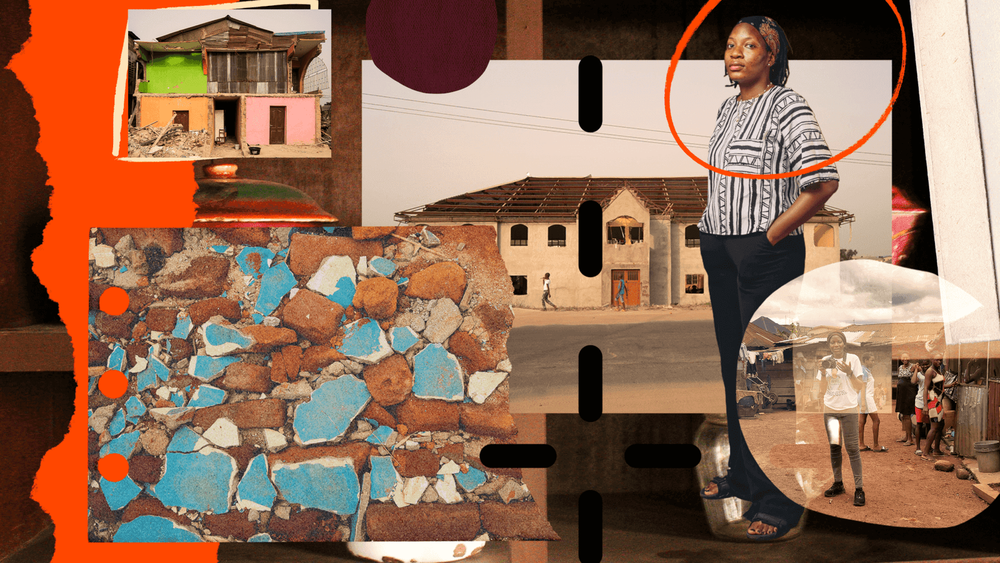
One of the things she is hoping to inspire in fellow visual storytellers is an interest in material history and cultural memory. The theme for last year’s festival was ‘Shades of Coal’, which paid homage to the city’s coal mining history and honoured the victims of the 1949 Enugu Colliery Massacre. This year’s theme, ‘From Ruins to Remembrance’, was born from the pervasive feeling of nostalgia in the city, and a call for submissions was issued earlier in the year.

For Ogochukwu Umeadi, whose short film No Let Dem Die (2024) is screening at the festival, the theme reminded him of the Biafran War. “The East has been through things,” he says. “Not always physical rubble but culturally and creatively, there’s been neglect. There’s been forgetting. And once people forget who they are, it becomes easy for the world to forget them too. But remembrance is how we rebuild.” His film is an ode to preserving cultural traditions, and he hopes it will encourage viewers to “remember our roots, our identity, our pride”. Nana-Ama Chioma Bosompem, a content creator with dual Ghanaian and Nigerian heritage, says the festival’s theme has emboldened her to document some of the vanishing communal rituals in Afikpo, her maternal hometown. She has also signed up for workshops to help her do so.
“The festival has attracted film submissions from locations spanning the Democratic Republic of Congo and the United Kingdom, showing that Enugu is well on its way to being positioned on the global creative map”
Other participating artists have interpreted the theme as an opportunity to document historical architecture, nudging Chidera to rent the colonial-era Public Works Department building for the photography exhibition. Lined up on the walls are photographs of Hausa architecture from Northern Nigeria, relics of an old cinema in Benue State, and rural dwellings in Yorubaland. “I’m very happy that we got submissions from outside the region,” she says, pointing out that the festival’s regional focus does not preclude cross-cultural interactions with creatives from other parts of the country and elsewhere.

Though, as to be expected, there are many works from artists based closer home – such as local photographer Ayogu Wilfred, whose series captures Zik’s Flats, derelict student housing originally gifted to the University of Nigeria in the 1980s by Nnamdi Azikiwe, the country’s first president. While for second-time exhibitor Sophia Ahuoyiza Abubakar, who moved to Enugu in 2012, participating in the Enugu Photo Festival presents an opportunity to learn more about Igbo culture and has given her a strong sense of belonging. She adds a note of appreciation for the impact the festival, and the resulting community, has had on her growth as a photographer: “Prior to when Chidera started, no one was doing this. She came along and gave us perspective and direction.”

Sophia joins a growing number of the festival’s participants who have gone on to pursue professional careers in Nigeria’s filmmaking industry, acting in the short film The Gift (2025) and taking on screenwriting and production gigs.
This kind of feedback is proof to Chidera that her investment in empowering regional talent is on track and the positive engagement affirms her belief in the power of visual storytelling. She is hopeful about the future but emphasises that there is more work to be done. “We haven’t scratched the surface of our stories,” she says. “Within the next five to 10 years, I hope to see growth and progress: more visual artists from the Southeast telling stories rooted in our identity and connecting with the world. I hope that the festival attracts the global creative community to interact with us, not only online, but to visit and experience Enugu.”
What Chidera is doing with the Enugu Photo Festival shows that creativity doesn’t have to follow the old rules. By building a space for artists to experiment, connect and tell their own stories, she’s helping Southeast Nigeria stake its claim on the creative map. It’s a reminder that culture isn’t just about history – it’s about the people shaping it right now, and that with energy, ideas, and community, even places outside the usual hubs can become the next big creative playground.