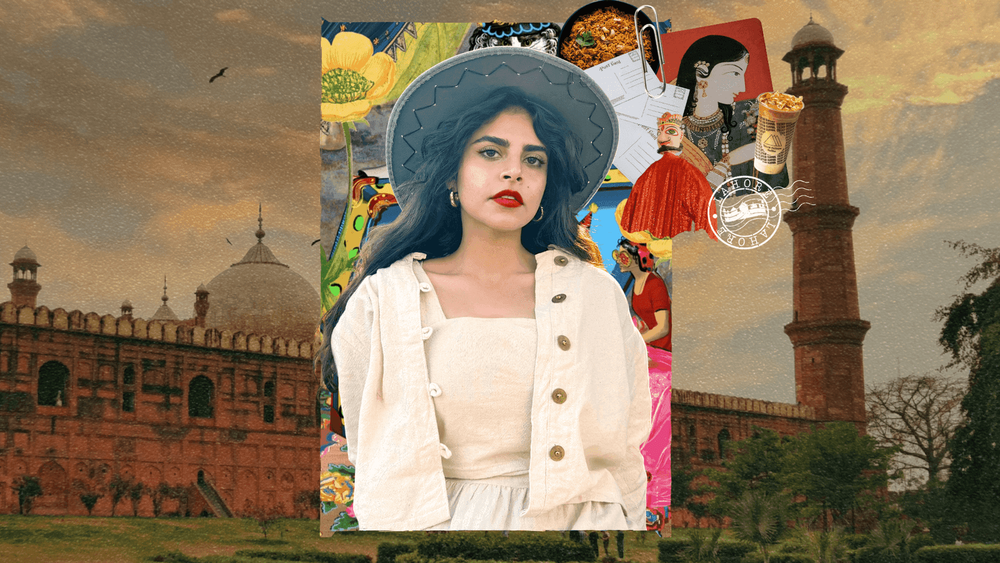
There’s a particular kind of energy to Pakistan’s cultural capital, Lahore – one that lingers through the narrow alleys of the Walled City, in the clatter of rickshaws swerving past and in the scent of doodh patti wafting from dhabas into restored havelis-turned-galleries and rooftop cafés. It’s a city layered with contradictions: ancient and modern, rigid and rebellious, sacred and chaotic. For visual artist Eemaan Beygum Bano, Lahore is more than home – it’s the heartbeat of her work.
“I had a really fun childhood,” she says, “but one that was still feathering from a post-colonial hangover.” Educated in a British-style grammar school where uniforms, vocabulary and classroom etiquette echoed colonial systems, Eemaan was surrounded by a curriculum that felt distinctly Western. At home and in wider society, the expectations were different – shaped by religion, tradition, and a cultural framework that dictated everything from “how [a girl] should dress, to what age you should marry,” she says.

There was, she explains, a clear duality as she got older: the tension between what it meant to be a South Asian, Muslim, Pakistani girl, and the content she was exposed to through global media. “Traditional values coming from religion were dictating everything... while western pop culture was sneaking in through MTV and Nickelodeon, which we’d watch in secret,” she laughs.
It’s this friction, between what she was told to be and what she was quietly drawn to, that seeded her earliest creative instincts. In her bedroom as a young girl, Eemaan began crafting collages from magazines and newspapers, layering political headlines with images of fashion and pop culture. “It was my way of making everything make sense,” she says. “That’s really where my journey with art began. It was a way of expressing and understanding the world around me.”

That instinct – to take the chaos and contradiction and shape it into something coherent and meaningful – would become central to her identity as an artist. Today, her work is deeply personal, reflecting the psychological and societal push-and-pull she experienced across the streets and structures of Lahore. “The city is rich in creative inspiration for me, as it created a sense of identity crisis,” she explains. “It’s what leads to great art: in oppression, or in that sense of ‘where am I supposed to be’ versus ‘where am I now’, through the lens of how my parents see me, how God sees me, how culture or society sees me. So, it makes for really interesting work.” Eemaan’s art doesn’t aim to resolve that crisis. Instead, she leans into it, documenting and dissecting the complexities of her surroundings, and giving visual form to the constant negotiation of identity in a post-colonial, globalised, yet still deeply traditional world.
Today, Lahore is a city in motion, evolving rapidly and pushing against the grain of its surrounding regions. Eemaan describes a new wave of energy moving through its streets: coffee shops overflowing with young people, where once coffee was a ritual reserved for the older generation. “There’s a coffee shop I go to a lot called Third Culture – and ironically, it really is that,” she says. “They’ve opened nearly 10 branches in the last three years, and they’re always packed. You can’t imagine lines outside coffee shops, but those exist now. There’s a real sense of community.”
She also finds inspiration in the city’s growing hospitality and creative spaces, such as new boutique hotels opening, which offer her not only a place to work, but a renewed creative charge. As the winter season approaches, that energy reaches a peak. “We have a term for it: ‘Decemberistan’,” she explains. “It’s wedding season, and it’s when Pakistan is at its loudest, most festive. Everyone is trying to ‘one-up’ each other and their outfits. This is the time that I’m usually most creative – when I’m around that energy.”

Ultimately, there’s a pull to Lahore that Eemaan can’t quite shake. It’s her home, the city that has shaped her identity and anchored her creativity since childhood. She has entertained the idea of leaving, but there’s something about its energy, beauty and history that keeps her rooted. And exactly this sense of place that finds its way into her art again and again. Below, Eemaan shares some of the spaces across the city that she loves the most: the places she finds community in and draws creative fuel from...
OUR SOCIAL SCENE IS AT... Lahore Polo Club – especially during the winter. Polo tournaments are popular here, and you get beautiful views by the lawn, along with fine dining options while watching the tournament.
IF I WANT A FUN ACTIVITY... I head to Liberty Bazaar for its hustle and bustle. It’s where you’ll find the local textile and handicraft scene – from handmade wedding dresses and hand-sewn and embroidered traditional shoes (Khussas, Peshawari chappals), to silversmith and gold shops. It’s a showcase of the best taste in quintessential Pakistani fashion.

I GET MY COFFEE FIX AT... Third Culture coffee shops. They brought coffee culture to the city, along with a sense of community. We’re traditionally tea drinkers (Chai/Doodh Patti) but now, with independent coffee shops, there’s a change in how people interact with spaces and the nature of ‘working from home’.

FOR UNAPOLOGETIC CREATIVITY, YOU’LL FIND ME AT... The Colony [a multidisciplinary art house and creative hub dedicated to fostering artistic expression and freedom]. In public spaces, artistic expression is limited, especially for women or anything seen as ‘too bold.’ The Colony is one of the very few arthouses that gives an intimate refuge for unapologetic creativity and independent dance shows, films and theatre performances.
ANOTHER FAMOUS CULTURAL HUB IS... Rafi Peer Theatre, which holds space for performing arts. It’s best known for the Rafi Peer International Puppet Festival, a really cool event that preserves the timeless art of folk puppetry – and a big school-trip favourite of mine growing up.
WHEN I WANT TO STEP INTO THE PAST... ‘Old Lahore’ or the ‘Walled City’ has lots of traditional food and antique shops, tombs, mosques and monuments. I also love the street life scene at Delhi Gate, where spice merchants, fabric dyers, copperware sellers, hakeems, calligraphers, and food vendors line the narrow lanes. It’s very reminiscent of the bygone Mughal era.

MOST OF THE CITY’S HISTORY CAN BE FOUND... Embedded in the architectural details, the geometric patterns and the mosaic and tile works of the Mosques. There’s the Wazir Khan Mosque and the Badshahi Mosque is hard to miss, with its massive red sandstone structure. For something a bit quieter, the Begum Shahi Mosque is a hidden spot with a lot of history, built by Emperor Jahangir’s mother.

MY FAVOURITE LAHORE STORE IS... Iqbal Begum: a small quaint concept store full of handcrafted trinkets and souvenirs, curated by Pakistan’s renowned art director Hashim Ali to capture the stories of the old city through thoughtfully designed objects.

MY GO-TO LOCAL FOOD SPORTS ARE... Any of the restaurants overlooking the Mosques. Favourites include Cuckoo’s Den, which used to be an artist’s home and has a real old-school vibe – the walls are full of paintings and antiques. Then, Baithak Sadequain is an ode to the artist Sadequain. Rather than being a typical gallery or café, it also functions as a third space for intellectual and artistic dialogue, hosting exhibitions and events that focus on the intersection of art, history and culture. Haveli Restaurant is another beautiful example of traditional Lahori architecture, featuring wooden balconies, jharokas (ornate windows), hand-carved doors, wrought iron railings and sun-dried brick. Finally, Amu’s Lahore is a great brunch spot, with its chef-curated, farm-to-table concept. Set in a mid-century modern Lahore house, it offers a warm, home-style dining experience.
FOR SOMEWHERE TO STAY... Fred Hotel is the place to be. It’s a luxury boutique hotel in the heart of the city (Gulberg). It has some really well-curated restaurants and a sushi bar. It’s modern but also integrates very typical Lahori architecture and nostalgic artefacts.
For the latest travel guidance on Pakistan, please refer to your government’s official travel advice.