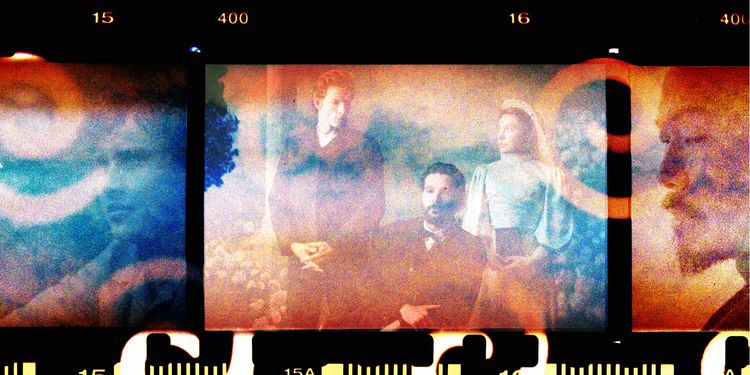
John Steinbeck’s 1952 novel East Of Eden asks a lot of questions. The just-released Netflix adaptation drives them home, leaving us to reflect on family dynamics and if who we are is rooted in where we come from. In this series of essays, we’re exploring the answers – and what we can learn from the lives played out onscreen. Note: this article contains spoilers.
Epigenetics isn’t a term that’s been officially associated with John Steinbeck. But perhaps it should. There’s no evidence to say he encountered it in his lifetime – it wasn’t coined until 1942 by embryologist Conrad Waddington – and stayed confined to a fairly narrow corner of biology until the 2000s. But his imagination seemed directed towards the idea that what happens to a person can directly affect who they become. It’s something he explores in depth throughout his novel East of Eden, which directly questions ideas of inheritance through one specific term: timshel. The final episode of Zoe Kazan’s new Netflix adaptation takes the same word as its title.
But what does it mean? That’s something East Of Eden’s character Lee, described as the Chinese-American servant of the Trask family, spends two years researching. He settles on a translation that is neither “thou shalt” (an order) nor “thou shalt not” (which also removes choice), but “thou mayest” – conveying that humanity can choose between good and evil.
Hebrew scholars have since argued John Steinbeck takes liberties here: the word appears in Genesis 4:7 and its more precise sense may be closer to “thou mayest rule over”. Still, “thou mayest” is the spine Steinbeck built his novel on and the root of the questions the Netflix series circles: are we doomed to inherit the traits and sins of our ancestors?
Adam Trask spends most of East Of Eden trying to build a paradise in California’s Salinas Valley, and failing. He marries Cathy Ames, who tries to abort their unborn child with a needle and, upon giving birth to twins, shoots her husband so she can flee, leaving Adam to raise the boys alone. Their sons could not be more different. Reliable Aron falls in love and considers priesthood, while dark, doubted Cal earns the family fortune back and still cannot win his father’s respect – and remains convinced this is because he has inherited his mother’s cruelty.
Can you genetically take on a personality trait? Epigenetics is the real-life study exploring this very question: how genes can be switched on or off, turned up or reduced, based on a person’s life experiences – whether that is stress, diet, trauma, the type of love we receive, etc – without the underlying DNA sequence itself changing.

“You can think of genetics like a recipe book,” says Rachel Barr, a neuroscientist and author of How To Make Your Brain Your Best Friend. “Each recipe – or gene – is used to cook up proteins, which become the building blocks of our physical and physiological forms. The recipes themselves don’t appear to change throughout life... What changes is how often that recipe is cooked up.”
A gene’s wrapper can be tied more tightly or loosened, she explains; a gene can be stamped with what she calls “a DO NOT COOK recipe blocker” that relegates it, and its protein, to near extinction. “These epigenetic alterations are governed by life – our environment, experiences, and our habits,” Rachel says. “And we can hand them down to our offspring, even our grandchildren, just as we do our basic genetic code.” One of the best-studied triggers, she notes, is early life stress, which renders a person more vulnerable to the same emotion well into adulthood. This is not hard to imagine, when you think of Cathy Ames’s cruelty and how that might have impacted Charles Trask’s violence toward his half-brother Adam.
But Rachel is resistant to the horror-story version of this science. “I like to remind people that epigenetics are, in fact, also a bit of an escape hatch from genetic determinism,” she says. She has evidence of her own: “We don't build muscle particularly easily in my family, but across years of weight training, I did eventually manage. Now, when I go back to the gym after a long hiatus, the body remembers – having been trained into epigenetic modifications that make muscle-building more like muscle memory than a genetic mountain.”
Cal’s temper, Aron’s naivety, or the seemingly habitual Trask habit of choosing a favourite son are lifelong patterns, and Rachel suggests those are things we might be able to change. “It’s somewhat philosophical, hinged on what we believe about free will.” Public-facing neuroscientists like Sam Harris and Robert Sapolsky argue against free will altogether, citing a deterministic universe and prior conditions like genetics, resources and environment that ultimately govern behaviour before we ever weigh in.
“We are, to some extent, born with a personality that follows us throughout life,” Rachel concedes. “The projects of change do appear to have some kind of ceiling, but it needn't be limiting, at least not in the sense of chaining us to the worst of ourselves.” And her examples come from a place most wouldn’t think to look for signs of hope – her socials: “My feed is full of people telling their stories of sobriety, celebrating their willful escape from an addiction they'd once believed to be a life sentence. Children raised in abusive homes will often make meaningful recovery, with the right care. I figure if the people whose odds are most stacked against change can pull it off, we surely all can.”
What does that change actually look like? Rachel is wary of the tidy version. “Positive change is often camouflaged,” she says, “both for arriving in never quite the same form, and for being most visible in hindsight.” She suggests we rarely notice the moment we don't repeat an old pattern. “It's only later, upon reflection, that we realise, ‘Oh, I didn't do that thing I normally do.’”
Rachel is also suspicious of the metrics we use to track our own growth. “Tracking takes us out of the activity we intend to habituate,” she says. It’s hard not to think of Cal, who brings a financial offering to his father made from wartime-bean harvest. Hoping the number is grand enough it might, in essence, ‘purchase’ Adam's love and correct Cal’s wretchedness, it is a metric of success Adam Trask ultimately rejects. “The greatest tools in your armoury for change are joy and engagement,” Rachel says. “You are not the machine our culture of self-optimisation demands. You are, rather, human.”
No matter what takes place in East Of Eden, Cal Trask never seems to fully believe he is free of his mother. Whether timshel is scientifically precise or just darkly beautiful shorthand about hurt and hope, it lands on the same idea as Rachel’s research: something arrives from the people who came before us. What we do with it, still, may be up to us to decide.
East Of Eden is now available to watch on Netflix.