My novel, Love Forms, opens in the Caribbean. Sixteen-year-old Dawn is forced to cross the sea, from Trinidad to Venezuela, where she gives birth in secret and gives her baby daughter up for adoption. Dawn thinks she’ll be able to carry on as if nothing had happened, but when we pick up with her story years later – when Dawn is middle-aged and living in London – it turns out that she’s never forgotten that child. It’s a story about motherhood, and the enduring bonds of love, family, and home.
Like Dawn, I was born and grew up in Trinidad, but have lived in London for most of my adult life. I drew on that experience while I was writing, but Love Forms isn’t autobiographical. I’ve never been to Venezuela. I didn’t give a baby up for adoption. That part of the book came from my imagination.
I’m often asked what kind of research I did for the novel. The answer is that I did spend some time researching the bureaucratic side of things – what sort of paperwork Dawn might search for, what she’d be able to access, and how. But my instinct told me that what was most important, really, was to understand Dawn’s emotional journey over the course of those decades – to try to tune into her feelings, rather than just assemble all the facts. It began with fiction, but before I realised, the lines had blurred – I was no longer just researching Dawn’s story, I was uncovering something of my own.
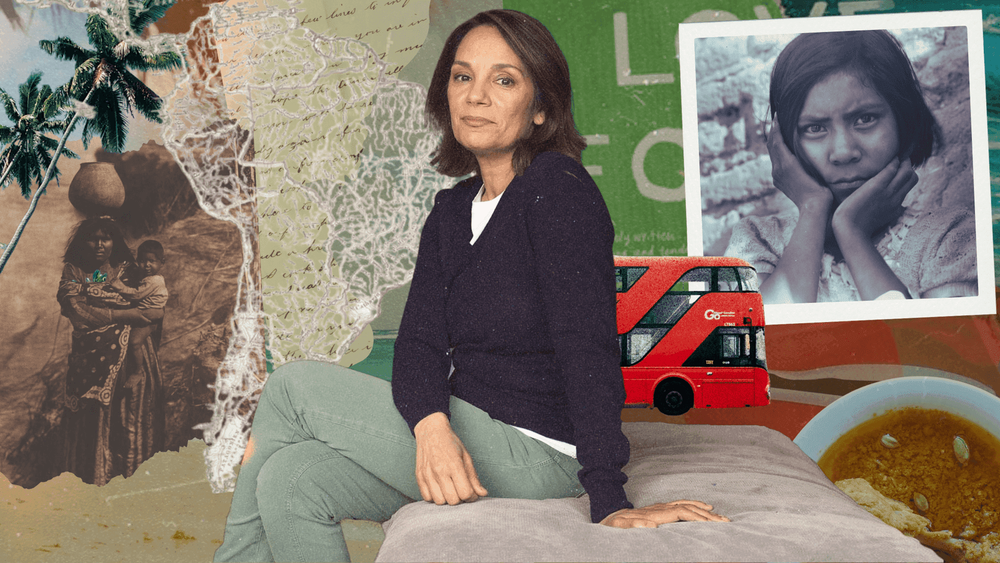
I found maps of South America and the Caribbean, and I spent hours poring over them, as I imagined Dawn might do, tracing paths along different routes. I looked up the address of the Venezuelan Embassy in London, and loitered outside its front door nervously, watching people who went in and out. And I spent a lot of time online, just as Dawn does in Love Forms – usually late at night, while my husband and children were asleep. I searched endlessly on Google, with all the same combinations of words – girl, November 1980, Venezuela, adoption, nuns – that Dawn tries. I trawled the internet for photos and downloaded hundreds of them to my laptop. Mostly, those images were of people – girls or women who looked like Dawn imagined her daughter to look. I zoomed in on those photos and studied them in minute detail, just as Dawn does in the book, searching for a resemblance to herself. Hours slid by in this way; days; weeks.
I searched all around the world, but mostly in Venezuela, Colombia and Brazil. I looked at big cities, little towns, coastal villages. I was surprised to learn that there were so many indigenous communities living in rural Venezuela. Out of curiosity, more than anything else, I clicked through some of the photos. A clearing in a tropical forest. A cluster of thatched huts, makeshift hammocks, red packed earth on the ground. Men and boys paddling canoes. Women cross-legged by the fire. And then I saw something I didn’t expect. A smiling girl of around seven or eight. Brown skin, dark, straight hair. It was like seeing a younger version of myself smiling at me through the screen.
The Missing Pieces
My mother’s family can be traced back a few generations in Ireland, so that side of the family tree is easy. But on my father’s side, I know very little. It’s mostly in shadow.
I never met my father’s parents. All I know about my grandfather is that a utility bill addressed to him – Sam Adam – used to arrive at our house every month. It was puzzling – he had never lived at our house, and it was unclear what the bill related to. I must have asked who this “Sam” was, and been told that it was my grandfather, by then deceased. No further information was provided, and I had the vague sense that I shouldn’t ask. As for my father’s mother, my grandmother, all I know is that she died when my father was very young. I’ve never seen a picture of her. In fact, I don’t even know her name.
In my child’s mind, I came to the conclusion that the reason my grandparents weren’t remembered was because they weren’t worth remembering. Whatever the unconscious logic of it was, the result was that a vague sense of shame seeped into the gaps in my knowledge.
I did have one uncle in Trinidad, my father’s brother, so that was something: we had “family”. Every other weekend, we went to my uncle and aunt’s house, where we played with our cousins and enjoyed delicious East Indian food: curry and roti. No-one in my father’s family seemed particularly religious, so the distinction between Hindu and Muslim never really arose. We gladly accepted invitations to both Divali and Eid (where plentiful food was served). The realisation that at some houses people didn’t eat pork, and at others they didn’t eat beef, only occurred to me much later.
*
I have dark hair and eyes, and brown skin that tans in the summer and fades in the winter. I could pass for Italian or Spanish, maybe, but it’s South Americans who have most often studied me when we passed in the street, seeing in my features, perhaps a resemblance to their own. (My siblings, by the way, have had similar experiences.) I can’t recall the number of times I’ve been approached with a friendly, “Hablas Español?” They’re always incredulous when I shake my head sorrowfully, and answer in English. “Trinidad,” I say. “Yes, it’s the Caribbean.” I point at my brown skin, and say, “But I’m Indian. Well – mother, white. Father, Indian.”
And then when I see the next question forming in their minds, I clarify: “As in, from India, the country.” I often have to explain these facts of Caribbean history next. After the abolition of slavery, I say, the landowners still needed people to work on the plantations, and indentured labourers were brought from India. (If I sound like I’m reciting an old history lesson, it’s because that’s pretty much exactly what I’m doing. It’s what we were taught in school – it’s all we know.) Before they turn to leave, the South American person – usually Colombian, Venezuelan – studies me one more time, in puzzlement, or maybe suspicion. This is what I’ve lived with all my life: this sense of a doubt hanging over me over who I really am; where I’ve come from. I’ve always assumed that the question will remain forever unanswered.
Unexpected Roots
Into this shadowland of my ancestry, the picture that I saw onscreen that night in London as I was trawling through photos doing “research” for Love Forms, was like a sudden flash of lightning illuminating the darkness. What it illuminated was a possibility, an idea: that a portion of my father’s ancestry, and my ancestry, might be Indigenous. It would explain why people from certain parts of South America seemed to be drawn to me and my siblings; why we’d all so often had strangers come up to us in the street.
Before this moment, it had never crossed my mind that Indigenous ancestry could even be possible. At school in Trinidad, we were taught that they – our textbooks used the word “Amerindians” – had died out long ago, killed by disease brought by the Europeans. But clearly, I realised now, they hadn’t died out altogether. Because, look, here they were, still living, thriving, in their own communities in Venezuela, Guyana, Colombia, Brazil; and here was this little girl smiling at the camera, like a younger version of myself smiling at me through the screen.
So in this way, I found myself sharing an experience that several characters in the book also have. The shock of new information arriving unbidden; the swirling of possibilities, questions, confusion. The initial feeling of loyalty to my previous version of myself; the feeling of betrayal in considering something new. The anxiety around drawing anyone else into it; the desire to respect other people’s boundaries.
But what I’ve learnt through writing Love Forms is that fragments of information come unannounced. One day, out of the blue, someone calls you into a room for a quiet conversation, or you get a phone call, or an email lands in your inbox. The next thing you know, you’re falling through space, unmade.
I haven’t yet taken any concrete steps to research my own ancestry: this idea about a possible Indigenous connection remains just that – an idea. I’m still dealing with the emotional shock of it, and working through the confusion about why the ‘truth’ should matter to me at all.
But, here, too, in the process of writing the novel, the lines between fiction and reality blur. In the same way that I mull over the impossibility of finding out the truth about my own family, so does Dawn; as I argue with myself about how little it really matters to my day-to-day life anyway, so does she. And towards the end of the book, both she and I reach the same conclusion: that, yes, it’s strange that the past should matter so much to us, and yet it does matter. As Dawn finally realises in Love Forms, all we really are to ourselves is a story.
Claire Adam is the author of Love Forms (Hogarth)