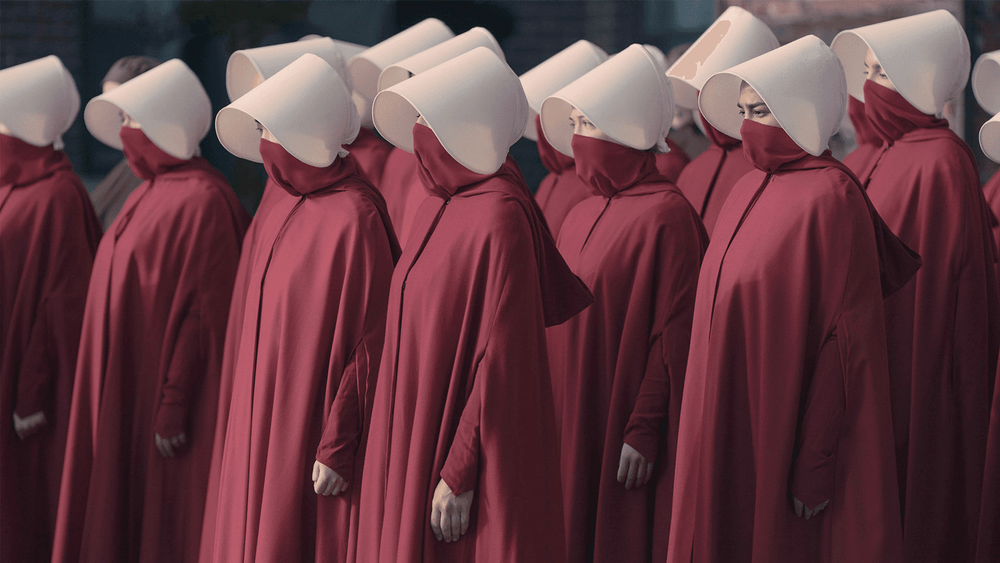
Red cloak. Red dress. Swathes of thick, heavy fabric covering every inch of skin from the neck down, sweeping the floor. A crisp white bonnet, extended to hide the face from view, with no way of looking left or right. “Prison uniforms,” as costume designer Ane Crabtree calls them. But the prison she’s referring to isn’t a physical cell; rather the invisible walls keeping women confined to subservient roles in the dystopian state of Gilead, the setting of Margaret Atwood’s novel, The Handmaid’s Tale (Dua’s Monthly Read for November). It’s a world Ane was tasked with bringing to life through costume for the 2017 series adaptation – one which showed us all Margaret’s seminal tale in a stark, and dangerously familiar, new light.
But how do you conceive a costume for screen that’s already been depicted countless times before? In the 40 years since the book was published, these blood-red ensembles and blinker-like headwear have become more than just costumes: they’re a universally recognised symbol of women’s oppression, rooted in a novel designed as fiction and later realised as prophecy. “When I look back on The Handmaid’s Tale, I realised that what I try to do is have a nonverbal emotional connection with the audience,” says Ane. She speaks softly, thoughtfully – each word and phrase as considered as her designs. “I want everything, every frame to be a work of art, whether it’s beautiful or ugly. And I want you to feel that in a visceral way.”

Clearly, this feeling resonated: take a look at any women’s rights protest since the TV show premiered in 2017 and you’ll see people in iterations of Ane’s Handmaids costume outside state buildings, holding placards, marching in crowds. And the core reason why it has connected with fans of the book and TV show alike? Because it’s rooted firmly in the text.
“I was a huge fan of the book. That’s why I did it in the first place,” she smiles, squinting from the sun that’s beaming in through the windows of her local library in Kentucky, where she’s calling from. After a lifetime of living in the world’s fashion and media capitals, from London and LA to New York, she’s moved back to the town she grew up in to be closer to family – a full-circle moment that is shaping Ane and her work in unexpected ways.
It Starts With The Script
To prepare for filming, Ane took the story with her on a trip deep into nature, a space where she constantly finds inspiration – “A byproduct from growing up in Kentucky”, she says. Ane soundtracked a seven-hour road trip from Toronto (the series was shot in Canada) to Manitoulin Island with the audio version of the book. “I drove there because it’s a really sacred, Indigenous place,” she says, explaining how the journey and the destination gave her the time and clarity to see the story in a new way. “I wanted to hear the book [during the drive],” she adds. “The problem with me and that book is I get so enamoured in reading it; in the words and Margaret’s style of writing, that it’s very difficult for me to focus on a script.”

In those early days, Ane mentions that she “peeked” at past productions of The Handmaid’s Tale for inspiration, “but none of it was something I wanted to do. Even though I loved the film, it was so strictly ’90s: it was like bright red, bright blue. That didn’t feel right for the time.” Instead, Ane was determined to shift perceptions of Gilead away from the past, and into something more timeless – a world that could be – might be – now.
“In the 40 years since the book was published, these blood-red ensembles and blinker-like headwear have become more than just costumes: they’re a universally recognised symbol of women’s oppression, rooted in a novel designed as fiction and later realised as prophecy”
Her initial concept was “a whole different Handmaid’s Tale”. During her interview, she was so inspired, she told show creator Bruce Miller and executive producer Warren Littlefield “something crazy. I said, ‘Look, in our dystopian times, the landfill of clothing is bursting at the seams. So the only thing that is going to be left are very bright, stretchy polyester things – no natural fibres will be left and they’ll be contaminated and dirty. So it’s going to be kind of like Blade Runner, but instead of being future-inspired, it’ll be 1970s to now, all polyester, bright colours, very, very dirty. And they both just looked at me like this,” she says, opening her eyes wide to mimic their shocked faces, before bursting into laughter.
Instead of backing down, Ane regrouped and “went into [details about] the different social groups and colours. That is something very, very, very important to people who are in love with the book. This is what our brain accepts as the view,” she explains. And suddenly, everyone was on board.
Bringing The Vision Into The Now
While the finished costumes weren’t quite as futuristic as that initial vision, the sentiment of making Gilead feel less dated remained. Because while Ane’s initial vision may have seemed extreme, it was rooted in reality: The Handmaid’s Tale remains so culturally relevant because its themes are a frightening parallel to events taking place today. Even when it came to submitting the series for awards season, Ane shares that it was put forward for the ‘period’ category. “That was the biggest argument I had. I said, ‘You have to say this is a current story. It is. Look at where we are today.’ It’s never in the past.”
It’s this amalgamation of perspectives that makes Ane’s approach so powerful, drawing inspiration from the original text, previous adaptations, reader perceptions, her own experiences and, of course, Margaret herself. “That woman,” she says, smiling again. “Margaret does so much and she’s so open-minded. She’s so modern and rooted and down to earth. She’s a huge supporter of women,” Ane adds, sharing how the author wasn’t prescriptive about the looks for the show, instead giving Ane freedom to conceive the costumes her way. “Even though I would write to her and say, ‘Hey, what do you think?’ She was like, ‘You know what you’re doing.’”
After the show’s 2017 premiere, designers drew inspiration from Ane’s work – Vaquera even created a capsule collection directly inspired by the show, and this year, Christian Siriano reimagined the Handmaid’s cloak in a bid to ‘reclaim the red’. “Margaret would see all the fashion designers who were using the costumes as a template,” says Ane. “And she would be like, ‘See, you can’t contain this design. You can’t contain the costumes. They are modern.’”

A New Era Of Handmaids
With the text fully absorbed and free reign granted from Margaret herself, the natural next step for Ane was to determine the colour of the Handmaids’ costume: “We needed to find a red that was going to work on all the different skin tones,” Ane explains. “Because it was 2016, instead of 1985, People of Colour were being casted as Handmaids in the show. I realised that all of the colours have to come from nature for it to work on every skin tone, because nature’s colours are pretty much perfect.” As for the shade: “We chose this red because it looked most like blood – everybody’s blood is the same colour. And it was a darker, more serious red. But the creating of it all came from so many different things.”
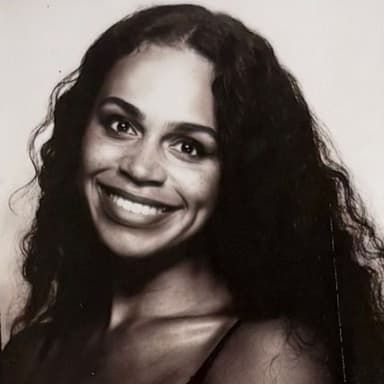
That instinct to draw from everywhere – memory, experience, emotion – defines Ane’s work. A true artist, she channels every part of her life into her designs: her education in Kentucky and the north of England; growing up as one of the only mixed-race people in those communities (her father is from the US, her mother from Okinawa, Japan). She pulls references from her time at design school in New York, where she shared a loft painted by Kenny Scharf and moved in circles that included legendary costume designer Patricia Field. Before costume design, there was a career styling for ELLE US and ’90s music videos, not to mention early gigs on “mafioso movies” – and even the beginnings of The Sopranos.
But to design the show’s costumes, Ane chose to step inside the minds of Gilead’s creators – a creative decision that came with its own mental toll. “I tried to think about the psychology of men in charge of building Gilead and what it meant to them, not just clothing-wise, but the psychological shit that would go down in their hopes of controlling women,” she explains. “I did things like put little tabs over the zippers [on the Handmaid’s dresses] so that the men’s minds wouldn’t be titillated to unzip them.”
“I tried to think about the psychology of men in charge of building Gilead and what it meant to them, not just clothing-wise, but the psychological shit that would go down in their hopes of controlling women”
Ane Crabtree
The intensity of that work was only amplified by the time in which the show was conceived. “Because 2017 was the first moment that person got in office. And I remember fitting Yvonne Strahovski [who played Serena Joy] and just crying, both of us hugging each other because we felt like we were living a parallel universe with the script. That hasn’t changed at all.”
Religious iconography also came into play. “I’m quite interested in spiritual ideas, spiritualist communities, religions,” she says. “I pulled from my Buddhist background – the star on Joseph Fiennes and Bradley Whitford’s black uniforms is a little white star that’s very Japanese.” She also references a flap she placed on the front of the Handmaids’ dresses: “I had a sketch from the 1990s of a priest in the Duomo walking, and this flap of fabric would move in front of him. I put that fabric in front of the Handmaids for movement, but also for when they had sex – for camera, it would cover the actors for filming. But it also could be titillating: a sea of red between a woman’s legs signifies fertility, no matter who you are,” Ane explains.
The First Fitting
Fittings with “Lizzie” – Elisabeth Moss, who played protagonist Offred and also served as an executive producer and director throughout the series – further shaped the costumes. Ane remembers the first time she tried on the Handmaid’s outfit: “I worked closely with Lizzie [on it], because she came from a dance background and I wanted the fabric to move beautifully on camera. So I would make up versions of the dress, the different hats, the caplets, the wings, and she would walk through the hotel room and show me how it moved.”
From these early try-ons came the most iconic element: the wings – which almost didn’t make it to screen. The restrictive white bonnets, described in the book as “to keep us from seeing, but also from being seen,” were originally cut from the script due to concerns about visibility and muffled voices. But Ane made them anyway, taking the shape from “these long metal buildings that farmers have here in Kentucky,” and after test shots of Elisabeth in the full ensemble, the wings were back in.

“All the actors said that [the wings] created a new way for them to have intimacy when they were speaking with other Handmaids,” says Ane, “And then the director of photography, Colin Watkinson, said the way that we constructed it was like a soft filter on the actors’ faces – the biggest compliment. It’s a linen that’s not opaque, which created a kind of light box around their faces – because for the most part, they weren’t wearing makeup. Handmaids couldn’t in that Gilead world.”
For Ane, every design is a reflection of the limits she’s navigated in her own life – threads that found their way into The Handmaid’s Tale. “I’m a woman of Colour, and going through life, you’re handed all of these rules that don’t pertain to anything to do with your history, or what it’s like to be a woman, or what it’s like to be beautiful,” she says of resonating deeply with the characters. “What I’ve done my whole life is navigate around those rules. I think I’ve done the same thing in my work. There are all these rules in the land of Gilead, right? I felt so guilty, honestly, about creating these kinds of shackles for the Handmaids. But then how do you take them and make them a kind of gift for women?”

The irony of creating a uniform of oppression that has now been openly adopted as a symbol for women’s freedom is not lost on Ane. “Living in this time is important as an artist. I really believe we are meant to live in these trying times because we are the only ones who can translate the time: writers, artists, good human beings who are still trying to change the world. Part of me is happy that [the costumes] give women a voice silently – which is the point. And part of me would love to go back in time to when it was just a costume for a show – but it never was, because Margaret Atwood as a seer, saw the ruminations of it back in 1985. She foretold so much.”
Just this July, women gathered in Fort Worth, Texas, to protest the lack of abortion rights in the state. Walking in unison – heads down, silent, swathed in red – one thing was clear: as society edges closer to a Gilead-like reality, the red cloaks and white wings Ane fought to bring to our screens remain both a reminder of those fighting for women’s rights, and a warning of what happens when we fail to listen.
There’s More – Delve Deeper Into The Handmaid’s Tale With The Service95 Book Club...
- WATCH Dua’s interview with Margaret
- BOOKMARK the novels that inspired Margaret Atwood’s vision
- LISTEN to The Handmaid’s Tale playlist, curated by Margaret
- DISCOVER what to read next from Margaret’s back catalogue
- READ Dua’s essay on what reading The Handmaid’s Tale taught her about the world
- EXPLORE what The Handmaid’s Tale tells us about women’s rights today