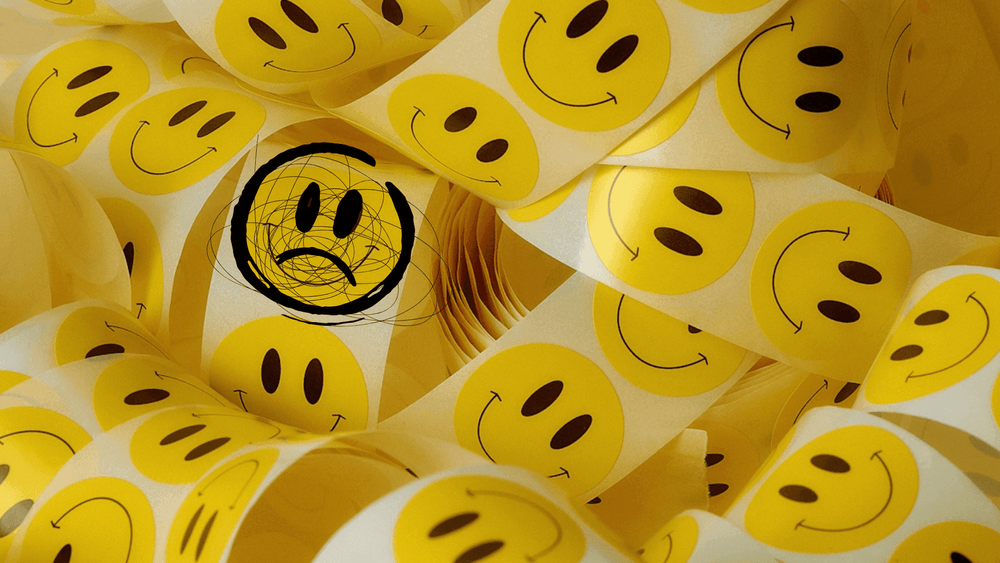
While it’s often well-intentioned, positivity can become toxic – when used at the wrong time, with the wrong audience, or while discussing a topic where it doesn’t help. This unrelenting pressure to be positive has become so ingrained in our culture that we believe positivity is the only way to deal with hardship and the only response when someone is struggling.
Of course, a positive outlook can be beneficial. However, when we take that positivity just a little too far, it becomes dismissive or unhelpful. See: when a friend is grieving, and someone says, “Just be grateful you had time with them.” Or when someone has just suffered a miscarriage: “At least you know you can get pregnant.” Or when someone deals with any type of prejudice, from racism to homophobia: “Thankfully most people don’t think like that.”
In these cases and more, toxic positivity is offering someone a simple solution to a complicated problem. Talking about these kinds of topics is not the same as complaining about waiting in a queue or a long day at work. These are issues that profoundly impact us and expose our vulnerability. When we use toxic positivity in these moments, it makes the recipient feel isolated or ignored. Because if I tell you I’m struggling and you respond with, “Just be grateful it’s not worse,” am I going to keep sharing? No, I’m going to shut down.
It’s hard to imagine how something like positivity could harm us, but positive thinking is often a Band-Aid on a bullet wound. Instead of helping us become more positive, it leads to emotional suppression, which leads to worsened mood, negative feelings about social interactions, more negative emotions and diminished positive emotions.
A culture that is obsessed with happiness also negatively impacts our relationships and society. When we reinforce the idea that some feelings are ‘bad’, we miss out on the opportunity to connect with others. Positivity is also used as a weapon to minimise or deny the experience of certain groups. When we say things like, “Can’t we all just love each other?” in response to discrimination, we invalidate the experiences marginalised people regularly endure. Toxic positivity places all the responsibility on the individual, instead of on the systems and institutions that make positive thinking an impossible solution.
We’ve been promoting happiness and positivity as the magic cure for centuries – and it doesn’t seem to be working. If we want to have close relationships and experience the full spectrum of what it means to be human, we have to radically accept that life is complicated, and nothing will be all good or all bad. In place of misplaced positivity, we need to listen to the feelings that are being shared and offer an empathic response such as, “It sounds really difficult for you,” or, “I can hear the sadness in your voice.” Learning to meet ourselves and others where we’re at, without forcing positivity, may be the key to more real happiness in the end.
Whitney Goodman, LMFT, is the author of Toxic Positivity: Keeping It Real In A World Obsessed With Being Happy, the psychotherapist behind the Instagram account @sitwithwhit, and the owner of The Collaborative Counseling Center, a virtual therapy practice in Florida