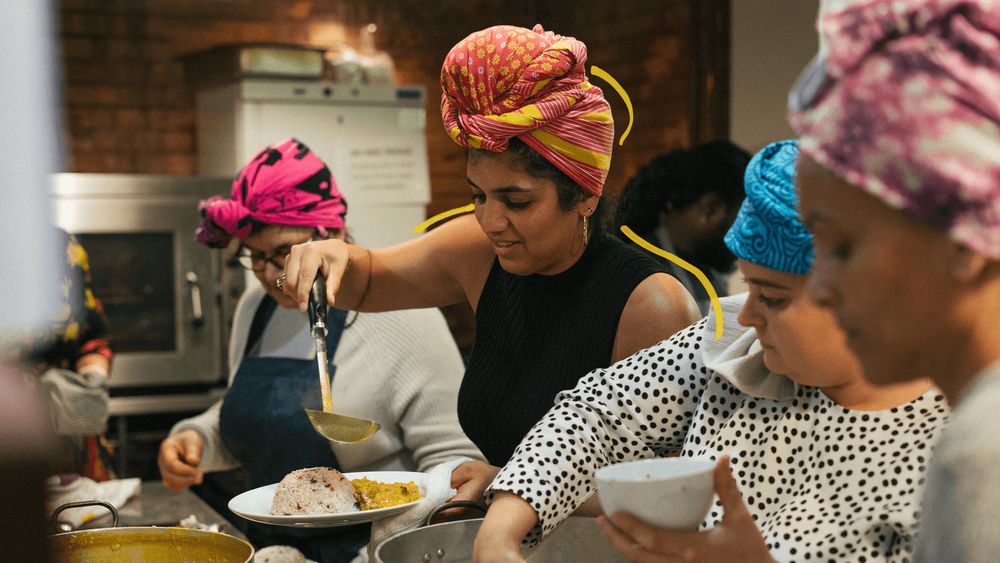
Dina Macki – @dinewithdina to her devoted community – is an Omani-Zanzibari chef whose work sits at the intersection of food, memory and identity. Her cooking isn’t just about flavour; it’s about storytelling. Each dish is anchored in her heritage, her family, the places that shaped her – which is why her cooking doesn’t just feed you; it moves you.
We first met in January this year at a dinner she co-hosted with the French perfume house Maison Crivelli to launch their fragrance, Safran Secret. Her brief was beautifully simple: build a menu inspired by the scent – its memories, its moods, the places it carried her. And what followed was pure magic. Course by course, Dina wove in family stories, heritage and personal reflections. The journey began with scent (the perfume in the air), moved through theatrical touches like swirling dry ice, a shifting bespoke soundtrack and finally flavours that were extraordinary from first bite to last.
It wasn’t just dinner; it was a full sensory conversation between perfume, memory and culture brought together over food – and the reason I instantly understood that “chef” and “storyteller” are, for Dina, inseparable. Since then, I’ve followed her work – experiences rooted not just in flavour but in narrative, with menus that read like memoir. Here, she opens up about where it all started, the way she builds her dishes – and how she protects her voice in an industry that often rewards noise over substance...
IT ALL BEGAIN IN PORTSMOUTH... Where I grew up. At the time, Portsmouth in the UK had a huge Zanzibari community. [Many were of Omani descent, whose families had long historical ties to Zanzibar – a connection dating back to when Zanzibar was ruled by a branch of Oman’s royal family.] There were Zanzibari Omanis who had moved over with the Sultan of Zanzibar – because he wasn’t allowed to go to Oman as there would’ve been two sultans in the same country – so Oman and Zanzibar used to essentially be one. When the revolution happened [in 1964], Zanzibaris in Oman had the choice to go to Oman or come to the UK. Loads of them, including my mum’s family, settled in Portsmouth.
AS A CHILD, I WAS CONSTANTLY SURROUNDED BY FOOD... It’s been the only way, I would say, that my family knew how to communicate, or show their generosity. [Back then], Portsmouth was a place that still didn’t have many other nationalities. It was a port by the sea, so to [those who had migrated there] it felt familiar – and they really stuck together. When people talk about having communities now, I feel like a lot are forced, but back then these were real communities, formed because they had nowhere else to go, no one else to be with, and all they knew was each other. That was their comfort, and my grandmother was constantly cooking to either feed the family, the Zanzibari community, or help feed the royal family. There was always someone to feed!
I remember being tossed the leftovers when she was making breads or dough-based things; she’d just give me her scraps to play with. I used to have this habit of trying to climb into the cupboards and my grandmother would try to stop me by wrapping everything in cotton wool. I was petrified of cotton wool, so that was the only way she could stop me touching food.

I WAS A RELUCTANT COOK, THOUGH... I hated cooking growing up because I was always forced to be in the kitchen. “You’re a girl, you’re going to be in the kitchen, you’re going to help,” relatives would say, whereas my boy cousins never had to. It wasn’t until university – the first Ramadan I was fasting alone – that it kicked in how much I missed what we were eating at home. So I phoned my mum and grandmother and said: “Teach me everything.” It meant I was fasting and trying to learn food – bearing in mind I’d never cooked – but it felt... natural. I cooked for all my housemates and their friends – and nobody questioned the food or said it looks strange or smells different; they just accepted it and enjoyed it. From then on, every night I wanted to cook something, give it to someone, and it just became part of who I am – everyone just knows: “Dina’s always cooking.”
I ORIGINALLY HAD MY SIGHTS SET ON THE CORPORATE WORLD... I graduated in 2016 and all I ever wanted at that stage was to climb the corporate career ladder. I didn’t have an industry I was passionate about, I just knew communications – so I went into that. When I think about that version of me now, I’m like, wow, I would’ve hated life. I lived in the Netherlands for a couple of years, then came back to England in 2019 and decided I wanted to take food more seriously. I started posting online – other people’s recipes, at first – then I posted an Omani dish, and the reaction was not what I expected. Because I had the Zanzibari heritage as well, I could tie in the whole story of Oman. The beginning of 2020 is when I finally got the confidence to start cooking my own food. It was so crazy – I couldn’t believe people were actually interested.
I REALISED I WANTED TO COOK BECAUSE... I didn’t know how to tell my story or where I was from. My friend would say my throat chakra was closed, and then food kind of opened it and helped me speak and figure out who I am. I’m fascinated by how you can have a donut on your plate, but how the hell did that donut get to your plate? I need to understand the whole process. I’ll search high and low for the stories that bring it to life.
And everything has a story. There’s a dish we cooked at home – an Iranian dish, traditionally walnuts, chicken and pomegranate. It made its way to Zanzibar because we have some Iranian connections. They couldn’t find walnuts, so they started using cashew nuts. When my grandparents moved to England in the sixties, cashew nuts were almost impossible to find, so my grandmother started making it with peanut butter. It’s such a simple dish, but as soon as I tell people the story, they all want to eat it. You’re not just eating the food – you’re holding onto a history in a moment and there’s beauty in that – it makes food more interesting than just spaghetti or rice on your plate. Plus, once you hear the story, you appreciate the food more, you understand it, you connect better with it – and the person cooking it.
WHEN I GET A BRIEF, I ALWAYS... Look at where the guests are from, think if I’ve been to their countries or eaten their food, pick out their favourite things, and then decide I want to create a story. For example, I’ve been writing a menu for an event I have coming up in Oman – people in really high positions coming from 15 different countries who all want to experience Oman through my eyes. I want them to experience a little bit of every region in Oman, starting from the capital and working down. So I’ve asked myself: Which dish is the most significant to me, which one has the story locked in my head? Then I’ll try to pair them together, but also think, I’ve got someone from Ireland coming and I love potato cakes – how can I use potato cake with an Omani dish?
TO GET SOMEONE TO TRULY APPRECIATE MY FOOD... I need to also find something from their [culture’s] cuisine that they understand, and then bring it together. I’ve learned that it’s too hard to just give people fully Omani or fully Zanzibari food. It doesn’t always look beautiful – the textures and flavours are different. So I’ll have this mental idea, put it down on a menu, and everyone’s like, “You haven’t tested it.” I’m like, “It’s fine, I know in my head this will work – I just need to work backwards to see what’s missing.” Then I cook it, pick it apart, and go, “No, we’re missing that, we need to change this” and it comes together.
I WANT TO LET REAL STORIES SHINE... My biggest challenge now is trying to do everything with [food] culture and education, while keeping up with people who just pump content out – they’ll get a lot of the clients because it’s fast and in your face. Also, because everyone can travel now, someone with a bigger following can fly to Oman and suddenly they’re “teaching” about Oman, but sometimes we need to let people from those countries just have their moment.
MY ADVICE IF YOU WANT TO CREATE IS... Don’t follow or overly consume work in the same space as you. I learned that when I worked as Labrinth’s PA at uni – he only listened to classical music in the car because he didn’t want to be influenced. Instead, surround yourself with people in completely different fields who you’ll learn from, and that will naturally feed into your storytelling. As for the food side: my mum always said the worst answer you can get is no. With cooking, the worst thing that can happen is it tastes disgusting. If you go in with that attitude, you can just experiment and have fun! Combine those two things and there’s so much you can offer.