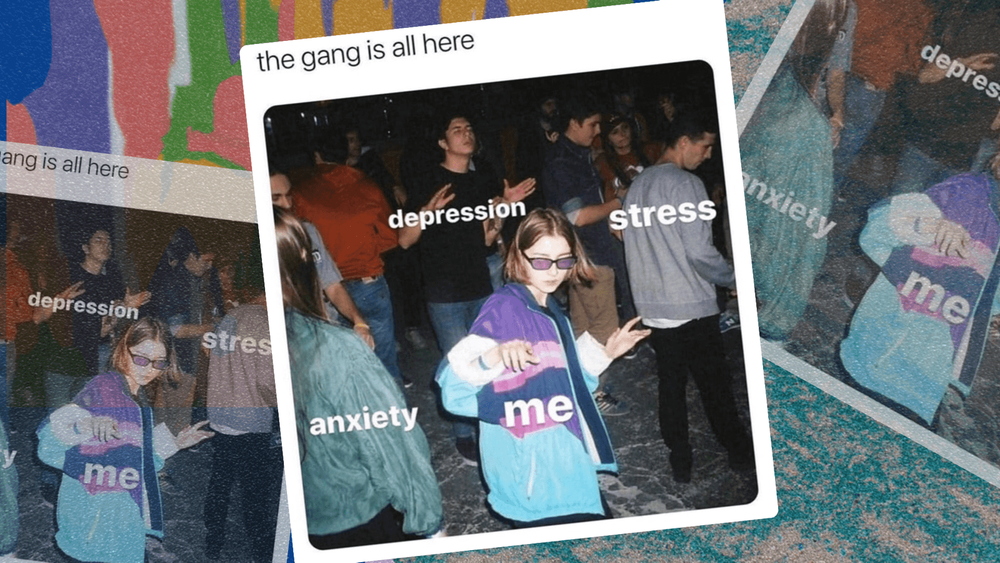
“They don’t write books about sane women,” reads the caption over one TikToker’s video, mascara-streaked tears streaming down her otherwise flawlessly contoured face as Billie Eilish plays in the background. “Why be a Rachel when you could be a Rue,” says an Instagram post juxtaposing the chirpy Friends character with Zendaya’s lead in Euphoria, the mentally unwell poster girl of the 2020s. From the recurrence of #SadGirlSummer to the memes about bed rotting, panic attacks and OCD that pull in millions of likes, it can often seem like all anyone is talking about online is how poor their mental state is. And while the openness is something to be celebrated, what if this flippant approach risks romanticising, rather than rectifying, mental ill health overall?
In the past decade, social media has been awash with mental health content, and much of it has been a lifeline for people who finally felt seen. Many of us grew up with very little education on the subject bar what we saw in the media: the ‘hysterical madwoman’ trope of the tabloids, who treated unwell women as entertainment, or the ‘sexy psycho’ made famous by Basic Instinct. With this in mind, it makes sense that anyone feeling depressed, anxious or affected by myriad other forms of mental ill health had to seek out an understanding themselves. And while handy infographics and well-meaning posts about how to get help do spring up, the majority of mental illness content is rooted in the language of the internet: tongue-in-cheek and seriously lacking in nuance.
Sushrut Yadav, who runs Instagram account @ihatekatebush and posts moody photographs of melancholy figures such as Sylvia Plath and Joni Mitchell, believes the odd meme poking fun at a common negative experience can be a balm. “At the end of the day, I do think a laugh, rightly timed, has liberatory potential,” she says. “It certainly makes you feel less alone.” It’s something Dr Sophie Mort, clinical psychologist and author of (Un)Stuck, is quick to point out, too. “Using humour, memes or familiar pop culture references can make experiences of mental distress feel less lonely,” she says. “Trends like #SadGirlSummer or #HotAnxiousGirl often comes from a place of wanting to say, ‘I’m more than my anxiety or sadness; I’m also funny, messy, desirable, complex.’ In many ways, these posts are attempts to reclaim identity, to express multidimensionality, and to push back against stigma. They can feel like moments of glimmering authenticity.”
“In the past decade, social media has been awash with mental health content, and much of it has been a lifeline for people who finally felt seen”
But for all the positives she sees in this kind of sharing, Dr Sophie says there are some people who take it too far. “Turning clinical conditions into hashtags can blur the line between self-expression and performance,” she says. “For some, the creation of such content may be less about genuine connection and more about identity branding, where mental ill health becomes a kind of cultural currency online.” This sort of glamorisation can have a worrying impact on more vulnerable people, and especially children, who come across it in a time when they’re still learning how to show up in the world. When ‘beautiful suffering’, as Nietzsche called it, looks aspirational, it can not only draw them into a web of dark content but actively turn them away from things that could make them feel better.
This is the argument of many online safety campaigners, including Amnesty International, which recently conducted a report into the harm social media algorithms were causing young people. Using accounts mimicking 13-year-old TikTok users, they found it only took between 3 and 20 minutes before they were drawn into “rabbit holes of potentially harmful content, including videos that romanticise and encourage depressive thinking, self-harm and suicide.”
Clearly, this sort of content is served up more frequently because it performs well. A qualitative analysis of TikTok videos by researchers in Barcelona paints the other half of the picture, finding that young people often use aesthetic elements, such as music and imagery, to make mental illness seem more relatable or even attractive, and these content creators are, in turn, rewarded with higher engagement rates.
When you get into the mechanics of why posts that romanticise something that’s life-limiting for millions have become so popular, it starts to look less like harmless fun. Dr Sophie voices concern that being sucked into these echo chambers can actively stop people getting the help they need. “Yes, it’s important to normalise pain, but it’s equally important to encourage seeking support and moving towards wellbeing,” she says. “The online romanticisation of mental ill health risks repeating the pattern, validating people’s experiences but, at times, unintentionally discouraging change.”
“The online romanticisation of mental ill health risks repeating the pattern, validating people’s experiences but, at times, unintentionally discouraging change”
So what can you do if you feel like your algorithms are keeping you in the dark, rather than lifting you up? The first step, Dr Sophie stresses, should be putting your phone down, speaking to someone you trust and seeking immediate professional help through charities like Samaritans or going to A&E if you are in crisis. “Once you’re receiving support, there are smaller, practical strategies that can help loosen the grip of the cycle,” she adds. “Sometimes it starts with a bit of gentle curiosity: asking yourself, ‘How do I feel after scrolling or posting things like this? Am I soothed and connected or am I actually left feeling more stuck?’ Simply noticing the impact can be surprisingly powerful.”
She also suggests intentionally diversifying your social media feeds. “Algorithms only reflect what we click on, so following accounts that focus on recovery, coping strategies or even light-hearted interests outside of mental health can shift what you see,” she says. It’s also a good idea to experiment with different ways to regulate and express what you’re going through, such as journaling or creating something with your hands that feels like you: a meal, a painting, a piece of pottery. “Ultimately I always come back to this: those steps are secondary,” says Dr Sophie. “The bigger priority will always be putting the phone down, reaching out, and getting the help you deserve.”
Words by Juno Kelly and Meena Alexander.