It was late afternoon, the heat thick and unmoving, when the call came through. I was the only journalist aboard the Ocean Viking, a search-and-rescue ship patrolling the Central Mediterranean, when its radio crackled to life. A Frontex aircraft – part of the EU’s border agency – had spotted a small, likely overloaded fishing boat: 15 people onboard; no shade, no life jackets, no sign it was moving.
This wasn’t a sighting. It was a distress call.
The crew barely flinched; they’d heard it before. Ocean Viking – run by the humanitarian NGO SOS Mediterranee – confirmed a course change. If we were lucky, we’d reach the boat before nightfall.
There was blue water for miles, the Sicilian coast now only a memory on the horizon. By 5.30pm, the rescue team were pulling on their thick overalls and rubber boots. We were far beyond Libyan waters – a no man’s sea, where rescue is political and danger is constant. Sweat slid down faces before the zips were even fastened.

We waited. The crew never know what they’ll find – how long survivors have been drifting, or whether they’ll still be alive. The rescue boats were ready. On the deck, quiet chatter gave way to silence. The sun burned gold through the ropes overhead. Still no word. Still searching.
A Sea Of Politics
In these waters, humanitarian rescue is more than a mission – it’s a flashpoint. Under a 2023 law known as the Piantedosi Decree, the Italian government gained broader powers to detain civilian rescue vessels and assign disembarkation ports hundreds of miles away in Northern Italy. It means after surviving the sea, those rescued often face deportation if they come from countries deemed “safe” by Italian authorities.
The only certainty with these rescues is the time the sun rises and sets. During that first night of my journey, the last light rippled across the sea just before 8pm and the crew were told to stand down. Once the light disappears, Lucille Guenier – the Communications Coordinator on board – told me, it’s “like a needle in a haystack.” Despite Frontex initially sharing the location of the small boat, their aircraft did not keep track of the vessel, and the chances of losing its precise whereabouts increased by the minute.
When the crew woke as the sun rose again, it was to the news that the boat had been found – but it was empty; a ghostly vessel floating on the waves. It was assumed that the Libyan coastguard arrived first to forcibly detain the migrants on board and return them to Libya, instead of onwards to Italy where they were heading.

Their probable fate would have been imprisonment in the country’s infamous detention centres, where migrants are subjected to systemic torture and sexual violence. Despite the well-documented evidence of the Libyan coastguard’s central role in the abuse of migrants, EU countries continue to provide boats, aircraft and training to them in exchange for Libya decreasing the number of migrants who reach Europe’s borders.
Since beginning operations in 2019, Ocean Viking has heard dozens of migrant testimonies alleging that those piloting Libyan coast guard vessels are also human traffickers and militia members — claims echoed in a 2023 UN Report confirming the coast guard’s involvement in trafficking, smuggling and illegal detention. “The situation in Libya is very blurry, so we don’t know where the authority ends and the militia starts,” says coordinator Angelo Selim. “Nobody is really able to track where this money goes.”

Rescue Or Return
Shortly after the empty boat was found, a Libyan coast guard vessel began circling the Ocean Viking. Crew members say this kind of approach is common – a show of force aimed at pressuring rescue ships to withdraw. A voice came through on the radio in Arabic: leave the area – and fast. After three tense hours, the Ocean Viking changed course to patrol north.
But the effort to intercept migrant boats didn’t stop. The Libyan coast guard vessels (twice as fast as Ocean Viking) often reached boats before we could. Their advantage isn’t just speed: a 2024 Lighthouse Reports investigation found Frontex shared migrant boat locations with Libya over 2,000 times in three years, despite reports of violence against survivors.
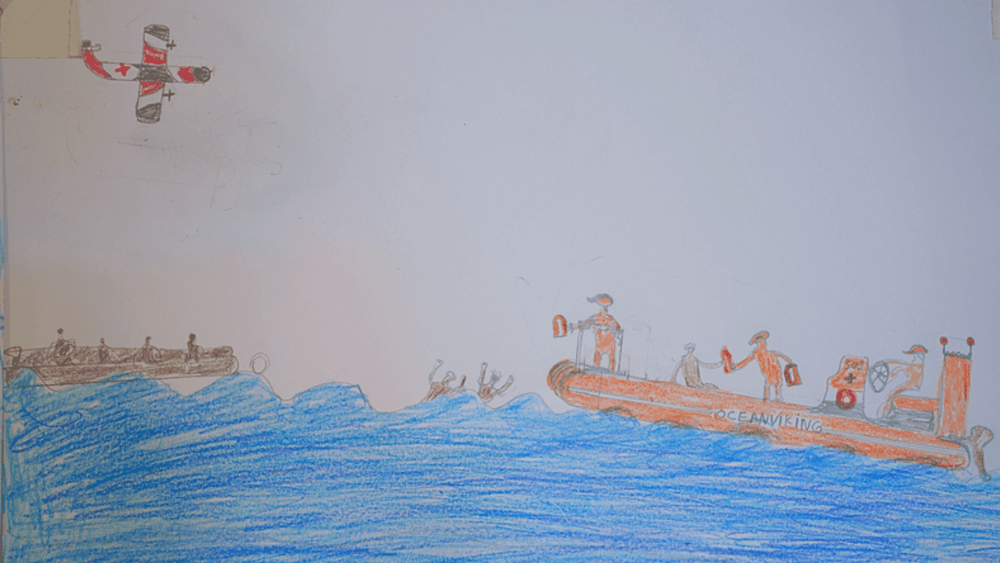
That night, as our crew finally prepared for bed, another alert arrived. This time 45 people, including nine minors, were drifting on a rubber boat after their engine had stopped working. Three rescue boats launched immediately, the crew moving swiftly on the fast, bouncing vessel, shifting life jackets into place while torches lit arcs of light over the black water.
As we sped toward the boat, silence fell, except for the engine’s roar. A pinprick white light grew into a blue rubber boat; legs dangled over the sides. As we drew near, faces became clear – one man gently placed a hand on a young teenager’s back. The three rescue vessels surrounded the migrant boat to keep everyone balanced, while a crew member called out in English, “We are here to help you, but you have to follow our instructions.”

The SOS crew then helped migrants onto the rescue boats, where team member Antoine explained what would happen next in Arabic. As they settled, one held his head in his hands, another offered a brief smile and his name. I quietly observed their fearful, exhausted faces, guessing their ages and how recently some had left childhood behind. The boat then returned to the Ocean Viking, once again silent except for the engine.
Stories That Carry
As soon as the rescued migrants boarded the Ocean Viking, the second pillar of SOS’ mission – to protect – began. The protection team registered each person – a simple but high-stakes task, as errors can lead to the ship’s detention. Most said they were from Sudan, where civil war has killed more than 150,000, displaced 12 million and triggered what the UN calls the world’s largest humanitarian crisis.
On the ship’s main deck, hopscotch was painted on the floor, a tree was drawn above the shelter and houseplants crowded the corner. Survivors washed, ate and rested while the crew collapsed into bed. But just hours later, over cereal and grapefruit, another case came through. The team pulled on their still-damp overalls and launched back into the sunlit sea. Another black rubber boat, stark against the surrounding blue water and sky, appeared – almost identical to the last. The rescue was swift and calm. The only difference was in the faces of each person as they jumped from the vessel on which they almost died after three days without food and water: joy, relief, shock.
“I lost all hopes of having any life, but when the rescue boat arrived, my soul came back to my body. This is a new life, and I will start again”
That afternoon, the deck was full of life. Tables were pulled out with paper and pens for drawing, books in different languages placed on benches, as we drank tea and chatted to the survivors. I spoke with two young Sudanese men who had fled the war. One, unnamed, had studied veterinary medicine before being forced to flee. The other, Abdoosh, left his family and fiancée behind in Libya, hoping to secure their future together. “I want to learn and get educated,” he said. “I want to work for an organisation like [SOS] because it has inspired me. I want to make my life better.” Then, he said, he could marry his fiancée. His friend still hoped to finish his training.

None of this had been possible for them in Libya. When Abdoosh arrived, he was imprisoned for two weeks and beaten – he pointed to the scar on his leg. Both men had found work but were often unpaid, faced discrimination and even threatened at gun point. “I left my job because someone there said I’m just like a slave. I wouldn’t disrespect myself. I said, ‘I cannot work here anymore,’” said Abdoosh’s friend.
By the time we found them at sea, they had been drifting for days. “I remembered my memories from Sudan, because I thought, Maybe I will die this day,” Abdoosh said. “If it was the Libyan government [that found us] I would commit suicide and jump into the sea. I lost all hopes of having any life, but when the rescue boat arrived, my soul came back to my body. This is a new life, and I will start again.”
Under Fire
Around 3pm the same day, Lucille told me to come up to the navigational bridge to observe tense communications with the Libyans, when Angelo suddenly announced that there was a security threat. Seconds later, a crew member yelled “get down”, and we crawled into the safe room.
The Libyan coast guard had again ordered the Ocean Viking to leave – but when told the ship had authorisation to assist a distress case, they opened fire. On the bridge, Lucille saw a masked man aim a gun straight at them. She dropped to her knees as bullets shattered the windows and walls where she had just been standing. As we crowded in the engine room waiting for news, I quickly realised I had left my phone in the cabin – and all I could think of was my husband, and whether I’d get the chance to speak to him again.

The coast guard boat, gifted by Italy as part of the 2023 EU ‘migration management’ plan, circled the Ocean Viking three times, shooting hundreds of bullets – some hitting the main deck and accommodation, where crew and survivors were vulnerable to harm. The protection crew, who were trapped on the main deck with survivors, could see the coast guard vessel getting closer and were certain that they would attempt to board. But then the gunfire stopped and the Libyans issued one final warning over radio: “Leave the area! It should be empty when we return in one hour.”
In the communications room, Lucille and her team immediately began collecting evidence. Elsewhere, crews checked in on one another and survivors, trying to process what had happened. “Given the fact that the bullets were pointing right at us, for me, there is no doubt that they were trying to kill us,” Lucille told me as we surveyed the damage. All three rescue boats were out of action, shattered glass covered the bridge, and a bullet hole pierced straight through a sign on the women’s shelter that read, ‘Welcome, you are safe’. “It’s so hard, because when survivors come on board, we tell them that they are finally safe. Now, that is not true,” the lead medic told me as we returned to port. The atmosphere was subdued – and I realised the Ocean Viking wouldn’t be able to carry out rescues for some time.
Still, that does not take away from its profound impact: as of summer 2025, SOS has saved the lives of more than 40,000 people; men, women and children. “If we lose the capacity to empathise with other humans we can expect only the rise of barbarity,” Angelo said, reflecting on his five years at the helm of these search-and-rescue vessels. Speaking about the EU’s ‘migration management’ scheme, he added: “If we build higher walls at our borders, people take more risks to pass those walls, so they die just trying to survive.”
As we docked in Sicily, authorities told SOS to disembark the 87 survivors beside a scrap heap, where they’d spend days in a temporary camp. One had been isolated and tested for tuberculosis, prompting officials to order the Ocean Viking to anchor offshore for a five-day quarantine. The crew signed consent forms in Italian and were tested, too. Bullet holes still scarred the ship, and everyone was exhausted. But as the sun set, music played on the main deck – and somehow, people danced.

During my time on the Ocean Viking, I witnessed moments of despair and staggering hope, of rescue and near-death, of bullets tearing through steel and yet somehow missing flesh. I felt fear grip the crew as they crawled into a ‘safe’ room, but I also saw joy spark in the eyes of someone who had been lost at sea. What I’ve learned is simple, but urgent: no one boards a rubber boat unless staying is worse. These missions aren’t political statements – they’re acts of basic humanity. In a sea of silence, abandonment and violence, they offer the rarest thing: someone is still looking for you. That you are not invisible. That your life matters.