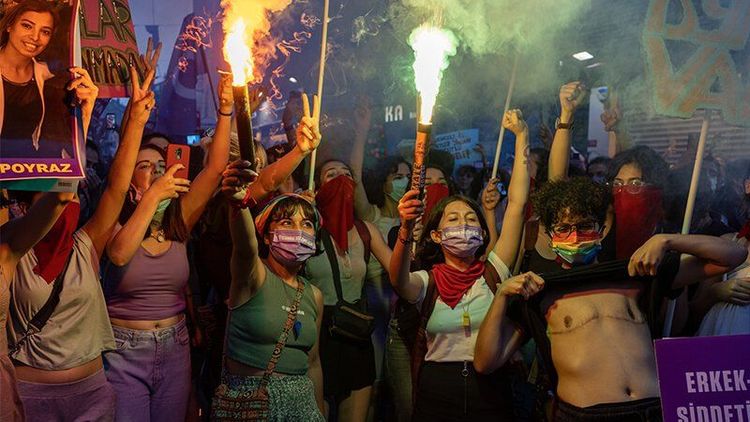
Nazli Duman was strangled by her boyfriend. Sümeyye Yavlak was stabbed through the heart. Deniz Suna’s husband killed her and her 16-year-old son.
These women are among 29 in Turkey who were murdered by male partners in August 2023, alongside a further 21 whose deaths were marked as suspicious by the We Will End Femicide Platform, a Turkish NGO. Over the past 10 years, femicide rates have soared in Turkey from an already high rate of 232 women murdered in 2013, to a horrifying 403 in 2022 – that’s nearly four times the number of women killed per year in the UK.
Campaigners say that is no coincidence. In 2021, Turkey pulled out of the Istanbul Convention, a European agreement designed to protect women against domestic violence and ensure that victims are properly supported by the police, courts and health services. Turkey’s President, Recep Tayyip Erdoğan, is an Islamist who pushes a staunch pro-family, anti-women and anti-LGBTQIA+ agenda. As Turkey scrapped the convention, Erdoğan’s spokesman said that it had been “hijacked by a group of people attempting to normalise homosexuality” due to its mention of gender identity.
Now outside the convention, the Turkish government is no longer obliged to collect data on domestic violence, nor recognise psychological violence, stalking or forced marriages as abuse. It is not required to set up crisis shelters or hotlines, or to provide specialist support services to victims. For Turkish women, there are consequences. Victims of abuse are often reluctant to go to the police, and sentencing has always been lax: men who are convicted are routinely handed short sentences and treated as heroes in prison. In short, there is little to deter men who want to harm women.
“The basic issue is men’s inability to deal with women’s increasing freedom,” says Berna Akkizal, executive director and co-founder of the Civil Spaces Study Association in Istanbul. “The result of pulling out of this convention is that men have been given the freedom and security to use violence as they want.”
LGBTQIA+ people are in the firing line, too. Homosexuality is legal in Turkey but Istanbul’s annual Pride event has been banned since 2015 and dozens of queer activists are arrested each year as they try to hold events. Erdoğan and Turkey’s clerics denounce gay people as ‘degenerates’, while the head of the state’s religious body accused LGBTQIA+ people of spreading Covid. Hate crimes against gay and trans people are not officially recorded, but there have been several apparently targeted murders of trans women in recent years.
İlkin Zeybek, an activist and publisher of Zed’s fanzine, a gay photography zine, says that Turkey’s LGBTQIA+ community is on the sharp end of rising male violence. When he walks home late at night, he uses backstreets to avoid attention and confrontations.
“I am scared not because of something I do, but because of who I am,” Zeybek says. “The people who hate me are on the main street, and the government is behind them.”
Turkey is not alone: across Europe and beyond, populists are rolling back women’s and LGBTQIA+ rights as they pitch to conservative and often religious voters. EU member state Poland had said it would pull out of the Istanbul Convention on the grounds that it does not respect religion and promotes “controversial ideologies about gender” (Poland is staunchly Catholic and has recently made abortion almost impossible to access) – although the opposition’s win in the October election was a hopeful sign that it may change course. Meanwhile, six other EU members – Bulgaria, Czech Republic, Hungary, Latvia, Lithuania and Slovakia – have never signed the convention.
These are countries where homophobia is still commonplace, and their leaders have realised that by linking women’s rights with LGBTQIA+ rights, they can stir up a conservative backlash big enough to win elections. They know they cannot be kicked out of the EU: the bloc sets standards on democracy and human rights for countries that want to join, but it has no mechanism to sanction member states that break the rules (Turkey is currently a candidate for EU membership).
America is not immune either, as its repeal of abortion rights and the enduring popularity of Donald Trump show. Further afield, regimes such as the Taliban in Afghanistan deny women basic rights, such as freedom of movement, education and employment. In Iran, women are arrested and tortured for refusing to wear the headscarf. Right across the world, a wave of chauvinism is rising.
In Turkey, the reasons for the rise in femicides and anti-LGBTQIA+ rhetoric are complex. There is a searing economic crisis, which is placing strain on families. Homophobia and chauvinism have always been widespread, and Erdoğan’s religious rhetoric is fuelling it further. Stoking misogynism is an easy way to galvanise a large part of the population, even as it alienates others.
“He is trying to please the voters, who are becoming more conservative. And, of course, the culture and economic crisis are factors too,” Akkizal says of Erdoğan. “Withdrawing from an agreement that protects women is a move that strengthens autocrats’ hands.”