While studying graphic design at Parsons, Linda Huang took a book cover design class that would quietly shape the course of her entire career. One of her instructors happened to be a designer at the legendary publishing house Alfred A. Knopf: “That became my entry point into the world of book covers – and I’ve been there ever since. It’s actually the only job I’ve ever had,” she says. Proof that one class – and the right mentor – can change everything.
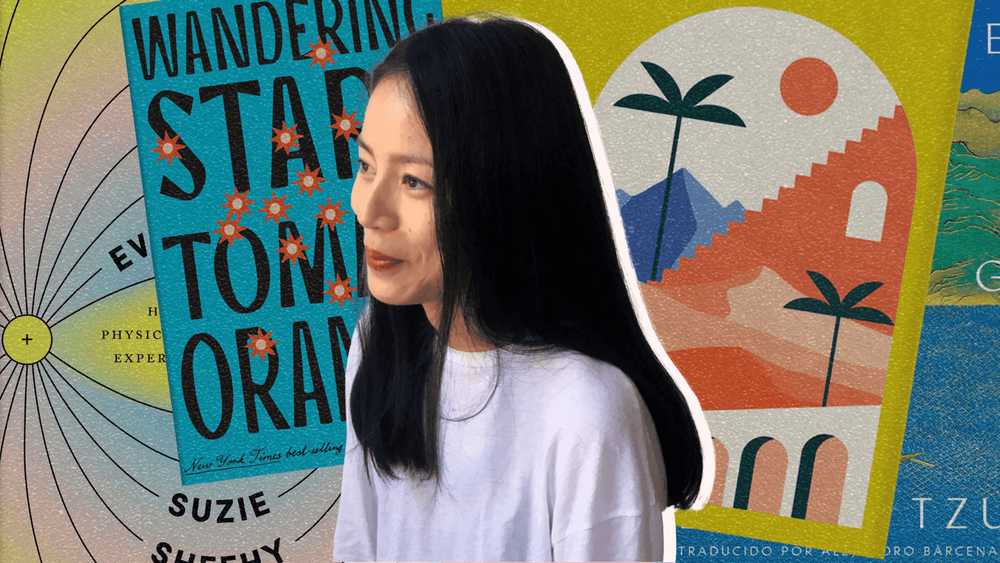
More than two decades later, the New York-based creative is now the art director at Pantheon Books, while continuing to design covers for Knopf. Her thoughtful designs have helped define the visual identities of authors such as Tommy Orange, Tess Gunty, Kaveh Akbar and Patti Smith. Each cover carrying a sensitivity and depth that reflects her intuitive approach to storytelling through image and type.
In this conversation with Service95, Linda shares the rituals behind her creative process, how she approaches the challenge of designing across genres, and the ways she draws inspiration from the visual noise of everyday life in Manhattan. From unglamorous production work to moments of creative breakthrough, she offers a candid glimpse into the constantly moving world of book cover design...
IT ALL STARTS WITH... A sketch. I wear two hats: one as an art director, the other as a designer. Both roles are very different: If I’m working on a book, it might involve reading a manuscript and, ideally, it includes a block of creative time where I’m sketching visual concepts for a book cover (this is actually quite hard to do every day). It really pains me when a few days go by and I have been lost in emails and haven’t been able to do that. It’s so important to my practice to carve out at least an hour each day to sketch visual ideas. That’s the only way to come up with something interesting. For me, it’s so hard to squeeze something good out at the last minute.
A LOT OF MY CREATIVITY HAPPENS... Beneath the surface, in my subconsciousness thanks to the vernacular design that surrounds us. I live in New York City, and the typography here is really interesting: the signage, the lettering. When grocery stores have mega sales and put up those bold posters, that can be inspiring to me. Or when you go to a protest and see hand-edited signs, or even things like packaging, receipts and business cards – it’s all those everyday design elements that I encounter that feed my creativity. I think those are the tools we use to communicate with others, too. You have to work within a familiar framework for people to understand the concept, so using visual culture is a huge part of graphic design. I just love looking at typography, because that’s the critical part of design – without typography, it would just be an image.

CONFESSION: I DON’T ALWAYS READ THE BOOK... Especially if it’s fiction. Sometimes, when I was starting out, I’d try to read the entire book, and I still do if I’m genuinely interested. But often, if I’m pressed for time, I might actually read a third, or half, of it, just to get a sense of the tone. Rather than jumping straight into sketching visual ideas, I’ll usually begin by writing out in full sentences what I think the cover needs to convey. Things like: It needs to communicate this; it should visually reflect that. That helps clarify the direction before I move on to visual research. Sometimes I’ll build a mental mood board, other times I’ll collect imagery to help me get into the right mindset, especially if the book is more stylised and I really need to lean into that visual language. But if it’s more conceptual, which is often the case with non-fiction, then it’s more about expressing the core idea as clearly as possible – in which case, reading the whole book doesn’t always help.
I DON’T CONSIDER MYSELF AN ARTIST BECAUSE... I feel like I’m helping another artist – a writer – achieve their vision. I’m providing a service. I’m just helping them figure things out and I’m not really pushing for my own voice to show. Sure, I am bringing my viewpoint – my approach and way of thinking – but it’s not about what I want. It’s ultimately about what the publisher wants, and how that aligns with the author’s vision. So it’s not like I’m creating a personal body of work. I mean, you might think differently when you see my work – you might notice recurring themes, approaches or styles. And I do hope that my work is shape-shifting. I don’t want to be pinned down to a particular style. I want it to suit the book it’s designed for, and I like that about my work. In that way, I’m able to be a chameleon, and it’s never boring! I’ll bury myself in a manuscript, live in that world for a while, and then I’ll transform. That’s what makes this job interesting.

WHEN I WAS STARTING OUT I WAS INSPIRED BY... People like Peter Mendelsund, Leanne Shapton and John Gall. I’ve had the chance to work with both Peter and John – John is actually my current boss. They’re major figures in the world of book design. From a historical perspective, Paul Rand is also a huge influence. He’s one of the greatest book cover designers of all time, and it’s hard not to be inspired by his work (he was behind brand logos such as ABC and IBM, as well as book covers like Leave Cancelled by Nicholas Monsarrat and Mine Boy by Peter Abrahams). Leanne Shapton is also a great illustrator. Her work (like for the covers of The New York Review of Books) has so much intimacy and emotion – qualities that are incredibly hard to achieve with purely graphic or typographic solutions. Everything she does is handmade, and that adds a very human, personal touch.
ONE PROJECT I’LL NEVER FORGET WAS... The first book I worked on that I actually thought was good. It’s called The Book of Heaven by Patricia Storace, and it came out in hardcover in 2013. That was the first time I thought, Oh, this is actually decent. I really like this. I was looking at a lot of fine art and discovered an artist called Dolfi Trost, who created these amazing, web-like drawings. I thought the shapes were so interesting, and so I based my design on that. I was inspired by his work, I internalised it – and then I made it my own. It wasn’t like I was drawn to a particular graphic style and I was trying to rip off that style stylistically. And in that way, I felt like it was a very pure process.

ONE THING THAT HELPS ME GET INTO THE RIGHT HEADSPACE IS... Music. Sometimes I’ll listen to something that connects to the theme of the book, like African music for a book set in or about Africa. It might not be directly related, but it helps create the right mood. When I was recently working on a book about the Chinese internet, The Wall Dancers, I listened to Howie Lee to immerse myself in that world. And then there’s one song I often, maybe lazily, put on repeat: It Don’t Rain in Beverly Hills by Dean & Britta. Even though it has vocals, it’s incredibly soothing. I’ve listened to that song regularly for more than 20 years. It’s so familiar that it doesn’t distract me; it actually helps me focus. It’s just very calming and creates a kind of safe space where ideas flow more freely.
I’VE LEARNT THAT IT’S IMPORTANT TO... Constantly challenge yourself with interesting projects and books that push you. You have to keep designing, otherwise, you’re going to lose that muscle. It keeps the project alive. And while art direction is very interesting, and sometimes less stressful, I also think it’s important – if you want to stay relevant – to keep doing design work yourself. It’s easy to fall into the habit of taking on straightforward book projects where you already have the solution. But you’re not going to grow as a designer if you keep giving yourself those kinds of assignments.
I ALWAYS GET STUCK ON... Every project! Every time, I feel like I have no idea what I’m doing – like I’m starting from scratch. Each brief is so different, and I always find myself asking, How do I make this rectangle interesting again? It’s tempting to scroll through Instagram or Pinterest for inspiration, but I try to avoid that. It usually just leads to more anxiety and, often, you end up copying a style rather than finding a deeper, more original source of inspiration. Instead, I try to reframe the brief. I take a step back and ask, What am I actually trying to do here? Defining the problem again helps. Short walks help. So does taking a shower. But mostly, it’s about showing up and putting in the hours. It doesn’t have to be good at first – in fact, it usually isn’t. I just focus for 20 minutes, even if it’s staring at a blank page. Eventually, something comes. You get stuck when that creative muscle weakens, especially if you’re constantly distracted by other people’s work. Staying focused on the problem and redefining it is key. That’s probably not the answer people want to hear, but, for me, it’s the reality.