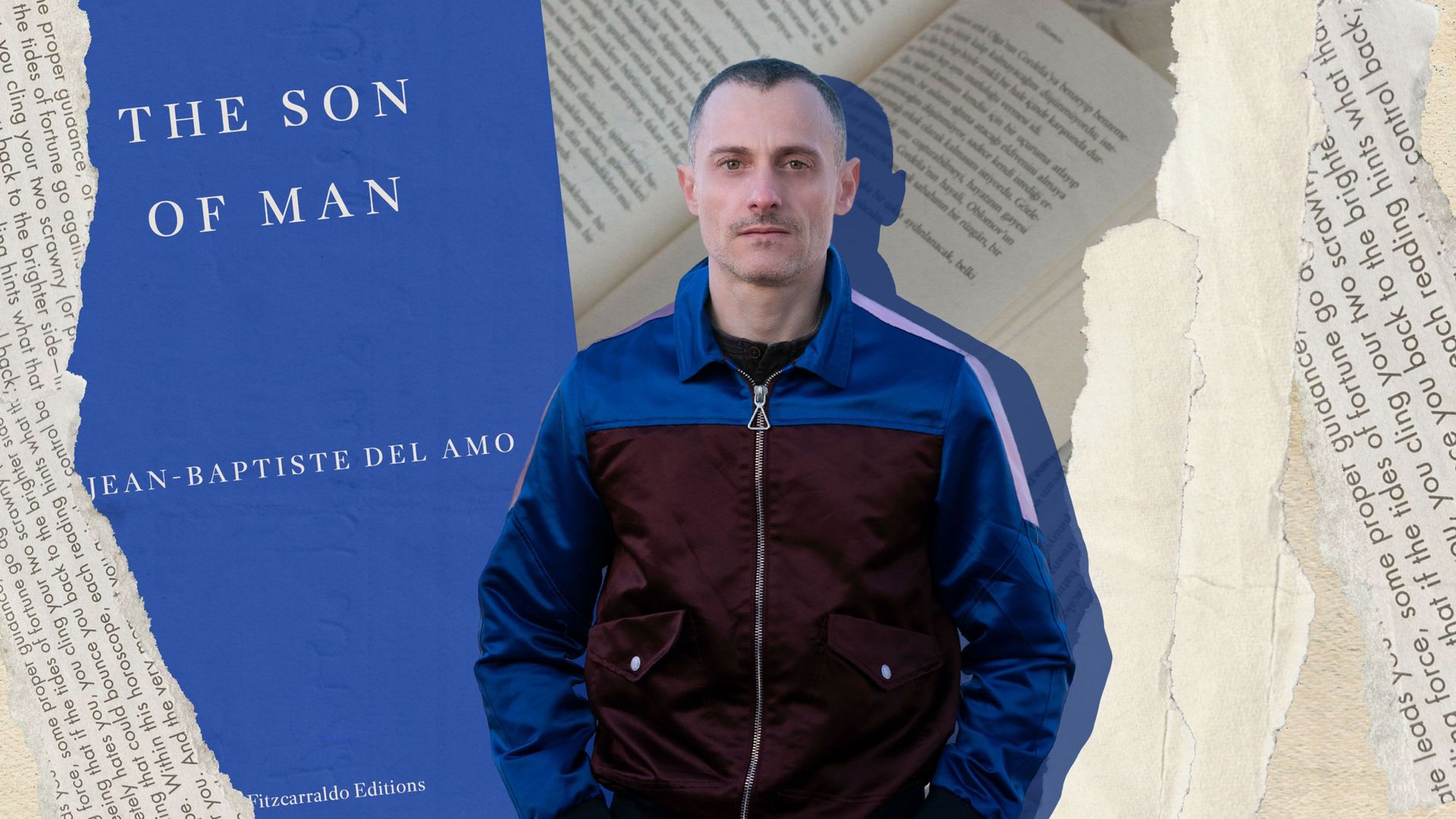
Have you ever had that deflated feeling after finishing a really great book – where you feel a little lost after finally reaching the end of a novel you’ve been racing through? That’s exactly how we felt after turning the last page of Dua’s Monthly Read for February, The Son of Man. Admittedly, it’s not the easiest read (even Dua calls it a “dark” one, and she loves a heavy read), but Jean-Baptiste Del Amo’s captivating prose – beautifully translated by Frank Wynn – drives you through the novel. By the time you finish, you’re left slightly adrift without it, desperate for another fictional world to lose yourself in.
Fortunately, the author has shared five books that entertained, absorbed and inspired him while he was writing The Son of Man, from modern classics to poetry collections and even one of his own books (backing yourself is a must). These are the reads to pick up next – and why Jean-Baptiste loves them.
“It may seem pretentious to mention one of my own books, but I wouldn’t be honest if I didn’t talk about Animalia, which was the origin of The Son of Man. It’s a novel in which I explore the theme of the transmission of violence through a family over a century and five generations. After finishing that novel, I chose to take a narrative counterpoint in an attempt to find the primal images of the transmission of violence through just three characters and a single setting.”
“I chose Blood Meridian, but I could just as easily choose any other book by McCarthy (The Road, obviously, for the father-son relationship). McCarthy makes very little use of his characters’ interiority or of psychological interpretation. What we understand about them comes primarily through description, atmosphere and dialogue. This highly visual approach left a deep impression on me as a reader and encouraged me to seek a language of vision and sensation.”
“It is certainly not one of the most immediately accessible Faulkners, but I consider it one of his greatest. I was particularly struck by the way he lends a lyrical voice to characters who are ordinary people and do not necessarily have much education. There is no realism in the way they speak, and this flow of language gives them a tragic, mythological dimension. I often struggled with how my own characters should speak – most of them coming from working-class or middle-class backgrounds – and Faulkner, in a way, gave me permission to grant them a voice that transcends them. I owe the central monologue of the father in The Son of Man in part to him.”
“I love the poetry of Georg Trakl, one of the greatest Austrian poets. His images of organic nature, the funereal themes that run through his work and his exploration of forbidden desire move me profoundly. The way he brings together colours, dawns and landscapes is extraordinary. I even have his eye tattooed on one of my arms!”
“The Cinnamon Shops is an imaginative text in which everyday reality is transformed through memory, dream and metamorphosis. What moved me most deeply is the way the figure of the father is explored through an almost mythological lens: he becomes larger than life; unstable, shifting, suspended between authority, madness and disappearance. This vision of the father – as both intimate and legendary – resonated strongly with me and left a lasting impression.”