A neon-green building on Chicago Avenue has been serving breakfast to regulars in South Minneapolis for 15 years. On a biting morning in late January 2026, something fundamental changed. The breakfast plates, doughnuts and coffee that make it a neighbourhood hub are still on the menu, only now, they’re free. Owner Dylan Alverson announced the transformation on Instagram: Modern Times is now Post Modern Times – a place where everyone is welcome.
That is, everyone except for ICE agents. ICE (Immigration and Customs Enforcement) is the US federal agency that investigates immigration and customs violations, and its agents work in conjunction with Customs and Border Protection (CBP), which focuses on border security. Part of their mandate is to detain and deport people without legal permission to stay in the country. Under US law, there is supposed to be due process: warrants, court hearings and legal representation. But the scale and aggression of ICE operations under President Trump’s administration – the raids, the detentions, the deportations, often conducted without warrants or proper legal procedure – have been unlike anything seen before.
Post Modern Times is just three blocks from where Renee Nicole Good was shot and killed by an ICE agent on 7 January. Federal officials claimed the ICE agent acted in self-defence, but eyewitnesses, journalists and a family-commissioned autopsy contest their account. A few weeks later, Dylan changed the name of his restaurant after Alex Pretti – an intensive care nurse who had devoted his career to serving veterans – was also fatally shot by CBP agents a neighbourhood over after trying to help a woman who had been pushed to the ground by agents. Both Renee and Alex were acting as legal (or constitutional) observers: non-violent community volunteers who watch law enforcement to document any potential rights violations. Both died within blocks of where George Floyd was murdered in 2020.
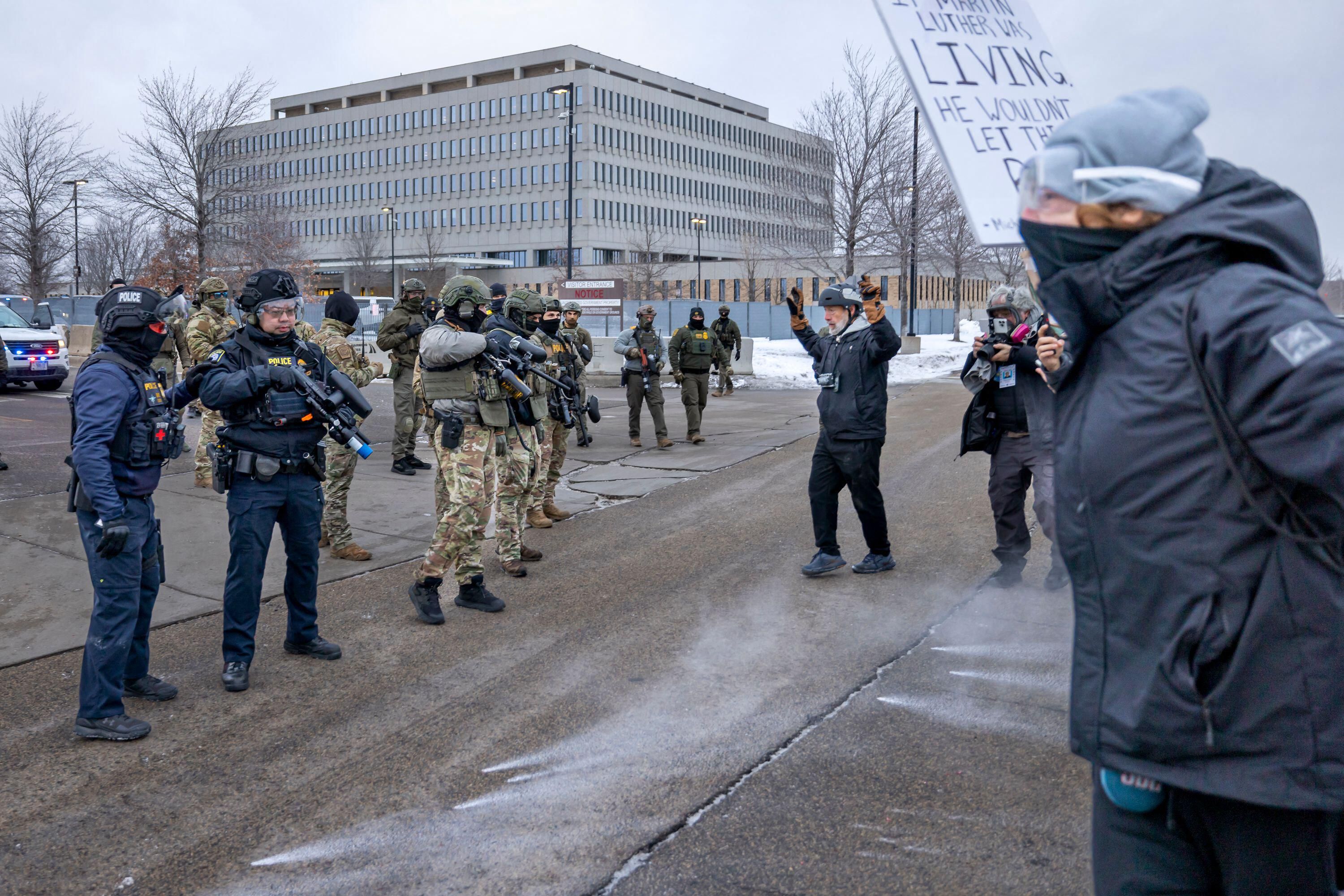
“I rushed over to Nicollet Avenue after learning Alex Pretti had been murdered,” Dylan says. He and his wife, who had come straight from the gym, kept having to dodge aggression by officers, eventually leaving to return better equipped after seeing two military-style transport vehicles advancing, full of FBI and CBP agents in combat gear. “They were tear-gassing and shooting pepper balls and concussion grenades. It was as close as I have ever felt to being in a warzone."
This is not an isolated eruption of violence – for two months, armoured vehicles and federal tactical units have maintained a visible presence across Minneapolis. And, for those same two months, residents have answered not with retreat, but with resistance: showing up, organising, refusing to look away, insisting that their city refuses to give into authoritarianism – that they will not be ruled by fear.
ICE In Minnesota: Where It Began
These streets have been simmering since December 2025, when the US Department of Homeland Security deployed what it called “the largest immigration enforcement operation ever carried out”: Operation Metro Surge. The target? Minnesota, which has the largest Somali population in the country. The administration claimed it was there to investigate fraud. Minnesota officials saw it differently: this was payback for being a progressive state that refused to cooperate with the deportation agenda. By early January 2026, between 2,000 and 3,000 federal agents had descended on the Minneapolis-Saint Paul (MSP) area alone (often referred to as the Twin Cities).
Over the following two and a half months, ICE arrested approximately 4,000 people across Minnesota. Federal agents conducted warrantless raids, arrested people as they waited for the bus or walked to the store and illegally detained US citizens. Most detainees were taken to the Bishop Henry Whipple Federal Building – a processing centre near MSP Airport that quickly became overwhelmed, with people sleeping on concrete floors and limited access to attorneys. A federal judge later ruled that ICE had likely violated detainees’ constitutional rights there. Schools went into lockdown. Officials in Minneapolis say the city experienced more than $203 million in economic damage in January alone.
“They were tear-gassing and shooting pepper balls and concussion grenades. It was as close as I have ever felt to being in a warzone”
Those numbers don’t capture what occupation looks like in practice: a naturalised US citizen from Laos dragged from his home in his underwear in subfreezing weather without a warrant, only to be released when agents realised they had the wrong person; four members of the Oglala Lakota Nation detained during a raid on a homeless encampment; a 55-year-old Minneapolis resident tackled to the ground after asking: “Are you ICE?” on a public sidewalk, cuffed and held for five hours before being released without charges; cars abandoned – in parking lots and on street corners – belonging to people who never come back. In just three weeks in January 2026, 319 wrongful detention lawsuits were filed in Minneapolis federal court – more than double the 128 filed in all of 2025 – and, across the city, residents were pushed from frustration to action.
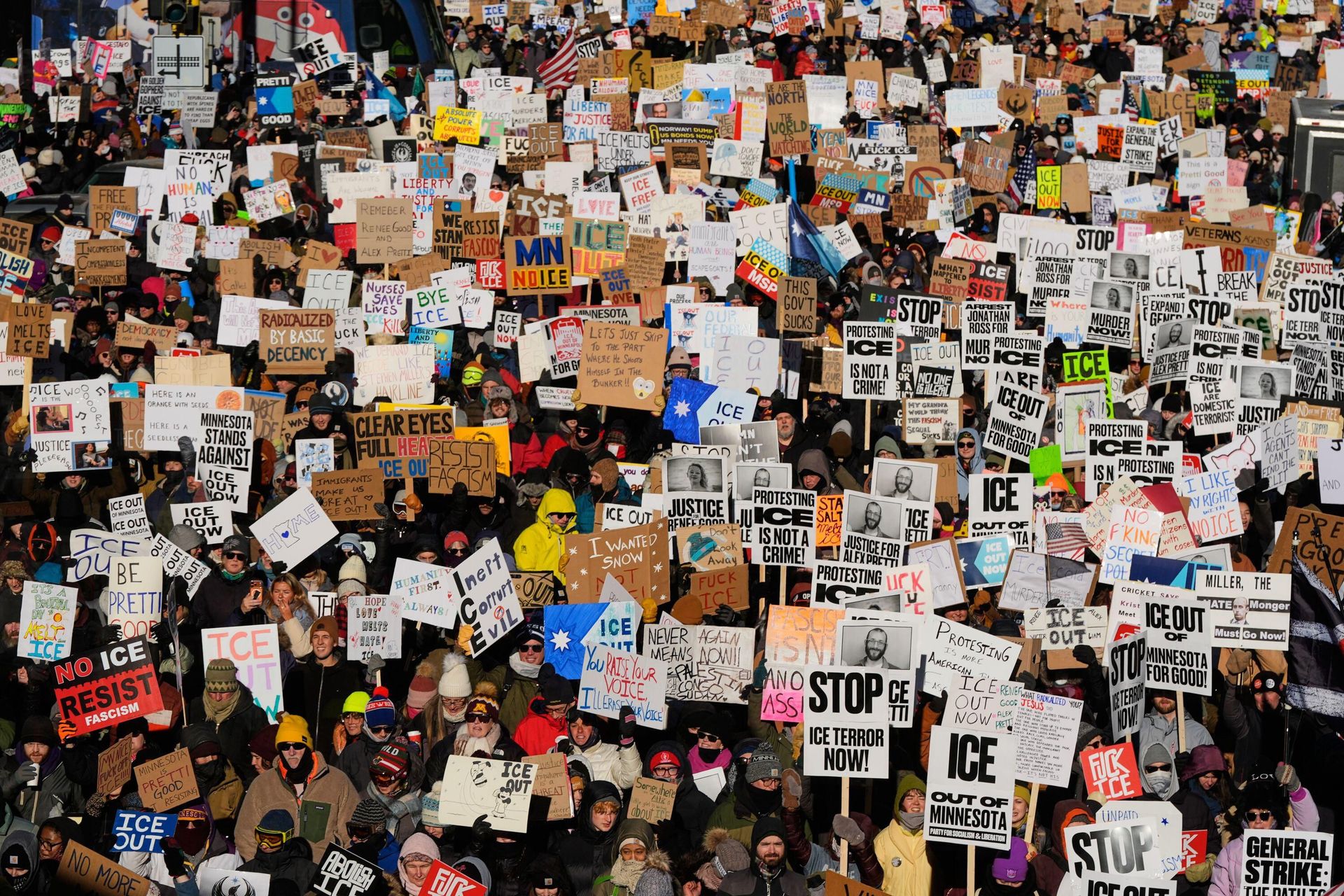
The first protests were small, mostly activists and student groups organising "noise demonstrations" outside hotels housing federal agents. The bigger protests, drawing tens of thousands, were in response to the murder of Renee Good. Both her and Alex Pretti’s shootings were captured, verified and shared widely on social media triggering a national outcry from the whole country – and beyond.
The Community Steps Up
Out of that surge of citizen resistance came Defend the 612 – a volunteer network co-founded by Minneapolis activist Andrew Fahlstrom on 1 December, the very day that Operation Metro Surge began. Named after Minneapolis’ area code, the group quickly become a central hub for volunteer networks monitoring federal enforcement and mobilising residents. It now runs more than 150 neighbourhood Signal chats across Minnesota, sharing real‑time alerts about ICE activity. (The encrypted messaging app is favoured by activists because it doesn’t collect user data like WhatsApp and iMessage.) Maps update multiple times a day, and a crowdsourced database tracks more than 4,800 licence plates of suspected ICE vehicles.
Defend the 612 also distributes ‘community protector’ vests to volunteers who patrol and observe enforcement actions, making observers more visible to neighbours and agents alike. The vests themselves aren’t dangerous, the real risk comes from watching – a role that has already cost two people their lives.
When someone spots ICE, they blow their whistle to alert the neighbourhood – a simple but effective early warning system. Stella Carlson, whose video of Alex Pretti’s shooting acted as a vital rebuttal to the administration’s attempts to frame him as a radical insurgent, described the system’s ubiquity: “I was getting ready to go to work when I heard whistles outside. I knew the whistlers meant that ICE agents were in the area, so I decided to check it out.” The whistles – 3D-printed en masse and unable to keep up with demand – have formed the soundscape for a city under siege; a small and inexpensive item used by a community that refuses to feel helpless. One that continues to look out for one another.
Six miles from where Alex died, Smitten Kitten – a progressive sex education store – also reinvented itself. By mid-January, adult toys shared shelf space with towers of diapers and canned goods, distributed to those too at risk to leave their homes. “We’ve always been passionate about taking care of our community, giving people accurate information about how to make choices for their own lives,” Anne Lehman, the store’s social media coordinator, told the Hill & Lake Press. “So we’re just extending that to the most basic human needs: food and safety.” Anne did a Costco haul for household essentials and posted Smitten Kitten’s Venmo details to social media, raising $500 in just 10 minutes. By January, the team had shifted to distributing cash to families who couldn’t work or pay rent. They continue posting campaigns daily on Instagram – the support remains urgent. And outside the city, allies have been rallying to help.
“We’ve always been passionate about taking care of our community. So we’re just extending that to the most basic human needs, which are food and safety”
A Movement Of Faith
On 23 January 2026, in -20°F weather, around 100 multi-faith leaders gathered at MSP Airport for the ICE Out of Minnesota: Day of Truth & Freedom march. They sang hymns, prayed and shared stories of airport workers detained by ICE, calling on Delta Air Lines and Signature Aviation to end the deportation flights leaving. Volunteers tracking ICE flights estimate that more than 2,900 people have been deported through the airport since 1 January, with up to two flights departing daily in early February. Reverend Elizabeth Barish Browne travelled from Cheyenne, Wyoming for the protest. “What’s happening here is clearly immoral,” they told the National Catholic Reporter. “It’s definitely chilly, but the kind of ice that’s dangerous to us is not the weather.”
After two hours in freezing weather – having moved beyond their permitted demonstration area to block airport roads – law enforcement moved in. Around 100 were taken into custody and loaded onto school buses, before being released with misdemeanour citations. But those arrests did not contain the protest; they amplified it. Images of clergy in stoles and winter coats, kneeling on icy tarmac before being led away crystallised that this was about the moral direction of the state itself. The airport action became a defining moment: more than 700 businesses across Minnesota closed in solidarity, from tiny bookstores near the Canadian border to the landmark Guthrie Theatre. Organisers estimated that between 50,000 and 100,000 marched for the people of Minneapolis, and once again it caught the attention of the world’s press.
The Blueprint Of Black History
This isn’t the first time a federal push for compliance has radicalised resistance – nor the first time people have mobilised in response. In 1850, the federal government passed The Fugitive Slave Act, requiring citizens and law enforcement, even in free states, to assist in capturing and returning self-emancipated people to the South. Intended to suppress dissent, it instead galvanised previous hesitant citizens and strengthened the Underground Railroad.
Montgomery, Alabama had segregated buses since 1900, but it wasn't until 1955 – when Rosa Parks and others were arrested for refusing to give up their seats – that the community organised. They held a 381-day boycott, walking miles to work and arranging carpools. The law that meant to maintain segregation became the spark that helped end it.
In Selma in 1965, as civil rights marchers faced state violence, Dr Martin Luther King Jr observed: “The people of Selma will struggle for the soul of the nation, but it is fitting that all Americans help to bear the burden.” Sixty years later, the same could be said of Minneapolis. The tactics that ICE is using aren’t new; they reflect methods that Minneapolis Police have deployed for years. “This is an extension of local law enforcement,” says Patience Zalanga, a photojournalist documenting the occupation. “We’ve been here before.”
Minneapolis has indeed been here before – after the murders of Jamar Clark (2015), Philando Castile (2016), Ricky Cobb II (2023), Amir Locke (2022), and of George Floyd in 2020, whose murder sparked for the largest wave of Black Lives Matter protests – the infrastructure for resistance already existed. “Rapid response systems were already created behind the scenes,” says Lee Stedman, a community organiser who has been coordinating rapid response efforts in the city. “When this happened, people knew where to go.”
“The tactics ICE is using aren’t new; they reflect methods Minneapolis Police have deployed for years. ‘This is an extension of local law enforcement,’ says photojournalist Patience Zalanga. ‘We’ve been here before’”
The state has a long history of union halls and grassroots movements. For generations, Catholic and Lutheran churches have resettled refugees. In 2024, it had the nation’s highest voter turnout: 76.4%. Minnesota represents much of what America’s current leadership rejects. The administration targeted Minneapolis for its largest immigration crackdown in history deliberately and yet made a grave error in anticipating its response; this was not a state that would comply out of fear – it was a state with both the infrastructure and moral conviction to resist.
A Refusal To Back Down
Back at Post Modern Times, Dylan Alverson’s Instagram explains: “I am sick of generating money for the soldiers in our streets and for a government that won’t protect us.” The restaurant maintains normal hours with a smaller menu. The team gives their time as volunteers. Some customers pay what they can. Others pay more, because they can.
“Post Modern Times is a small stance amid a gigantic fight that may shape the future of this country,” Dylan wrote. “I am inspired by the ways our community has grown together, our hearts breaking open, to give and receive care in all the ways we can.”
Minnesota has embodied a lived democracy; one that is practised by fundraising the rent of neighbours scared to leave their homes, in the choice to stand guard so folks can pray safely. Whistles have become a language. Sex shops have become food banks. Restaurants have refused profit. Thirteen thousand people trained themselves to become ‘constitutional observers’, to act as witnesses.
And, on the surface, it worked: On 12 February, border tsar Tom Homan announced that Operation Metro Surge would end – and the federal agents are leaving. A city that was meant to serve as an example of federal power has become an example of something else entirely. “They thought they could break us,” Jacob Frey, the mayor of Minneapolis, said. “But a love for our neighbours and a resolve to endure can outlast an occupation.”
On the ground, the reality is more complex. ICE operations haven’t stopped – they’ve moved to surrounding suburbs and western Wisconsin, away from cameras and headlines. “It’s harder to figure out where federal agents are going to be,” says Lee. “Observers are still being followed. Guns are still being pointed into people’s faces.” Outside the Whipple Federal Building, a group called Haven Watch stations volunteers 24/7 to collect people released from detention, sometimes without shoes or ID. “We’re still trying to get them to safety,” says Lee.
And the psychological toll is profound. “Even if you weren’t directly impacted, you’ve been impacted,” says Patience. Employees too afraid to go to work. The horrifying and absurd hypocrisy that Native communities have been detained by ICE. Black and Brown-owned businesses that couldn’t operate for weeks now face economic ruin.
“I’m worried that our city government is unable or unwilling to step in with resources to help all the small businesses on the brink of collapse,” Dylan says. He hopes people keep raising money to subsidise the immigrant-owned businesses that make up the heart of the city. “Every block in south Minneapolis has stepped up and built networks to not only monitor ICE, but to feed and support who’s in need,” he notes. “Most people here anticipate a second wave,” adds Lee, referencing either more deportations, or broader intimidation tactics, such as ICE being stationed at polling locations during elections. “It’s a battle that's been somewhat won, but the chessboard is still in motion.”
Whatever comes, the city has already built the muscle memory of resistance: the networks, the courage – and the collective will to say no.
To support mutual aid efforts in Minneapolis, visit the Minnesota Immigrant Rights Action Committee, Smitten Kitten, Modern Times Cafe, Defend the 612, or Mercado Central.