When the shelling began in El Fasher last week, Umgasi Adam grabbed her children and ran. “We left our breakfast pots still on the stove,” she said from Tawila, 60 kilometres away. She didn’t look back – not at the goats still tied up, the chickens in the yard, or the neighbours who didn’t make it out.
She was one of the lucky few to escape from one of largest cities in Sudan’s western Darfur region, which has now been conquered by a brutal militia. The Rapid Support Forces (RSF) had swept through its streets with terrifying speed. Doctors were shot in their wards, patients executed in their beds. Satellite images later showed stains of blood wide enough to be seen from space. El Fasher’s fall was the catastrophe many had feared for months – a slow-motion collapse that the world watched and then looked away from.
To understand how Sudan reached this point, you have to go back to 2019 – the year the country dared to hope. After 30 years under dictator Omar al-Bashir’s rule, Sudan erupted. Millions filled the streets, demanding freedom. They brought him down and, for a moment, democracy flickered.
But then two men stepped forward – army chief Abdel Fattah al-Burhan and militia commander Mohamed Hamdan Dagalo, known as Hemedti. Together, they capitalised on the revolution’s momentum, positioning themselves at the centre of the country’s transitional period while deeper ambitions simmered beneath the surface. Hemedti, once a camel trader from Darfur, led the RSF – a militia born from the notorious Janjaweed, the same fighters who razed villages and committed genocide two decades earlier.
The tension between them – between the army’s claim to legitimacy and the RSF’s hunger for power – only deepened as Sudan’s transition faltered. Two years later, in 2023, the Burhan-Hemedti alliance collapsed into war. In April of that year, Burhan’s army and Hemedti’s RSF turned their guns on each other – Burhan’s forces controlling the east, Hemedti’s sweeping across the west.
Eighteen months on, Sudan is a country split in two. The army clings to the east; the RSF holds most of Darfur – a vast, gold-rich desert roughly the size of mainland Spain. More than 13 million people have been displaced. Famine has begun.

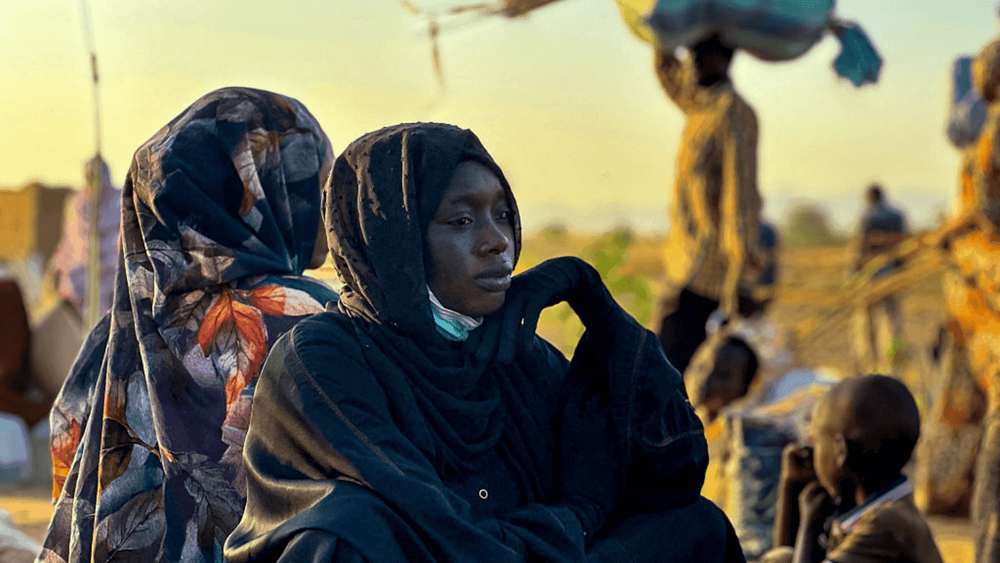
Dabaniera Camp, Tawila, North Darfur. Photo: Aurélie Lécrivain / MSF
For over a year, El Fasher – the army’s last stronghold in Darfur – was under siege, with reports that 260,000 people remained trapped inside and survived on things no human should have to eat: animal feed, leaves, scraps of bark. When the RSF finally broke through and captured the city, forcing Sudan’s army to withdraw, thousands fled into the desert, but aid agencies warn hundreds of thousands may still be trapped inside the city.
With communications cut and journalists vanishing, it could be months before the scale of the bloodshed is truly known. Interviews with survivors are only part of the horror as evidence of mass graves from satellite pictures and accounts of summary executions are mounting.
In Tawila, doctors from Médecins Sans Frontières said nearly 400 gunshot victims arrived in just three days. Paediatrician Giulia Chiopris said: “Every story is the same: torture, gunshots from travelling on the road and people surviving on animal compost.”
Umgasi, scarred by shrapnel, crawled for days in the heat, leading to friction burns all over her body. She said: “We ran into soldiers when I was injured – my children were carrying me in a wheelbarrow. They searched us and took my daughters’ phones, our money, rings, documents.” It’s almost impossible to imagine – a mother, half-conscious, being pushed through the desert by her children, only to be robbed by the very people meant to protect civilians.

Sumia Ibrahim said in hollow shock that a strike killed her son: “He was split in half.” Another woman, now sheltering in the camp at Tawila, described being hunted as she fled: “They kept coming after us. We hid under trees, bushes and hay, but we were surrounded.” The detail is devastating in its simplicity: people running not toward safety, but away from death that never stops coming. Francesco Lanino of Save the Children described what his teams have seen in El Fasher: “Door-to-door killings, starving families, and hospitals destroyed.” It is a portrait of total collapse – of a place where every structure of care, every space of mercy, has been deliberately torn apart.

Three months ago, in South Sudan, I met people who had fled Sudan long before El Fasher fell, yet fleeing war from elsewhere in the country and crossing the border in search of safety. Just this week the United Nations warned it was on the brink of another civil war but still, they fled there because there was nowhere else to go – it’s the nearest open border.
One mother I met, Hanan*, had walked for a month carrying her two-month-old baby while her three-year-old twins stumbled beside her. “They cried and asked for food on the road,” she told me, her feet still caked in mud. At the border crossing, she saw RSF fighters shooting civilians at close range. One of her twins lay listless on a mat as we spoke, legs like matchsticks. Healthcare workers told me he weighed barely 10 kilos – right at the acute end of severe acute malnutrition.
Across the compound, a heavily pregnant woman sat in the shade, cradling her belly. She said quietly: “I came on my own. When the gunfire started, everyone scattered. My brother was killed in front of me. My husband ran the other way, and we were separated.” In every story, there is the same thread: unimaginable endurance. These mothers walked through the night, feet bleeding, newborns strapped to their chests, refusing to stop.

Sudan’s war is not just Sudan’s tragedy, it’s a regional powder keg and the RSF’s brutal rise has been fuelled, analysts say, by outside powers. The UAE has been accused of supplying weapons, drawn by Sudan’s gold and its strategic position on the Red Sea. While Abu Dhabi denies involvement, evidence increasingly mounts that they are enabling the killing. Smuggling routes now stretch across Chad, Libya and Egypt. The longer the war drags on, the deeper these shadow economies take root and the harder it becomes to imagine Sudan as one nation again.
If Darfur is lost, Sudan could fracture permanently: an RSF-run west, rich in gold and trafficking networks and an army-held east controlling the Red Sea coast. That kind of partition would ripple far beyond Africa – destabilising trade, fuelling migration and emboldening militias across the region.
But beyond geopolitics lies a simpler truth: this is the horror the world swore would never happen after Darfur’s first genocide and Rwanda’s genocide. And yet, here we are – watching from afar as children starve and hospitals burn. “A desperate search for even a handful of grain is a daily reality. Families boil leaves to survive. What will it take for the world to act?” says Deepmala Mahla of CARE International.
Nathaniel Raymond from the Yale Humanitarian Research Lab, who have been tracing the satellite images of the horrors, issued a plea just yesterday: “A message to anyone: do something... Hours or days is the scale of time we’re working on here. And so call your congressman. Call your senator. Do whatever you can now. But we’re running out of time.”

It is almost impossible to capture the scale of what is happening. I think of those mothers walking through the night with their babies tied to their chests; the medics sending voicenotes from bombed-out hospitals, their voices trembling but steady; the air filled with trauma, hunger and exhaustion – the residue of a war the world has stopped watching.
Each number – 13 million displaced, 30 million in need – is a story still unfolding. A name. A voice. This war thrives on silence. It feeds on indifference. It depends on the world looking away. And if it keeps looking away, it will not only destroy Sudan – it will stain us all.
Organisations To Support
The UN’s aid arm, OCHA, says relief convoys are still barred from entering the city – despite the RSF-controlled Darfur administration urging agencies to speed up assistance. Aid groups fear the RSF aims to use humanitarian relief to pin civilians in place and burnish its own legitimacy. So it’s even more important to support credible global humanitarian organisations such as these:
- International Rescue Committee (IRC) works in Sudan with displaced people, providing health, nutrition and protection.
- Save the Children has been in Sudan for decades; supports children’s health, nutrition, education and emergency response.
- CORE (Community Organized Relief Effort) partners with local Sudanese NGOs, supporting mobile clinics, cash assistance and community-based response.
- IDP Humanitarian Network is an Indigenous-led network responding directly on the ground in Darfur, including in El Fasher and surrounding areas.
Supporting or following Sudanese-led groups helps ensure local voices are amplified and resources reach grassroots levels:
- Coalition for Mutual Aid in Sudan – coalition supporting local mutual-aid groups in Sudan.
- YCON – a local youth-led monitoring group tracking the humanitarian, political and security situation.
How You Can Support Such Initiatives:
- Share their stories and platforms to raise their visibility
- Provide funding or resources
- Engage in advocacy: ask your elected representatives to prioritise protection of civilians in Sudan
Reliable Sources To Stay Informed:
- International Center for Not-for-Profit Law (ICNL): The Civic Freedom Monitor for Sudan gives updates on civic space and legal issues.
- The Humanitarian Research Lab (HRL) at the Yale School of Public Health: One of the few international actors still conducting real-time monitoring in Sudan.
- The Ceasefire Centre for Civilian Rights: Diaspora network in documentation and reporting for timely updates.
- Women’s Peace and Humanitarian Fund (WPHF): Supports women-led and women-rights civil society organisations in Sudan.
*Names have been changed