I spent my twenties in a haze – drinking too much, partying often and achieving little of consequence beyond mastering one thing only: the dinner party. The first was in the tiny studio flat in London that I shared with my partner, Lo’, when we were 18-year-old broke students. We made fresh pasta, sat on the floor, drank £5 wine and smoked indoors – behaviour that felt impossibly glamorous at the time. What we learned quickly was this: gathering people around food was our favourite way to connect. To get to know new friends. To prove and provide affection. By our twenties, the ritual had become twice-weekly, sometimes three times, and – pandemic aside – it’s a rhythm that has shaped my life ever since.
Now, I’ve written a whole book on dinner parties – To Entertain (out in April 2026) – so I’ve spent a long time thinking about what actually makes them work. And the truth is, it’s rarely the food or the setting. It’s the people. Some guests, well, fall into certain archetypes. Not disastrous because of what they do, but because of what they say — the energy they bring, the thoughts they can’t help expressing. Here are five of the worst offenders, in my opinion...
The Premature Party Invader
A nightmare: someone you barely know arrives early. Your hair is wet, make-up unapplied, and you may or may not be wearing a towel. Worse, the house still bears the traces of your real life – sweet wrappers on the sofa, questionable medicine in the bathroom, chaos everywhere. At a loss, you offer them a drink, some crisps, but you can’t actually talk to them. You seem distracted, even unfriendly, while they hover awkwardly in your half-cleaned kitchen. By the time the other guests arrive, they’ll sense a certain chill between the two of you – a coolness that will never quite thaw. Any attempts toward warmth later reads as overbearing; any attempt at casualness lands as cold. The dynamic will continue until they leave. It is not their fault, not really, but be warned: if you’re that early guest, go for a walk, grab a drink or simply stare at your shoes until at least ten minutes after the official start time.

The Unapologetic Latecomer
Lateness, in itself, is no crime. Lives are complicated, leaving the house is hard, and late guests are often the most fun – arriving full of stories and excitement and a kind of sparking chaos that’s worth the wait. And while their excuses may be good, bad or entirely made up, such energy makes them jewels that usually eclipses any inconvenience. Besides, a good host is never derailed by lateness; nothing they serve relies on punctuality. One late arrival simply gives them more opportunity to lavish attention on whoever’s already there.
But then there is the other kind of late guest – the bad kind. They arrive without apology and, if eating has commenced, tuck in silently, as though they here solely for the food. They speak only about themselves, rarely laugh and remain fused to their phones, texting through the evening. Their lateness – harmless in theory – is indicative of how little they care for anyone else’s time and how highly they regard their own. They’re often the first to leave. And they should not be invited back.

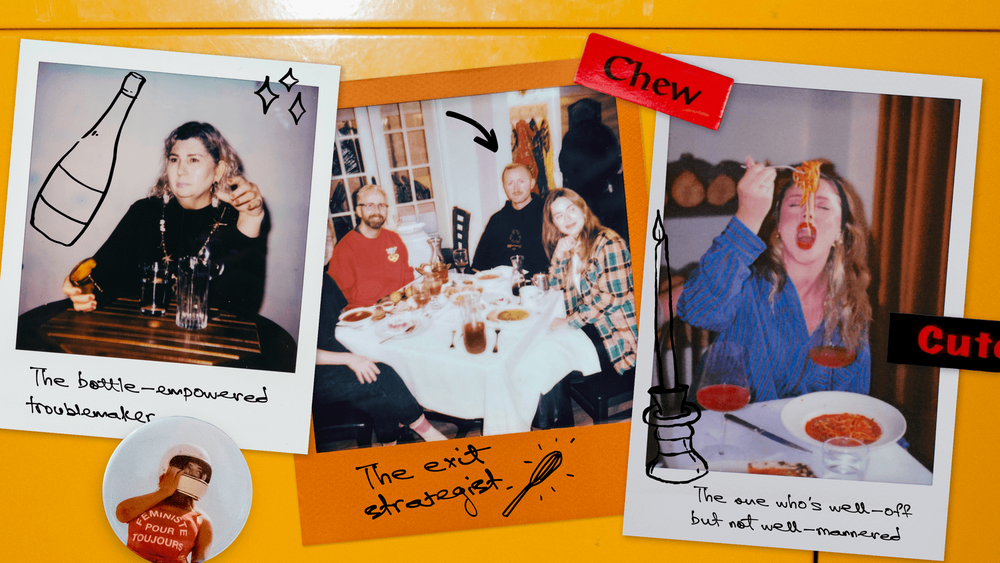
The Bottle-Empowered Troublemaker
I’m sober now, but I dislike dinner parties without alcohol. Having – and being – fun without its social lubrication is a skill many haven’t yet mastered; there’s a reason humans have been drinking for together for millennia. And so, more often than not, dinner parties often produce the drunk who may start out charming but soon they’re slurring their words, repeating themselves and derailing conversations with baffling non-sequiturs. No amount of gentle nudging, raised eyebrows or diplomatic subject-changes stops them from refilling their glass. The only intervention sharp enough to cut through would ruin the entire atmosphere. Sober, they can be thoughtful, interesting, even kind. Drunk, they can slip into something meaner.
It’s worth saying: while some people with alcoholic issues behave like drunks, most don’t – they are skilled at balancing consumption and composure, aware that too many missteps has consequences. This happened to me. Most drunk guests, though, are usually infrequent drinkers, someone whose missteps resemble those of a new driver – part inexperience, part nerves, part over-excitement. As long as they’re not cruel or aggressive, Drunks can be met with compassion. They deserve a gentle, private word when sober – a reminder of how enjoyable they are before they’re sloshed – and, if they’re willing to hear it, a second chance.

The One Who’s Well-Off But Not Well-Mannered
By definition, all guests are rich. Because generosity at a dinner party is not measured in the cost of the wine you bring, but by the spirit you arrive with. Someone without money who turns up with a £6 bottle, a jam or handful of hedgerow flowers is, in fact, the most generous of all – they have used what they have, and they’ve shown heart. Often, kind words alone can feel like a gift. Hospitality, when properly understood, is not a transaction.
But when someone with means arrives empty-handed, it can reveal a certain thoughtlessness – a belief that their mere presence is contribution enough. Worse, it suggests they assume everyone else is cushioned by wealth, forgetting that, for most of us, dinner parties are powered by pooled resources and that conviviality relies on sharing. When the wine’s run out, the rich non-bringer won’t volunteer to get more. They won’t be impressed, nor will they comment, upon your special garnish, homemade focaccia or the fact you ironed a tablecloth for the first time in years. They expect the finest things because they are used to the finest things. And in that sense – yes they are selfish. Which is probably how they got rich in the first place.

The Exit Strategist
These are the guests who want you to know, subtly but insistently, that you are lucky they came. They are busy, popular, important, possibly famous or at least they want you to think they are. Punctuality is a suggestion, generosity a rumour. Drunkenness? Never. They are saving themselves – for something, somewhere, someone better. They linger at the edge of the dinner table, never joining in. They seem bored, constantly checking their phone for the time and messages from people they’d prefer to be with. When pudding arrives, they vanish with a delicate excuse: a party, an engagement, a life far more interesting than yours. They do not ask anyone to join them; why would they?
After they leave, a stunned silence reigns for a few minutes; a brief existential question about what just happened – before you move on, as you must, and forget them. They will not forget you. Oh no. The next day, they’ll post pictures of their adventures, rubbing elbows with glamorous and intimidating people, making sure you see. And though you didn’t even want to go, and had a wonderful evening, you feel shunned. If they’d told you their plans before, if they’d been considerate, you might not even have minded. But for these guests, thoughtfulness is the point. They are not just leaving early – they are demonstrating, with exquisite cruelty, how little you, your dinner, truly matter. But you, meanwhile, had the pudding – and the company that actually mattered.

And, A Toast For The Guest Who Gets It...
At the heart of every dinner party is presence. Not just the act of showing up, but the willingness to arrive fully – curious, attentive, generous with time and laughter. A good guest notices the small things: the effort that went into a sauce, the story behind a wine bottle, the quiet rhythm of a conversation that isn’t theirs to dominate. They linger not to impress, but to belong; they leave not to prove a point, but because the night has run its course. It is these guests who transform a meal into something to remember, who make a host feel seen without demanding attention, who remind everyone that the truest measure of generosity is the company you keep. After all, the nibbles, the cocktails, the place settings are nothing without the people who bring them to life.