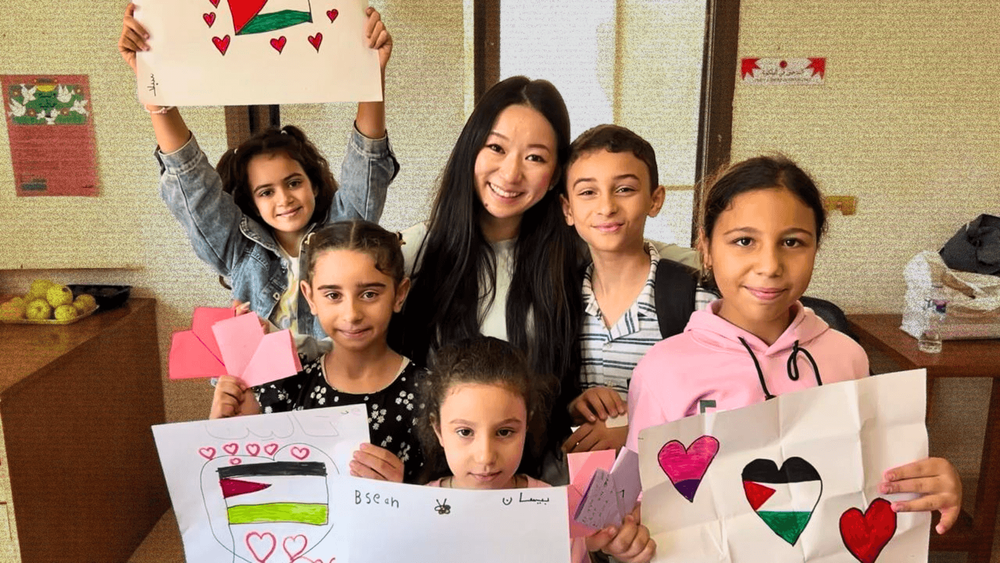
Sometimes, they don’t talk at all. For 60 minutes, through video or voice calls, a patient in Gaza and their therapist may hold moments of grief and tears in silence or move through breathing exercises – gentle somatic movements designed to release the chronic tension lodged in shoulders, neck and jaw from months of hypervigilance. Other times, a therapy session is interrupted by a small child, and the clinician must quickly pivot – bringing the boy into the conversation while his mother processes the trauma of tanks appearing outside their home and the impossible choice of fleeing with elderly in-laws into an uncertain night.
This is the unique space offered by Healing For Gaza (HFG) – an emergency mental health initiative that has delivered more than 1,500 psychotherapy sessions to Palestinian children, parents and frontline workers since it launched 14 months ago. What began as a team of three has grown into a global community of more than 120 psychotherapists, psychologists, psychiatrists, interpreters, clinical coordinators, advisors and volunteers responding to what international health organisations are calling an “unprecedented mental health crisis”. Patients are referred to Healing for Gaza either by partner NGOs on the ground, or they can sign up directly through an internet link via Instagram – and the HFG team have been flooded with requests. About one quarter of their caseload have also been referred by existing patients, already comforted by the spaces that HFG offers.
By April 2024, as the bombing, displacement and deprivation continued, UNICEF estimated that 100% of children in Gaza needed mental health and psychosocial support. “There’s nowhere else in the world where UNICEF has ever said that every single child needs mental health support,” UNICEF spokesperson James Elder told The New Yorker. If that was in 2024, then today the trauma runs even deeper, the need even greater – and even as a tentative ceasefire takes hold, there is still nowhere near enough help to go around.
The Making Of A Healer
Dr Alexandra Chen – a Harvard-educated psychologist from Hong Kong who may be the only Arabic-speaking child trauma psychologist in the world – had carried the idea for a decade. Then she spoke with Lina, whose eight-year-old son had lost both legs in 2019. “If there was anyone in the world who could help me tell him that his life was still meaningful, that he would still be able to pursue his dreams again – I would have looked everywhere for that person, and it was you.” The mother’s final words stayed with Dr Chen: “If you’re not starting this because you only have access to a few other therapists who can help only three, five, 10 children – shame on you, because each one of those children means the entire universe to someone.”

Though Dr Chen had spent almost two decades serving war-affected children from more than 40 conflict zones, Gaza was different. “There is no ‘post’ to post-traumatic stress disorder,” she says, just days before the first phase of the ceasefire was announced. “This is a genocide. Palestinian children know their trauma is man-made, which means man has the power to stop it. They understand the intent to erase their homes, families, lives, entire family lines. They know their suffering has been livestreamed before the world for almost two years – and no one has put a stop to it.
“There is no ‘post’ to post-traumatic stress disorder. Palestinian children know their trauma is man-made, which means man has the power to stop it.”
“One of my 7-year-old patients [Lara] lost both her legs in a bomb that killed her father,” adds Dr Chen. “Her father wrapped his body around her, protecting her vital organs, and she had to watch him die while trapped under rubble for almost three days.” According to the Child Trauma and Conflict Care Monitoring group (CTCCM), 96% of children in Gaza reported fearing imminent death as of January 2024. For many, that fear is rooted in direct exposure to violence and loss, and Dr Chen describes how children are desperate to preserve their culture as a form of survival, saying things like: “I need to hold on to every memory of Gaza, every piece of our dialect, because that’s all I’ve got left to give to my children one day.” These children can sometimes be just 10 years old or younger.
Treating Trauma In Real Time
Providing therapy during an ongoing genocide presents challenges unlike any other. Chief among them, is what Dr Chen calls “invisible fragmentation”. “In Gaza, families live in the same building – you’re on one floor, your parents on another, your brothers on the third floor,” she explains. “So when a bomb falls, the entire family gets lost. The family line might get wiped out.” For those who survive, their hearts exist in multiple places at once, creating an impossible emotional geography. The fragmentation follows those who evacuated. “Anyone who’s been medevaced or forcibly displaced can’t live a full life because they’re feeling guilty about everything they’re eating,” says Dr Chen, who recalls one mother whose own mother remains in Gaza: “‘My mother, who’s been my best friend my whole life, is starving. What am I doing? I feel like the only option is for me to not eat. But I know that if I do that, then everyone falls apart.’”
Displacement also brings a cruel paradox: physical proximity without emotional closeness. “In exile, 17 people crammed into a two-bedroom flat is something ridiculous but, emotionally, no one’s telling the other person about how they’re suffering,” Dr Chen observes. One journalist told her: “My mom has no idea who I am anymore. Because when we talk, I can’t tell her anything that’s going on with me, so she has no idea who I am – and so now we’re strangers.” Sometimes she doesn’t even want to call, because each conversation only deepens the distance. “Every person from Gaza is trying so hard not to burden the other person,” says Dr Chen. “They are physically closer than ever, but more isolated than ever because they cannot share their inner lives.”
The Body Keeps The Score

Beyond talking therapy, Healing for Gaza offers somatic interventions – breathwork and bodywork. Nadia Abou Seda, a Palestinian-Canadian therapist, sees the physical manifestations of trauma in every session: chronic fatigue from malnutrition and hyperarousal, muscles clenched tight in the necks and shoulders, digestive problems, insomnia, heart palpitations. And while trauma impacts the body, mind and nervous system everywhere, what she sees in Gaza is different – “in both scope and intensity”. Trauma outside Gaza is episodic, followed by safety and recovery. In Gaza, trauma is chronic, collective and cumulative. An 18-year-old in Gaza today has endured six wars, a blockade imposed since they were seven, and now two-years of military assault and starvation as a tactic of war.
“In Gaza, trauma is chronic, collective and cumulative. An 18-year-old in Gaza today has endured six wars, a blockade imposed since they were seven, and now two-years of military assault and starvation as a tactic of war”
Faced with this relentless, layered trauma, Nadia’s approach centres on cultural grounding and flexibility. She honours Palestinian practices – communal mourning, oral storytelling, prayer, embroidery – alongside Western techniques, so therapy lands not as something foreign, but as something already known. It’s an approach built on “options and agency”, says Dr Chen. “Our job is not to decide for people what they want or need, but to provide options and give them agency to choose. Some people want individual therapy, then group therapy. Some want talk therapy, some want body work. A lot of it is us evolving with them.”
A Bridge Between Worlds
At the heart of Dr Chen’s model lies an innovation in emergency mental health care: the cultural interpreter. Bilingual connectors fluent in Arabic and English allow for non-Arabic speaking clinicians and Palestinian patients to speak their own languages, while still connecting in a seamless therapy session. Unlike many humanitarian settings, however, HFG interpreters are assigned long-term to a specific clinician and patient, becoming an integral part of the therapeutic alliance. “I am a linguistic bridge, ensuring the patient is properly heard,” says Laura Albast, a Palestinian journalist on the interpreter team. “I also pick up on emotional cues, cultural or religious idioms.” Yet, the emotional toll is immense. “Most therapy takes place after trauma has occurred,” adds Laura. “[But] this is not over. People continue to be killed and displaced. There is no safe place.”

Even amid the constant danger and grief, the interpreter model has revealed an unexpected resilience. “In the beginning, I assumed that trauma therapy in English with a translator would inevitably be ‘second best’ to therapy with a native Arabic speaker,” reflects Dr Chen. “But some of our patients explicitly request a foreign therapist, and many are deeply thankful for their interpreters. When we can have a patient in Gaza, a therapist in Sydney, and an interpreter in Ohio who all meet every week to hold each other in a protected therapeutic space – there’s something quite magical about that. I’ve learned that the small gifts we can offer at Healing for Gaza are options and agency – and it is up to each patient to decide what is best for them.”
This sense of being truly ‘held’ carries over to HFG’s day-to-day impact, which is profoundly meaningful. Another child patient of Dr Chen told her: “I have two people in the world [her therapist and interpreter] whose only job is to care for how I’m doing.” She reiterates: “That means so much to her, because while she feels she can’t burden her parent with her suffering, she believes she can tell her therapists everything. To know there are two people in the world dedicated to holding you in your most difficult time in life is no small thing.”
“So much of our work is bearing witness – to enormous anguish and grief, but also to extraordinary love and courage in the face of brutality and unimaginable loss”
Moments like this reveal the heavy responsibility HFG staff carry. “So much of our work is bearing witness – to enormous anguish and grief, but also to extraordinary love and courage in the face of brutality and unimaginable loss,” adds Dr Chen. “This means that as war trauma therapists, we must be able to bear it, and so our job is to train each of our clinicians and interpreters so that they have the skills and resources and safety to accompany our patients week after week on this journey.”
Dr Chen also shared the words of one young woman, a 26-year-old patient whose voice “sounded like she was at least 50-something”, worn down by caring for four children and aging parents after losing both her sister and husband. “During our triage, I listened to her anguish and asked what she wanted from us in therapy – and she said, ‘I have surrendered to the fact that we may not make it. If this is what Allah has written for us [because in Islam, there’s a concept of maktoub, that your fate is written by the Divine], I surrender to His plan, because I know there will be better for me in paradise. But I know this is a test of my faith. So I ask of you only two things. First, to help me succeed in this test: to not lose my faith as I watch all four children starve – to not give up. Second, if nothing else, then at least someone will have witnessed my life, will know everything that I have endured and sacrificed and how I was brave, because I cannot share these things with the people closest to me.’”
Therapy As Survival
Amid the relentless humanitarian crisis in Gaza, where basic needs like food, water and shelter remain unmet, mental health care can seem secondary – or even out of reach. But for Dr Chen and her team, this is a false and dangerous divide. “The perception of therapy as a luxury is a Western perception,” Laura argues. “This is because of the cost of these services in high-income countries, as well as the way in which mental health and wellness are promoted in public spaces [...] as consumer services, rather than a medical necessity. We need to understand that mental health affects physical health. Like our bodies – which require us to take care of them if we’re tired, hurt, or sick – our mind and psychological state also require tending.”
“We need to understand that mental health affects physical health. Like our bodies, our mind and psychological state also require tending”
Laura agrees that medical and humanitarian aid can – and should – include mental health care. And, offering therapy doesn’t mean denying food, shelter, or safety – it means recognising that psychological survival matters, too. “If there are criticisms about offering emergency mental health services, free of charge, to Palestinians who have requested it – who feel like the world has abandoned them during nearly two years of genocide that can be stopped – who am I to tell them that a trauma-specialised clinician lending their ear, or I as an interpreter offering my language, is a ‘luxury’ reserved for everyone, except for Palestinians from Gaza? Luxuries are meant to be enjoyed – mental health, on the other hand, is a medical necessity. There is nothing enjoyable about grief and loss.”

While physical aid remains blocked at borders, mental health support can cross digital boundaries. Healing for Gaza needs qualified mental health professionals willing to dedicate several hours per week to remote sessions, and non-clinical volunteers fluent in English and Arabic to serve as interpreters. For those unable to volunteer, financial donations provide therapy sessions. Right now, the organisation needs to raise an initial $3 million to prepare to meet the enormity of the mental health needs of thousands experiencing severe trauma, loss and grief in Gaza – because healing requires both urgency and ongoing support.
It’s this hope for recovery that sustains everyone involved. Nadia draws hope from the remarkable resilience of her patients: “What continues to inspire me is the extraordinary resilience of my clients. While they should not have to be forced to be so resilient – and the horror they’ve endured will forever change them – their ability to eventually bounce back, to reclaim life and dignity once the machinery of war subsides, is the ultimate form of success.”
At a time when 90% of Gaza’s population has been displaced, and every child needs mental health support, Healing for Gaza represents a different kind of resistance, one that has faith in the possibility of healing even amid ongoing trauma. More than therapy, it offers a lifeline to humanity itself. Its humble effort is a profound act of defiance against erasure, a testament to the unbreakable spirit of a people determined to carry their stories, culture and hope forward.
To volunteer with Healing for Gaza as a therapist or interpreter, or to make a donation, visit healingforgaza.org. The organisation is fiscally sponsored by HEAL Palestine, a registered 501(c)(3) nonprofit.