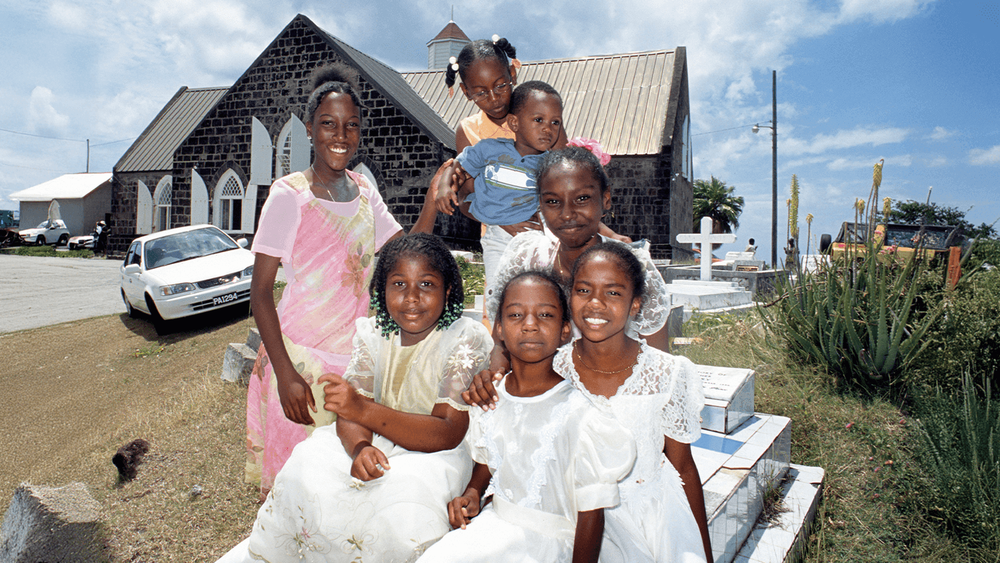
Whether or not you grew up going to church, you’ll know exactly what it means to don your Sunday Best. With roots in Black communities across the diaspora, it conjures vivid images of starched suits, colourful separates and towering hats; worshippers of all ages greeting each other on stone steps and parents fixing pleated skirts as they beam with pride. Putting on your smartest outfit has long been synonymous with the Sundays: time traditionally carved out to commune with your people, your faith and the very best version of yourself – no matter what else happened that week.
It might feel like something only elders adhere to now, but the Sunday Best tradition is enjoying a revival, from TikTok to the catwalks. ‘Get ready with me for church’ videos are going viral, with young Black men and women putting their own spin on dressing to impress. Designer Willy Chavarria clearly drew on the tailored, to-the-nines style for his AW25 collection, sending models in sharp tailoring, trilby hats and modest midi dresses down the runway at the American Cathedral in Paris. And the ripple effects of this year’s Met Gala, with its theme of dapper dressing and Black dandyism, continues to inspire the way we all show up in the world, with the trend for boxy shirts and statement ties still booming.

Sunday Best was borne from necessity; during the height of slavery, an hour off to worship at the weekend and a second set of clothes were about the only freedoms afforded to slaves of African descent. But even after abolition and well into the modern age, dressing well as a sign of respect both to yourself and your God became commonplace in Black communities, from the US and Great Britain to West Africa and the Caribbean.
“The Sunday Best tradition is enjoying a revival, from TikTok to the catwalks. ‘Get ready with me for church’ videos are going viral, and the ripple effects of this year’s Met Gala, with its theme of dapper dressing and Black dandyism, continues to inspire the way we all show up in the world”
“Church has been a saving grace for Black people at times when they had little else to look forward to,” says Karen Binns, a creative director and stylist from New York. During the Civil Rights era, especially, the Sunday Best look became a de facto uniform of non-violent protests; look back at any footage of that time and you’ll see rows of people walking, chins in the air, in their beautifully pressed dresses, waistcoats, pillbox hats and lace gloves. Coretta Scott King, especially, was known for marching alongside her husband in Castleberry tweed suits and a delicate string of pearls. It’s unsurprising, given that so much of the movement began inside churches, but it signifies so much more than that.

When deep-rooted racism attempts to paint Black people as less civilised and more unkempt than their white counterparts, the optics of Sunday Best dressing take on a political power. That’s certainly how the organisers of the Million Man March in 2020 felt, asking participants to step out in support of racial justice following the murder of George Floyd “fully adorned in their Sunday Best”. Leo Jones, one of the brains behind it, said the dress code was intended to “reframe the narrative and build a sense of joy in our community to see us looking so well, and marching with such pride.”
Today, a tradition that stemmed from a traumatic history has been reclaimed; a means of projecting Black worth and expressing who we are, on our own terms. Omoyemi Akerele, founder and CEO of Lagos Fashion Week, says that in Nigeria the Sunday ritual goes beyond class or economic power. “People are living their lives with intention, and a natural extension of that is to express themselves through what they wear,” she says. “On Sundays, they put their best foot forward – no matter what their income bracket is. Sunday Best has become a way of life.”
“People are living their lives with intention, and a natural extension of that is to express themselves through what they wear. Sunday Best has become a way of life”
Perhaps it’s this sense of self-determination that makes the Sunday Best tradition so inspiring to the world’s creatives. Designer Christopher John Rogers used his SS19 collection to pay homage to the extravagant church ensembles he witnessed during his childhood in Louisiana, while South African photographer Alice Mann spent a year and a half heading to her local church in Camberwell with her camera to create her collection, Always Wear Your Best On A Sunday. London-based photographer Katie Waggett also captures the cultural codes of dress and religion in her book Sunday Best, and Aida Amoako’s As We See It – a book that explores the concept of the Black gaze across photography and art – prominently features Lana Turner, a Harlem socialite and prominent member of the historic Abyssinian Baptist Church, known for joyfully flamboyant Sunday styles.

Whether you worship at the altar of fashion, faith or both, Sunday Best is a rich tradition that we can all draw inspiration from. Our Sunday Best reminds us that we deserve to dress up, feel good and surround ourselves with love and joy, no matter our circumstances. It’s a mantra for life, not just for the weekend.
Additional words by Meena Alexander.