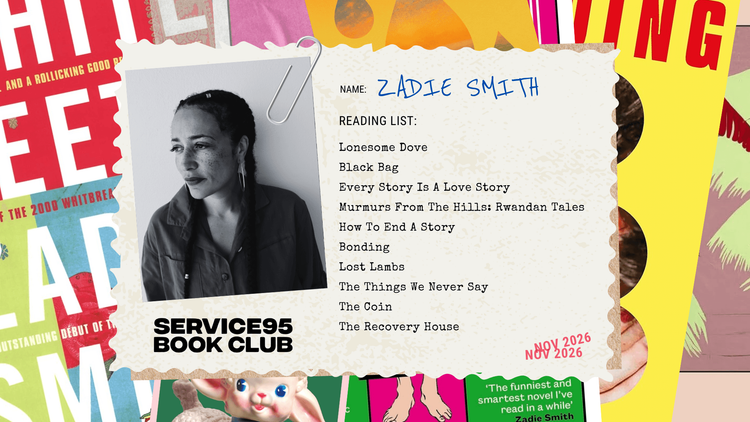
Zadie Smith was 24 when White Teeth was published in 2000. Twenty-six years later, it remains a defining portrait of London and the people who call it home. So the Southbank Centre was the natural setting for Dua’s latest Monthly Read conversation: two North West London girls, in front of a live audience in the heart of the city, revisiting the novel and its extraordinary legacy.
White Teeth is Dua’s Monthly Read for November, and the conversation was recorded as part of the London Literature Festival, curated this year by Dua and the Service95 Book Club. Set in London in the 1980s and 1990s, the novel follows three families – the Iqbals, the Joneses and the Chalfens – whose lives intersect across generations and cultures. Through the friendship between Archie Jones and Samad Iqbal, and the contrasting paths taken by Archie’s daughter, Irie, and Samad’s twin sons, Millat and Magid, it examines how family history and religion shape who we become. For all its big ideas, the book is full of absurdity and dark humour, bringing to life a cast of characters who are flawed and deeply human.
Zadie has had a famously complex relationship with her debut, once describing it as “the literary equivalent of a hyperactive, ginger-haired, tap-dancing 10-year-old”. But returning to the book now allows more space for reflection and affection: on writing unselfconsciously in your early twenties, becoming a literary sensation almost overnight and the reviews – good and bad – that followed.
Both Dua and Zadie grew up between different cultures. For Zadie, the daughter of a Jamaican mother and English father, that background was a starting point for White Teeth and for telling a different story about the communities she knew. “I would read about us in the papers, our neighbourhood as a problem, our communities as strange... I wanted to write not from the point of view of the newspapers, but from the point of view of life,” she says. That refusal to reduce people to a single version of who they are is perhaps why the novel has endured.
Later on, talk turns to Britain today, and how economic insecurity can turn difference into division: “When you’re living in decent housing, when you hurt yourself, you know you can go to hospital and be treated just like the rich kid down the road, then the differences [with others] become interesting, sometimes annoying, but not existential,” Zadie says. “Now, they’re existential.”
Twenty-six years on, the novel’s observations on identity, immigration and multicultural Britain feel strikingly contemporary.
Listen to Dua and Zadie’s full conversation on Service95’s YouTube channel or wherever you get your podcasts.
There’s More – Delve Deeper Into White Teeth With The Service95 Book Club...
LISTEN to a playlist chosen by Zadie that captures the mood of the 1990s
BOOKMARK the titles Zadie has been getting stuck into recently