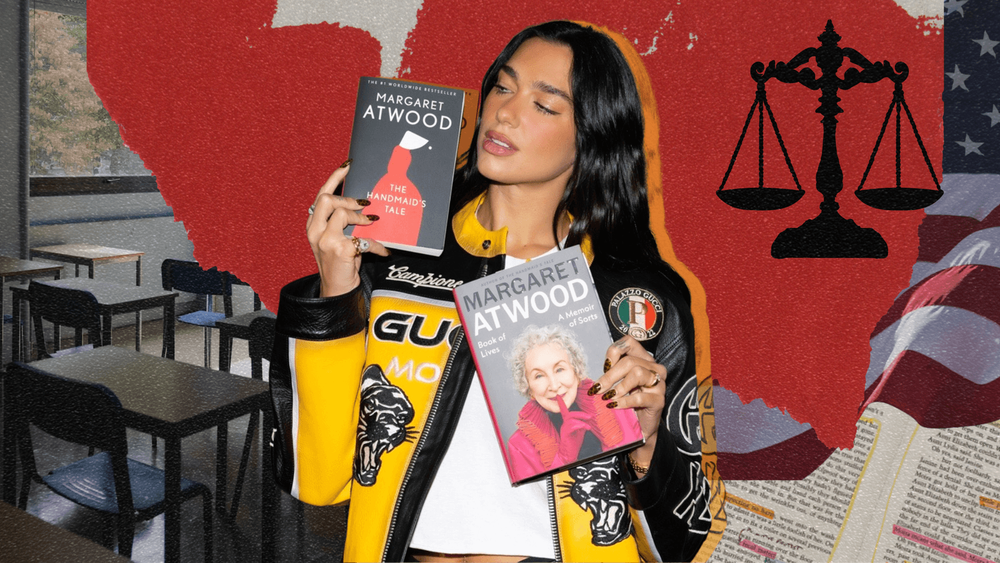
Everyone remembers the first time they read The Handmaid’s Tale.
I was 15 years old. I’d just returned from Kosovo to London to study for my GCSEs. Not only did I have a lot of catching up to do, but I had to get used to annotating and analysing books in English again. Honestly, it was a chore. Then, we were asked to read The Handmaid’s Tale – and I was hooked. It was a dramatic page-turner, and the dystopian world of Gilead blew my mind, partly because it was so different from what I knew. A world where women are not allowed to read and write? Pure fiction. A world where women are forced to procreate for others? Would never happen. A world where men call all the shots? Only in far and distant lands.
That’s what it was to 15-year-old me: a story; an exercise in imagination; a dark but fictional world.
Fast forward 15 years and re-reading The Handmaid’s Tale at 30 hits different. Maybe the world has changed, maybe I have lost my innocence, but it no longer feels so far-fetched.
In her excellent memoir Book Of Lives, Margaret Atwood talks about the difference between sci-fi and speculative fiction. She says: “The grandaddy of sci-fi is H.G. Wells with his big-brained and cannibalistic Martian aliens who invade Earth – a scenario unlikely to happen. The granddaddy of speculative fiction is Jules Verne, with his submarines and balloon trips around the world. In his time, such things were considered eminently possible. Nineteen Eighty-Four, too, is eminently possible. So is The Handmaid’s Tale. They are both speculative fictions.”
So, there we have it. “Eminently possible.”
It’s interesting to read in Book of Lives how The Handmaid’s Tale was received when it was published in 1985:
England: Jolly good yarn.
Canada: Nervous, as usual. “Could it happen here?”
The United States: On the one hand: “Don’t be silly, we’re the world’s leading liberal democracy, it could never happen here.” On the other hand: “How long have we got?”
How long have we got? For women in the US still reeling from the overturning of Roe v Wade, it might feel like time is running out. For women in Poland, still in shock from the 2020 ruling making abortion illegal in all but the most extreme circumstances, it might feel like time has already run out. That’s before we even start discussing Afghanistan and Iran.
Women’s rights are always in a state of flux. Just because you have it good (or at least better) doesn’t mean it will stay good. Maybe that’s what I didn’t understand when I was 15.
“Women’s rights are always in a state of flux. Just because you have it good (or at least better) doesn’t mean it will stay good”
Likewise, if things are bad, it’s always worth fighting for it to be better. Abortion in Mexico is now safe and legal. Thailand has legalised same-sex marriage. France is the first country in the world to enshrine abortion as a constitutional right. All this has happened in just the past two years – something that was no doubt unthinkable in 1985.
When I read the book today, and when I watch the TV show (which I have rewatched more times than I care to admit), it genuinely terrifies me. I find myself thinking: OK, who would I be in this scenario? Would I be ready to fight back in the way that Offred ultimately does? Would I be brave like Moira, who is fuelled by her rage, always fighting for a way out?
No one wants to believe she would become an Aunt. When I spoke to Margaret, she said: “Every colonialist knows that the best way to enforce your rule is to enlist an army from amongst those you wish to control.”
Before Gilead, the Aunts were just like us – librarians, lawyers, leaders of provincial Weight Watchers groups. After, faced with a choice of torture followed by death or complicity with the regime, they become terrifying enforcers of women who rule over the Handmaids with electric cattle prods and steel cables. Faced with the same choice, which way would we turn?
As Margaret likes to remind us, history doesn’t repeat itself – but it rhymes. I hear the book echoing lessons from history, whispering to me: this is how to prepare yourself for something ‘eminently possible’. It tells me: librarians and teachers are your superheroes. Protest book bans. Demand equal pay. Fight for your constitutional rights. And never, ever ignore the warning signs.
“As Margaret likes to remind us, history doesn’t repeat itself – but it rhymes. I hear the book echoing lessons from history, whispering to me, this is how to prepare yourself for something ‘eminently possible’. Never, ever ignore the warning signs”
There will never be a time when our rights are secured forever. And that’s why there is never going to be a time when we don’t need The Handmaid’s Tale. Note that in 2022, as the Supreme Court prepared to vote on Roe v Wade, the Handmaids were there. In their iconic red dresses and white bonnets, women protested, sending a message: Don’t fuck this up. If you do, this is where we are headed. It’s depressing to have lost that battle... But only for now.
In the book, Offred is part of a transitional generation. Aunt Lydia tells her that ordinary is what you are used to, and Gilead will “become ordinary”.
Ultimately, it’s up to us what kind of generation we want to be part of. Let’s keep The Handmaid’s Tale on the school curriculum so that every generation of boys and girls can read it and hear its warning. It’s up to us to listen and choose the future we want to live in.
There’s More – Delve Deeper Into The Handmaid’s Tale With The Service95 Book Club...
- WATCH Dua’s interview with Margaret
- BOOKMARK the novels that inspired Margaret Atwood’s vision
- LISTEN to The Handmaid’s Tale playlist, curated by Margaret
- DISCOVER what to read next from Margaret’s back catalogue
- EXPLORE what The Handmaid’s Tale tells us about women’s rights today
- MEET the costume designer who brought Gilead to life for the screen