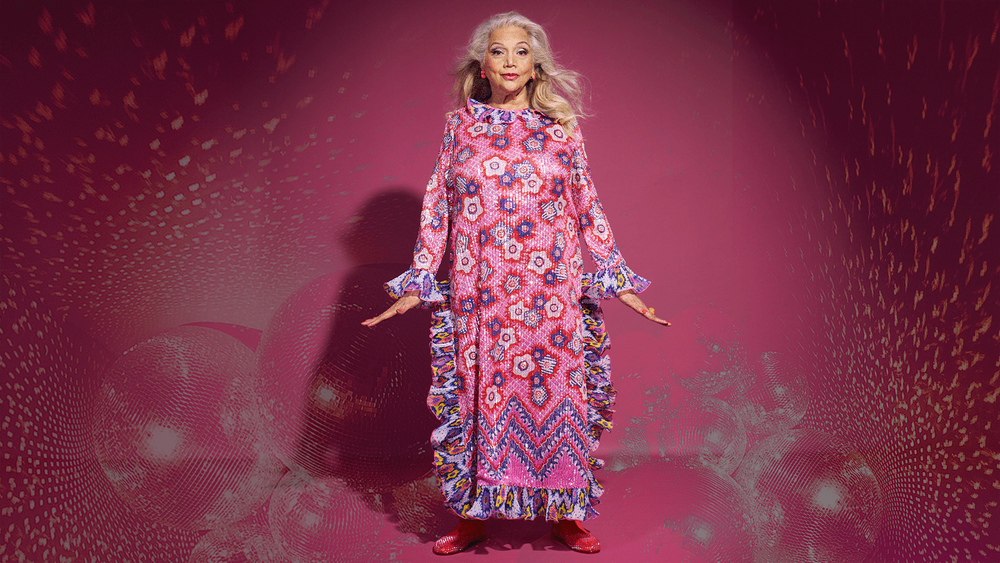
“My journey [in music] began as an embryo,” says music maverick Asha Puthli with a warm laugh, speaking to me over Zoom from sunny Florida. Her hair is tied in a loose bun, thick-rimmed glasses perched on her nose – still every bit as fabulous as the fashion-forward icon she became in the 1970s. Now aged 80, Asha remains as bold and magnetic as ever, a trailblazing artist whose career has spanned five decades, three continents and countless genres.
Blending jazz, disco and funk with Indian classical music, Asha was always ahead of her time – so much so that audiences didn’t always keep up. Her music has echoed through decades, sampled by some of hip-hop’s biggest names, even if most listeners never knew it was her. But in 2025, she’s finally getting her due.
Her resurgence began when UK label Mr Bongo reissued a string of her albums on streaming platforms: her 1973 debut Asha Puthli, followed by 1976’s The Devil Is Loose, and The Essential Asha Puthli, a 20-track retrospective, in 2022. Asha followed up with a remix EP of her cult hit Space Talk by Dimitri From Paris, and her official remix album Disco Mystik (via Naya Beats), featuring reworks by contemporary artists and disco legend Maurice Fulton. The renewed attention introduced her shape-shifting sound to a new generation – and in 2024, at the age of 79, she announced her first tour in over four decades. Next week, she returns to the stage in New York for a rare live performance at Central Park’s SummerStage – a full-circle moment in the city that first embraced her boundary-breaking spirit.
If you need proof that her comeback is more than just nostalgia, look no further than recent footage from her tour: Asha has lit up stages from Glastonbury’s West Holts – the same year Service95 founder Dua Lipa headlined the Pyramid Stage – to the We Out Here festival, curated by her friend DJ Gilles Peterson. She’s also played sold-out venues like The Jazz Cafe in London and shows across Australia. “Even though I am in my 80s,” she says, “when I am on that stage – thanks to the love and energy [the audience] gives you – you’re young... You are suddenly able to move and sing.”

For Asha, these festivals felt like “fairytales, straight out of a storybook” – but with better sound systems and crowds that actually got her. The same year of Asha’s first performance at the festival was also the debut of Glastonbury’s new South Asian-focused stage, Arrivals – a bold shift for the festival, and a powerful moment for a lifelong groundbreaker. Watching a new generation of South Asian talent come up behind her, many of whom cite her as an influence, hit hard. “It felt spiritual,” she says. After years off the radar, stepping back into the spotlight like this was more than a comeback – it was a statement. The family element of We Out There particularly touched Asha: “Giles actually asked me one day to read to children, which I did. It was such a wonderful feeling. The families came. We sat on the grass, under a tent, and it was like one big family picnic. It brought up the child in me, too – which isn’t hard.”
Bombay Beats
Asha might not be a household name (yet), but her music journey is anything but ordinary. Born in Bombay (now Mumbai) in 1945, she grew up in what she calls “a burgeoning metropolis filled with Indian film music” blasting out of homes and windows everywhere. When she thinks back to her first musical loves, it’s all about Lata Mangeshkar – whose “sweet, high voice” was basically the soundtrack to Indian films, with fans sometimes buying tickets just to hear her latest songs. Music ran in the family, too: her grandma chanting spiritual mantrams around the house, and her “talented” older sister diving deep into classical singing and ghazals. While Asha was totally into Indian classical music herself (she even studied Indian classical and opera), she had a secret obsession with jazz – the genre that would go on to shape her whole career.

“We used to get jazz on the radio for an hour or so on the USIS radio station... I would get up in the middle of the night whenever it was and religiously listen to it,” she says. Years later, she’d collaborate with the jazz legends she once tuned into – and “that very station would actually play my music just a year after I came to the States”. In Bombay, Asha shared her love of jazz by singing improv scales at tea parties – moments noted by writer Ved Mehta in his 1967 essay A Portrait of India, which helped spark her discovery in the US. But her journey wasn’t straightforward. Breaking “that centuries old tradition” of arranged marriage and homemaking expected of young Indian women, she was inspired by her aunt, a freedom fighter in India’s anti-colonialism movement. “She was a huge influence on me,” says Asha. “It was that same intrinsic drive that pushed me to move across the world.”

Rather than follow the paths of her brother and sister (and appease her mother’s wishes), Asha became a flight attendant with British Airways – an opportunity that “just literally [landed in her lap]”. After dropping a friend off to collect her pay slip from the British Airways office in India, the director urged her to join as a hostess, desperate for staff. “He dangled this one word: ‘passport’,” Asha says. That was all she needed. After colonialism and independence, passports were tough to get, “especially for artists”.
Downtown Rebel
A new passport changed everything. It brought Asha to New York, where she earned a scholarship to the Martha Graham School and never looked back. For over 50 years, the city was home – and she quickly became a fixture in its downtown creative scene. She partied and performed at Studio 54, became friends with Grace Jones and Andy Warhol, and was once stopped by Salvador Dalí, who was captivated by her style. “I think [the LGBTQIA+ community] saw me as they were – an outsider,” she says, describing the “deep mutual connection” she felt with both New York’s and the international queer scene, who embraced her long before the mainstream did. “I still remember,” she recounts, “walking into a drag club in Italy, and the queen onstage starting to sing and dance to my song The Devil is Loose.” Unknown to the drag queen, Asha was in that same room, admiring from afar.

But while the clubs welcomed her, record execs didn’t know what to do with an Indian artist fusing jazz, disco and Eastern sounds. “Black people are not going to buy your music, white people aren’t going to buy it and Indians don’t buy mainstream music... they just buy film music,” she was told.
When a major label came knocking, Asha pushed back. “I was being offered much less than my counterparts and I didn’t think that was fair... so I said no. Plus, they wanted me to change my name,” she says. Their suggestion? Ann Powers. When she refused, she was labelled “difficult.”

Unlike artists such as Freddie Mercury – born Farrokh Bulsara – Asha held onto her name. “It was my connection to India,” she says. That choice took guts, especially at a time when Western audiences struggled with anything “too foreign”. But it’s exactly this defiance that resonates with a new generation. “[She] simply paved the way for people like me,” wrote Punjabi-American artist Raveena in a heartfelt Instagram post – a nod to the power of showing up as your full self, name and all.
For a young Indian woman breaking into the music industry in the 1970s – with no real blueprint before her – playing by the label’s rules might’ve seemed like the only option. But instead of caving to their demands, she stayed true to her voice – and it paid off. A chance encounter in New York with writer Ved Mehta led her to Columbia Records’ John Hammond, who introduced her to jazz legend Ornette Coleman – who Asha once listened to on the radio back home. She ended up singing on his 1971 album Science Fiction, earning rave reviews and a DownBeat Critics Poll win for Best Female Jazz Vocalist – alongside Ella Fitzgerald. The industry was finally paying attention.

Legacy Locked In
Asha signed her first record deal with CBS in London in the early 1970s – the first South Asian person to ever be signed by the label – “and never once did they ask me to change my name”.
Her eponymous first album, Asha Puthli, was released in 1973 to high praise, and her track Space Talk became a cult classic. If you don’t think you’ve listened to Asha’s music before, you probably have heard this song. It’s been sampled dozens of times by hip-hop legends such as The Neptunes, Notorious B.I.G, Jay-Z and 50 Cent across the 1990s and 2000s. This has always fascinated Asha, because back “in those days [when the song was released], humans were not listening to [the track]... I used to joke only the aliens were hearing it.” Decades later, people certainly are.

As a result, she became legendary within underground circles, thanks to her punchy baselines, disco rhythms and space-high vocal range. “I feel very blessed and very lucky that these crate diggers, remixers and hip-hop A-listers have given my songs so much longevity.” Space Talk was even broadcasted into space to celebrate 40 years since NASA’s Apollo mission.
So with all this success, why isn’t Asha more widely recognised? By the 1980s, she’d hit pause – burned out by an industry that couldn’t box her in and wasn’t ready for a genre-defying South Asian woman. She turned her focus to raising her son, Janu, and distanced herself from the spotlight. Still, she never fully vanished, popping up with new music and collaborations, staying just under the radar – but always ahead of her time.
Now, thanks to recognition from tastemaker labels like Mr Bongo and LA’s Naya Beats Records, Asha’s not just back – she’s having a full-blown renaissance. Her early albums are being reissued, she’s playing major stages again and a new generation of artists is singing her praises: Raveena calls her a “musical fairy godmother” and even named her album Asha’s Awakening in her honour.

As for how she’s feeling about next week’s New York performance, “It’s like returning home because I lived in New York for 20 years... I’m a New Yorker”, she says, adding it’s where she also played the same festival nearly 20 years ago – a bittersweet reminder of how far she’s come. And she’s not stopping there: a summer of live dates follows, kicking off in Detroit (“the home of Motown,” she grins), before heading to UK festivals like Rally, Green Man and Summer Sounds as part of the Saturday lineup curated by South Asian collective and platform Dialled In. When reflecting on the new wave of South Asian musicians and DJs which Dialled In help to create a necessary platform for, Asha explains: “What makes me high is when I see the most amazing talent within the younger generation... it brings me a great amount of joy that the platform has widened. There’s strength in numbers – it’s not a competition, it never is.”
Ultimately, what strikes me most about Asha’s story is how true artistry doesn’t follow a straight path – it swerves, disappears, resurfaces and refuses to be defined by anyone else’s expectations. By staying true to herself, she turned what the industry once saw as “difficult” into something undeniably magnetic. Her recent induction into the Songwriters’ Hall of Fame – the first for a South Asian woman – feels not just overdue, but symbolic. Her legacy is a reminder that sometimes the most meaningful recognition comes not from playing by the rules, but by rewriting them entirely. As she puts it best: “It has been quite the journey.”